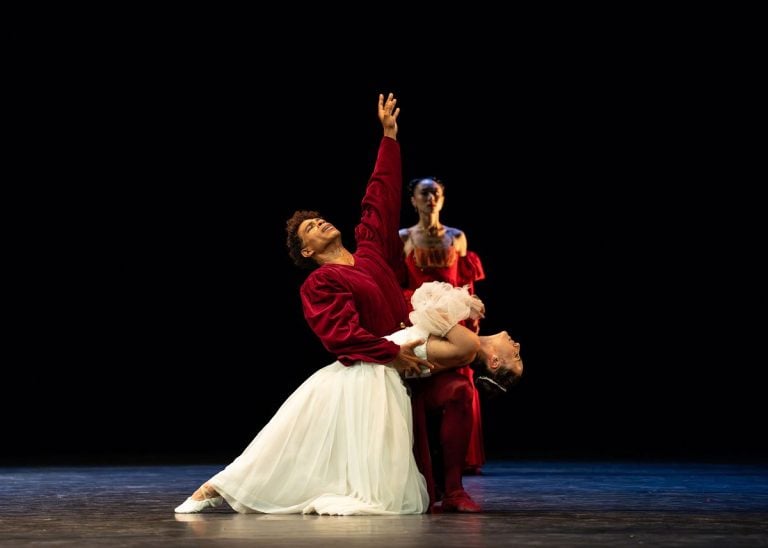
Pacific Northwest Ballet in ‘Love and Loss’ with works by Alexei Ratmansky, Dani Rowe and Donald Byrd

Graham Watts sees Pacific Northwest Ballet’s triple bill ‘Love and Loss’
| Title | Love and Loss |
| Company | Pacific Northwest Ballet |
| Venue | The McCaw Hall, Seattle |
| Date | 20 November 2023 |
| Reviewer | Graham Watts |
I knew little about Pacific NorthWest Ballet before the pandemic, but it was one company that made the most of that adversity by streaming performances even when there was no one in the audience. To their credit, the company has maintained that strategy after audiences returned to the theatres, because of which I’ve been able to follow their repertoire and dancers over the past three years just as if I were a resident of Frasier’s fair city. One other key point is that due to union agreements, the streaming only remains online for a limited period (generally five days) giving an added incentive to make sure that it is watched in good time.
Many shows have begun with long-standing artistic director, Peter Boal, making onstage promotions and this Love and Loss programme was no exception. First up was Kuu Sakuragi, promoted to soloist and described by Boal “as humble and kind as he is talented and engaging with magnificent jumps that seem to defy gravity”. Another promotion to soloist was Clara Ruf Maldonado, a New Yorker who joined the company as an apprentice in 2018, described by Boal as “simply transcendent”.
A dancer who has impressed me from the very beginning of my online adventure with PNB is Sarah-Gabrielle Ryan and she was promoted to become PNB’s newest principal dancer – Boal spoke of her “sheer joy of movement” adding, “She is fearless, focussed, magnetic and undaunted, the epitome of power and grace.”

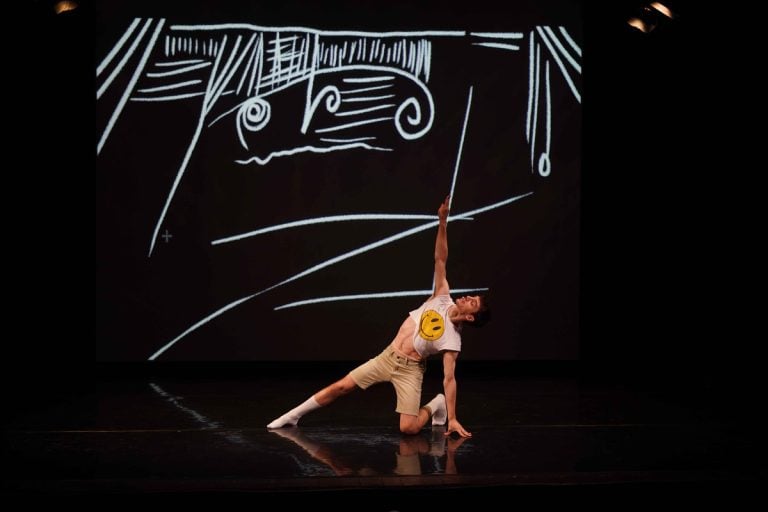
This second programme in the new season started with Wartime Elegy, which premiered in the same theatre last year as the first work choreographed by Alexei Ratmansky after the Russian invasion of Ukraine. Ratmansky – the former director of the Bolshoi who has a Russian mother and a Ukrainian father – has been vociferously opposed to the Russian invasion. Unsurprisingly, his latest work for PNB is essentially a celebration of the Ukrainian people.
The brief work for four heterosexual couples (including the new soloist, Sakuragi dancing with Madison Rayn Abeo) is presented for a large part against a set of projections (by Wendell K Harrington) that show Ukrainian folk art. It starts in silence with a contemplative, melancholic feel through layers of movement in both harmony and canon, danced to Valentin Silvestrov’s Four Postludes for piano and string orchestra (2004), but later bursts into sunny, joyful dance to Ukrainian village music recorded in the 1930s.
The choreography feels different than other works by Ratmansky – in keeping with his own claim that the war has changed him as an artist – with one abiding memory being of the dancers in revolving circles of movement opening out as if the blooming of a flower captured in stop-motion photography. Angelica Generosa and Lucien Postlewaite were especially strong as the lead couple.
The second movement opened with a boisterous male trio, which led to spontaneous applause for the dancers’ virtuosity, followed by a women’s quartet opening with three of the dancers firing jetés across the stage. This fast and exhilarating pace gave way to a slow movement danced to just solo piano (played beautifully by Christina Siemens) and background strings, ending with all eight dancers performing individually with a solo girl spotlit in arabesque. The whole ballet is done and dusted in less than 20 minutes but leaves an abundance of memories in its integration of dance, music, Ukrainian voiceovers, and artwork.

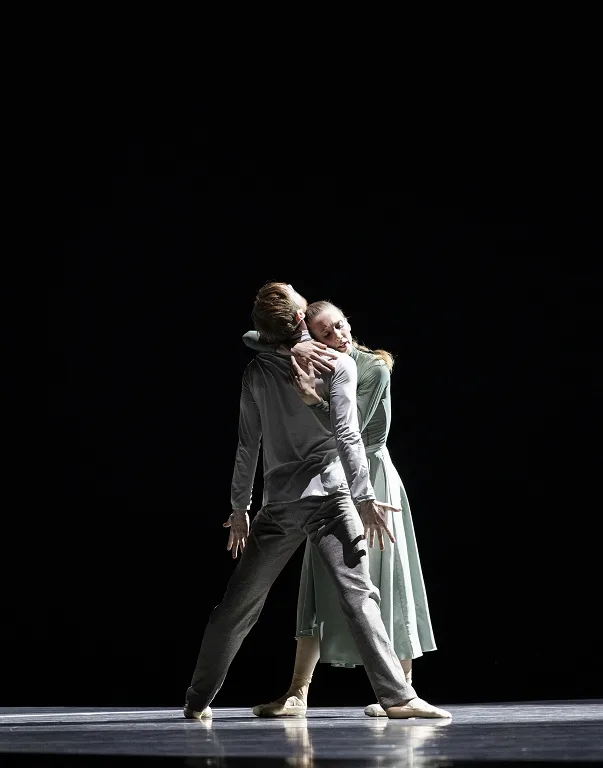
The minimal middle work was something of a risk with just three dancers performing to the enormous 2,900-seat McCaw Hall auditorium, in the world premiere performance of Dani Rowe’s The Window. By coincidence, I had just watched Hitchcock’s Rear Window (starring James Stewart and Grace Kelly) and Rowe’s narrative-driven work had much in common (although minus the murder).
Rowe – an Australian by birth – is now artistic director of Oregon Ballet Theatre and she has devised a ballet that concerns two adjoining apartments with overlooking windows – one is occupied by a single woman, who is effectively the watcher (a dreamy performance by Melisa Guilliams), whilst a (perhaps newly married) couple (Elizabeth Murphy and James Kirby Rogers) reside in the other. In five ‘chapters’ of another brief work (just 25 minutes) the lone woman witnesses intermittent tumultuous moments in her neighbours’ lives. Rowe overcomes the limitations of dancer numbers by cleverly dividing up the stage to represent the various rooms. It is superbly lit by Reed Nakayama.
The excellent score was specially commissioned from Shannon Rugani – the first orchestral work for this former dancer. Soft, romantic music set the scene for each chapter, with a ballroom style, partnered duet in the second part and another yearning, hugging pas de deux (with an impressive upside-down lift) in the fourth chapter implying the couple’s close romance. It all became urgent in the final chapter where the two women mirrored each other’s movement in their separate boxes of light. The work ends with the watcher still standing alone at her window.
The Window has an intriguing psychological narrative, much more implied than obvious, and benefits from an arresting and descriptive score – at one point it was so grandiose and formal that it could have been from the soundtrack of Downton Abbey.

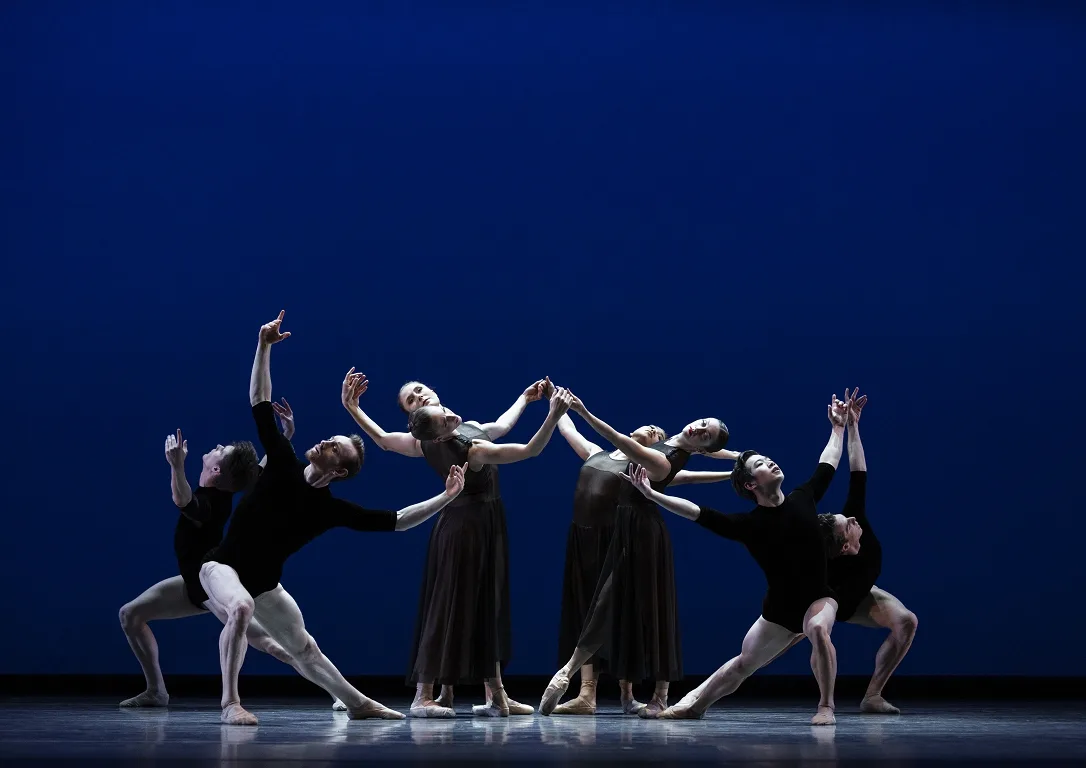
Unsurprisingly, Donald Byrd has based Love and Loss (after which the whole programme was named) on the loss of a relationship. The work premiered just prior to the pandemic (in November 2019) and Byrd’s title is taken from Songs of Love and Loss, an intimate string quartet by Israeli Composer, Emmanuel Witzhum, with repeated electronic phrases patched into the string orchestra by a busy conductor (Josh Archibald-Seifer) – Emil de Cou conducted the earlier works.
It’s a work generally defined by the adagio harmonic quality of Byrd’s choreography with no great reliance on virtuosity, although it opens with male dancers coming forward with big leaps. The movement – with dancers often paired together – compliments Witzhum’s contemplative music. The set design (by the company’s technical director, Norbert Herriges) features five doorways that appear upstage and remain in situ throughout the ballet in shades of Bluebeard’s Castle, as the stage takes on the impression of a palatial ballroom. Doris Black’s costumes appear to be everyday modern clothes fitted for dance.
The newly promoted Sarah-Gabrielle Ryan is evident in the second movement pas de deux, one of several slow and meaningful duets for four leading couples, supported by an 11-strong corps. It was an evening for upside-down lifts since two featured in these partnered duets. All the pairs returned for what I assumed to be a group finale but at the point that it should have ended there was another male solo – with the other men standing behind – resulting in yet another planned fall to the floor. Finally, a woman appeared with the man on the floor watching her before getting up. They walked off with the woman facing him, back to the audience, while other dancers walked around aimlessly as the music and lights faded.
Although there were exceptionally beautiful moments in Byrd’s ballet, I felt that the dancers went to floor-based movement far too many times, the work is over-long and soporifically slow-moving –especially when watched online (as I did) in the wee small hours!
Overall, this was an interesting programme within which Rowe’s new work sat proudly. I’m grateful to PNB for continuing to provide these streamings, thus enabling such new works to be experienced by those not fortunate enough to be in Seattle. I look forward to many more to come.

Graham Watts is a freelance writer and dance critic. He writes for The Spectator, Tanz, Shinshokan Dance Magazine (Japan), Ballet Magazine (Romania), BachTrack and the Hong Kong International Arts Festival and has previously written for the Sunday Express, Dancing Times, Dance Europe, DanceTabs, London Dance, the Edinburgh International Festival and Pointe magazine (USA). He has also written the biography of Daria Klimentová (The Agony and the Ecstasy) and contributed chapters about the work of Akram Khan to the Oxford Handbook of Contemporary Ballet and on Shobana Jeyasingh for the third edition of Routledge’s Fifty Contemporary Choreographers.
He is Chairman of the Dance Section of The Critics’ Circle and of the UK National Dance Awards and regularly lectures on dance writing and criticism at The Royal Academy of Dance, The Place and (until the war) for Balletristic in Kyiv. He was a nominee for the Dance Writing Award in the 2018 One Dance UK Awards and was appointed OBE in 2008.