[Review] Spirited Away – Hayao Miyazaki’s Oscar-winning film, re-imagined for the stage

Graham Watts sees Studio Ghibli’s Spirited Away, created by animator and director Hayao Miyazaki and re-imagined for the stage by Olivier and Tony award-winning director, John Caird.
| Title | Spirited Away |
| Company | Studio Ghibli |
| Venue | London Coliseum |
| Date | 14 May 2024 |
| Reviewer | Graham Watts |
Hayao Miyazaki’s award-winning film, Spirited Away is regarded not only as the premier example of Japanese anime but also as one of the greatest animation films (alongside the very best of Disney) and, as such, it has an enormous devotional following. It was the first of Miyazaki’s films to be fully digitalised, utilising CGI to create spectacular imagery. Replicating this shape-shifting cinematic masterpiece on stage must have been an enormous challenge and, unsurprisingly, the credit list of creatives takes up eight pages in the programme (admittedly everyone is credited in both English and Japanese)!
This huge team has produced a stage adaptation that is so faithful to the film that the two storybooks could probably run side-by-side without omission or extension. Miyazaki’s animated fantasy has been marvellously interpreted on this human scale, using an imaginative set (designed by Jon Bausor), ingenious puppetry (Toby Olié) and sensational costumes (Sachiko Nakahara). Often one finds that such adaptations disappoint the obsessive aficionados in such cult followings but judging from the universal buzz around the house (including a complete standing ovation), this is clearly a rip-roaring success.
The heroine, Chihiro, is a ten-year-old girl who gets lost while moving home with her parents. She reluctantly follows them through a tunnel that leads to a disused theme park. Ma and Pa discover and gorge upon a buffet of delicious food, but Chihiro refuses to join their feast and wanders off. She encounters an adolescent boy, Haku, who warns her to get away. Having retraced her steps, Chihiro discovers that her parents’ gluttony has turned them into pigs and the river has flooded, barring her way back. Haku advises her to find the boilerman, Kamaji, who controls the temperature of the park’s bathhouse, the hot springs of which provide a relaxing refuge for the ‘eight million gods’ of Shintoism.
Chihiro’s subsequent adventures involve various encounters with these gods and the other inhabitants of this fantastic world. Kamaji is a true spiderman, having eight limbs that work the boiler room controls. The place is run by a witch named Zubaba who has an identical twin sister, Zeniba (to conjure their image think of a cross between Mrs Doubtfire and Ursula, the Sea Witch, in Disney’s The Little Mermaid).
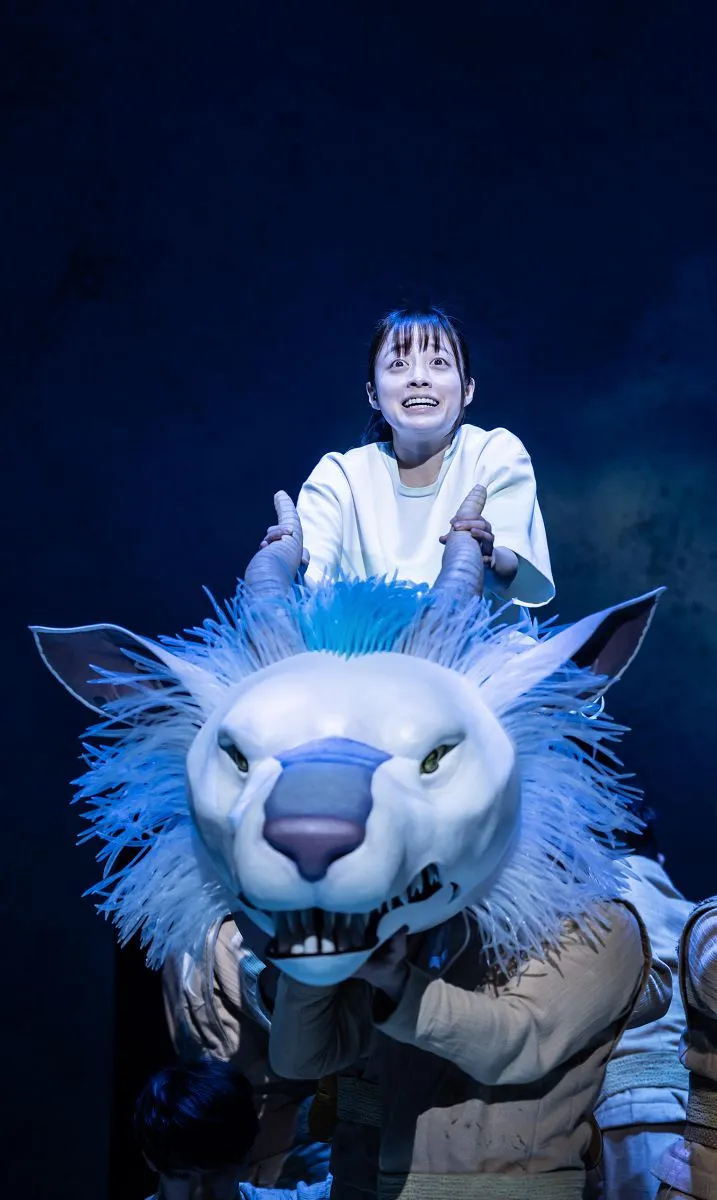


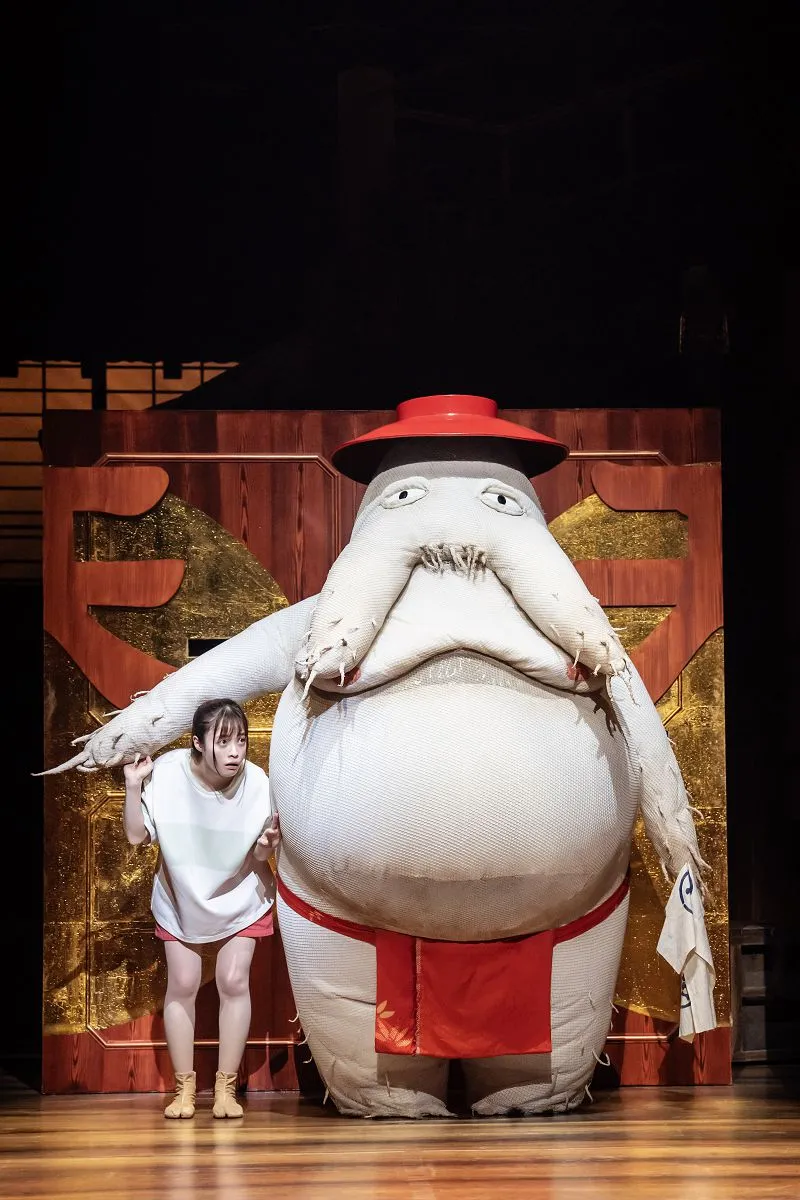


It’s the bathhouse gods that have been created with the greatest costume ingenuity: it’s hard to pick a favourite from the giant white radish god (with long courgette-like, hairy cheeks, plentiful pectorals, and a bulbous stomach) to the masked gods in beautiful red robes supposedly covering their invisible bodies. The chick gods and ox-ogres have a more Muppet-like appeal and even the so-called “scary-looking monster gods” were no more frightening than the Cookie Monster! But I suspect that Miss Piggy would have turned her nose up at Okusare-sama: ‘the rotting god of sludge and putrefaction’. Thank goodness the realism in costume design did not include an olfactory equivalent!
Written Japanese language has an important part to play in Spirited Away. Each symbol (or kanji) can have a different meaning, depending upon the context. So, for example, the name Chihiro is formed of two kanji but if the second of these is removed, the remaining kanji is pronounced as ‘Sen’ and not ‘Chi’. It seems that Miyazaki had a mischievous sense of fun in playing with kanji throughout the film (something that would only be obvious to anyone fluent in Japanese) but he also used it as a plot device since Zubaba controlled her prisoners (like Chihiro) by removing a kanji and making them forget their names.
The over-arching plot dynamic is that no character is all-evil or all-good. Even Zubaba has a soft spot for her son, an overgrown and corpulent baby called Boh (reminiscent of the Michelin Man for those with long memories). Then there is No-Face, a character (also known as Kaonashi) that appears to have escaped from a Nightmare on Elm Street, who both liberally dispenses gold and swallows the bathhouse workers whole! (But don’t worry, Kaonashi eventually vomits them all up, still alive). As you can perhaps tell, we left shades of the Muppets behind some time ago!
The original score for Spirited Away by Joe Hisaishi, an integral part of the film’s enduring appeal, has been adapted and arranged for the stage by Brad Haak and Conor Keelan, and it was played live by an orchestra that was ingeniously hidden under the greenery of the set, which stretched out over the pit. The dreamy descriptive music has themes for all characters and occasions. The excellent choreography by Shigehiro Ide is mostly at an ensemble level, moving large groups of performers with fluid consistency, punctuated by impressive outbursts of solo acrobatics.
The blurring of boundaries between fantasy and reality extends to the performers themselves. 25-year-old Kanna Hashimoto led the performance with a spirited and believable portrayal of the child, Chihiro, her character being almost ever-present throughout the entire show. Kotaru Daigo (23) was especially charismatic as Haku (although his character spends half the show as a beautiful kite-flown dragon, Haku’s alter-ego). The chaste romance between these leads was both virtuous and endearing. Mari Natsuki was comedy gold, channelling her inner Robin Williams into both the witch sisters (Yubaba and Zeniba), well matched by the physical comedy of Tomorrowo Taguchi as Kamaji, the man with eight limbs; and Fu Hinami added more than a touch of glamorous beauty as both Chihiro’s mother and her bathhouse friend, Lin.
Does Chihiro save her Ma and Pa from the bacon slicer so that they can all return to civilisation? Well, half the world already knows. The other half should get down to the London Coliseum before the end of August to find out for themselves. Whether anime fans or not, I promise that you’re in for a treat.

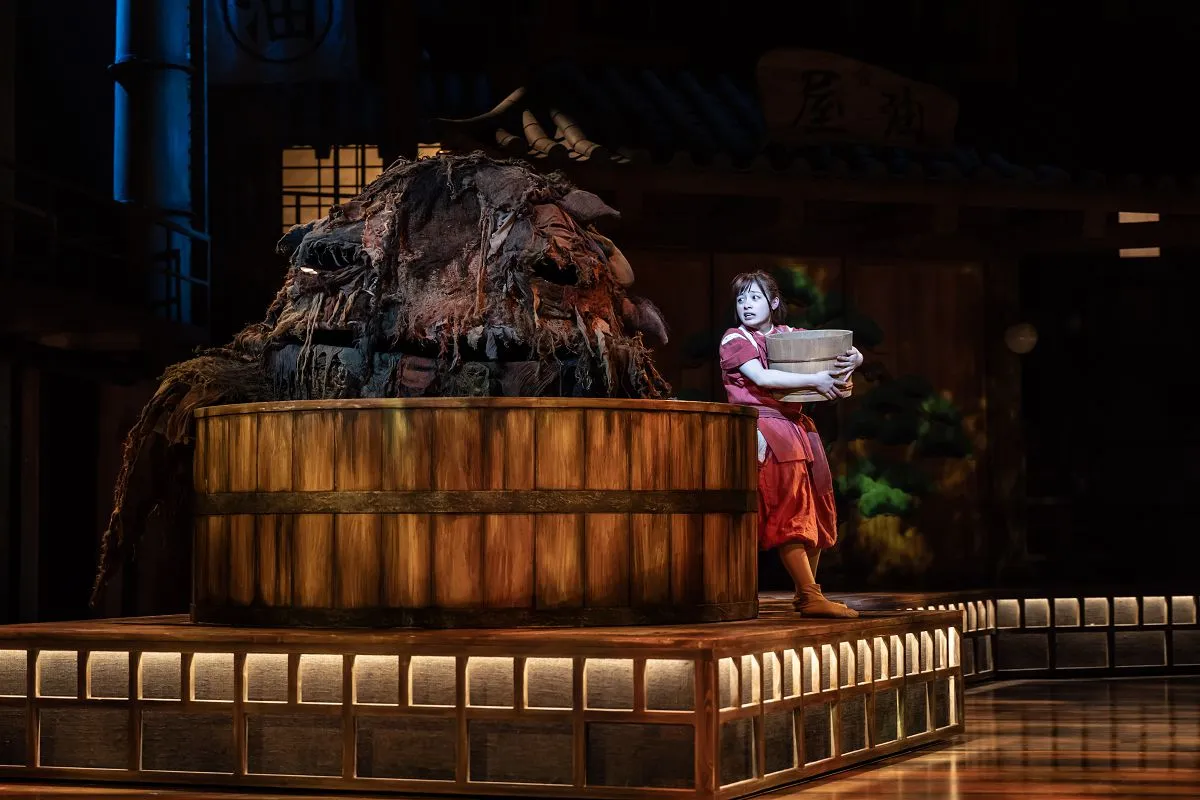


Runs until 24th August 2024

Graham Watts is a freelance writer and dance critic. He writes for The Spectator, Tanz, Shinshokan Dance Magazine (Japan), Ballet Magazine (Romania), BachTrack and the Hong Kong International Arts Festival and has previously written for the Sunday Express, Dancing Times, Dance Europe, DanceTabs, London Dance, the Edinburgh International Festival and Pointe magazine (USA). He has also written the biography of Daria Klimentová (The Agony and the Ecstasy) and contributed chapters about the work of Akram Khan to the Oxford Handbook of Contemporary Ballet and on Shobana Jeyasingh for the third edition of Routledge’s Fifty Contemporary Choreographers.
He is Chairman of the Dance Section of The Critics’ Circle and of the UK National Dance Awards and regularly lectures on dance writing and criticism at The Royal Academy of Dance, The Place and (until the war) for Balletristic in Kyiv. He was a nominee for the Dance Writing Award in the 2018 One Dance UK Awards and was appointed OBE in 2008.