[Review] Swan Lake with San Francisco Ballet – with Nikisha Fogo there’s risk, drama, bravery, and major confidence

Matthew Paluch sees Swan Lake with San Francisco Ballet and is struck by Nikisha Fogo’s Odette/Odile: a super interesting dancer – nothing is held back.
| Title | Swan Lake |
| Company | San Francisco Ballet |
| Venue | War Memorial Opera House; San Francisco |
| Date | 4 May 2024 |
| Reviewer | Matthew Paluch |
Dance is delicate. Just look at the casting for the Encore performances of Helgi Tomasson‘s 2009 production of Swan Lake.
Tamara Rojo, current director of San Francisco Ballet, had aimed to bring external star attraction to the second run of performances by presenting some of the most talked about dancers of the ballet world – the Royal Ballet’s Natalia Osipova, Dutch National’s Jacopo Tissi and American Ballet Theatre’s Daniel Camargo. However, indisposition means only Camargo actually makes it to the stage.
Camargo’s Prince Siegfried is partnered by another very interesting dancer, Nikisha Fogo. Fogo trained at the Royal Swedish Ballet School and London’s Royal Ballet School before having a successful career at the Vienna State Ballet from 2013 under the direction of Manuel Legris. Fogo’s move to San Francisco Ballet was announced in 2020.
Any major ballet company has a Swan Lake on its books, and Tomasson’s 2009 production is predictable in the sense that it both acknowledges the past, through narrative application and choreographic reference, and seeks to find a future through revisions, like the implementation of a Prologue and sets and costumes by London based designer Jonathan Fensom. At the time of the 2009 production, Fensom hadn’t designed a ballet beforehand and was interested to access the (possible) structural power of the historic work through a modern interpretation.
The matinee performance I attended was full of firsts – I’d never seen San Francisco Ballet before, Tomasson’s Swan Lake, or Fogo and Camargo dance live… exciting times. The War Memorial Opera House is a fine building with a receptive audience, meaning Rojo has the tools to keep SF Ballet an ongoing success.

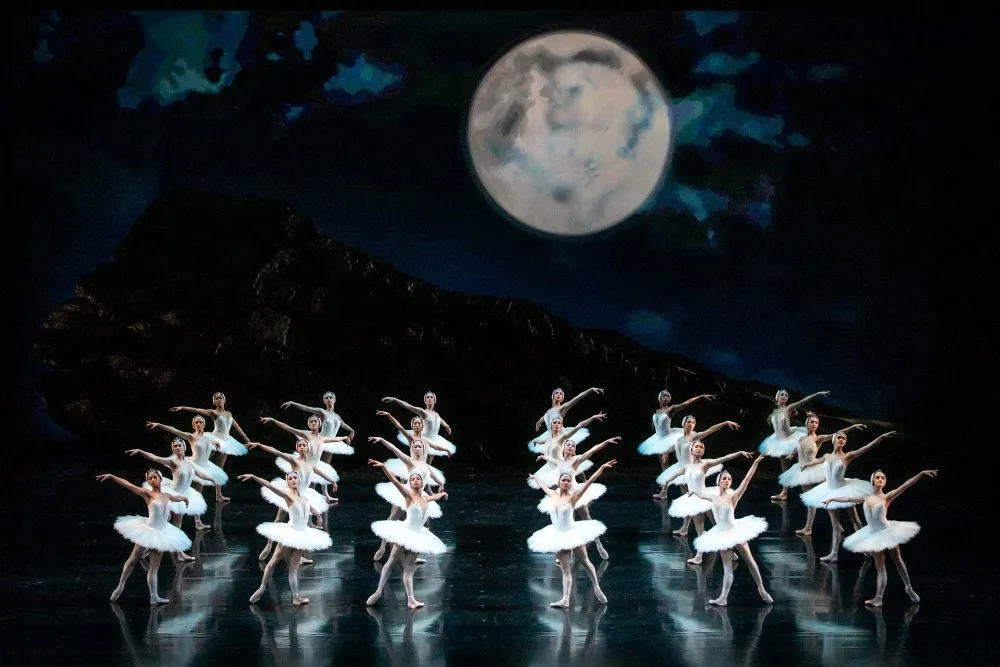

Most Swan Lake productions have Act 1 & 2 together with intervals before Act 3 and Act 4, but Tomasson’s version is the opposite, and having Acts 3 & 4 connected has much more narrative impact in the moment. Likewise the fact Odile enters just before the grand pas de deux rather than near the beginning of the act – a far more compelling, structural choice. Elsewhere, the aforementioned Prologue is fleeting, giving Odette context as a woman pre-swan, but airing on the didactic side.
Fensom emphasises the structural power of sets – Act 1 is basically a pop-up Buckingham Palace, 2 a big, angry black rock; and 3, a sweeping staircase reminiscent of the one at New York City’s Metropolitan Opera House. All acts have undressed wings, and this works very well for the white acts with the decluttered, vast space highlighting the precise dancing, abundant formations and framing the narrative energy.
1 & 3 feel less successful, cold even and the uninspiring stagecraft offered by the majority of the company doesn’t help matters. Nobody wants the corps de ballet inappropriately pulling focus, but musical statues isn’t the answer either – talk about flat.
The level of (plastique) dancing is unquestionably high however, though throughout, the agenda communicates form rather than feeling. Much of the movement feels “empty” and this tends to be caused by a combination of unnecessarily hard, complicated choreography, and individual desire to have rhythmic gymnastics style arabesque – the higher the better. With zero consideration to overall line or sense of opposition, which is the step’s initial, integral intention.
Act 3 is a low point, in relation to all of the national/character dances. Tomasson seems to have gone towards the jazz side of things, with the majority of the choreography feeling showy à la Wham! Bam! Thank You, Ma’am! And additionally, character work in pointe shoes is just a big, fat no. No one can make it look good, or achieve the innate style and technique required, with the end result being a very weird, pseudo byproduct.
The corps de ballet do good work in the white acts, as do the Cygnets and Big Swans, but sadly both the latter numbers seem overly focused on the incessant inclusion of grand jeté to the detriment of everything else. Somebody call the (ballet) taste police!
Von Rothbart is more of a dancing role; cue grand allegro including the odd Balanchine pas de chat, which feels a tad awkward at times, both in content and execution, and isn’t helped by Fensom’s visual design realisation – a combination of Ozzy Osbourne and Brandon Lee in The Crow. Think hair.
Camargo I can’t work out. He’s a very capable dancer with easy line, open port de bras and a dynamic turn quality, but his dramatic interpretation is on the minimal side, to say the least. In Act 2 & 4 he basically disappears, which could either be seen as a huge compliment to his chivalrous, partnering skills, or begging the question why isn’t his presence more apparent? At times it almost felt like he didn’t want to be there… and some partnering tussles suggested a lack of rehearsal time for the principal couple. I’d like to see more of his dancing, as currently, I’m not sold.

Fogo is a super interesting dancer, who’s basically dancing for her life. As in nothing is held back – there’s risk, drama, bravery, and major confidence, which is all quite something considering she only debuted in the role this February, and with a different partner.
Her Odette brings the turmoil but also the bipolarity. I realise the character is in a pickle, but Fogo needs to keep fine-tuning how and when to communicate the drama, so her interpretation has balance even in the most melodramatic moments of the ballet.
Her Odile is magnetic from start to finish, though I’m unsure whether she managed to convince her Siegfried, but she absolutely did her audience. And those fouettés! Talk about daring. Fogo uses the consecutive turning phrase to entrance all those watching her, and I personally gasped numerous times, out of both bewilderment and fear. She attempted a triple pirouette midway through which wasn’t perfectly executed, and at this point most dancers would segue into singles for the duration of the coda. Not Fogo! She continued bewitching, went for another triple a few fouettés later and then brought the spins to a dynamic end for all to savour. Quite something. Beast mode springs to mind.
My only slight quibble with Fogo is her footwork in arabesque and attitude. It doesn’t look like she’s working her toes to the end of the line, and it’s a shame, as this unfortunate detail becomes the focus rather than everything else her dancing is offering. At 29, she’s in a very important moment of her career, and it would be interesting to know who her coaches are.
Swan Lake isn’t my raison d’être, but this Saturday matinee was hugely enjoyable, allowing for an opportunity to relish in the company’s work and to keep musing over what the ballet can be in the right hands, in relation to choreographer, designer, coaches and dancers.
And finally, a huge nod to The San Francisco Ballet Orchestra under the baton of David LaMarche. The Tchaikovsky score was exquisitely played, with energised tempi throughout, reconfirming that few things are more beautiful to the naked ear than the waltz in Act 1 and all of Act 4. Heaven.
Note: the female, mixed race/black dancers of the company didn’t wear shoes and tights of their own skin colour during the performance. Visually this read uncomfortably in relation to inclusion and representation. Making one contemplate what conversations were (potentially) had concerning this racial/visual/artistic decision between the dancers and management.

Matthew Paluch was awarded a place at The Royal Ballet School in 1990 where he graduated in 1997. His first four years as a professional dancer were spent working with London City Ballet, Scottish Ballet, K-Ballet and English National Ballet, becoming a full-time member of ENB until leaving in 2006.
Matthew graduated from the Royal Academy of Dance, Professional Dancers’ Teaching Diploma in 2007, and was formerly on faculty at The Royal Ballet School. He completed his Masters in Ballet Studies at Roehampton University in 2011, has been a freelance writer since 2010 and currently works in the Law Sector.
He is a member of the Dance Section of The Critics’ Circle.