Review: Trisha Brown Dance Company in London… heaven!
Matthew Paluch sees the Trisha Brown Dance Company in Noé Soulier’s “hugely satisfying” In the Fall and Trisha Brown’s “brilliant” Working Title in the Dance Reflections by Van Cleef & Arpels Festival.
| Title | Noé Soulier – In the Fall Trisha Brown – Working Title |
| Company | Trisha Brown Dance Company |
| Venue | Sadler’s Wells, London |
| Date | 12 March 2025 |
| Reviewer | Matthew Paluch |
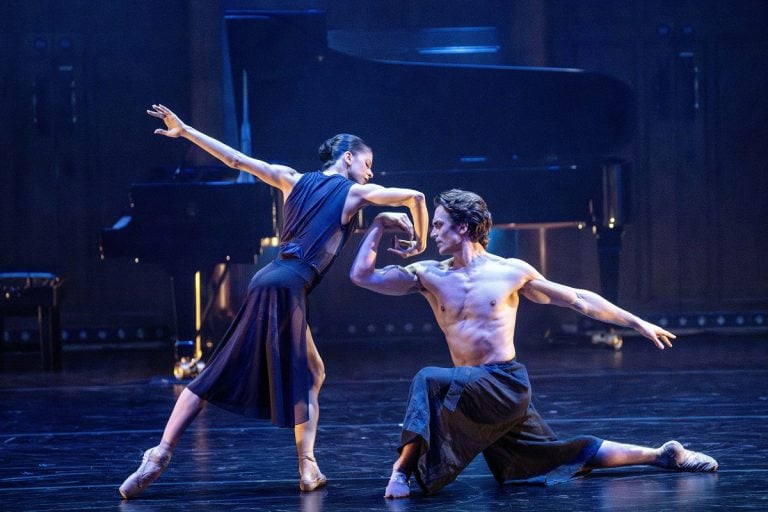
The Dance Reflections by Van Cleef & Arpels Festival started off with a bang at Sadler’s Wells last night with the Trisha Brown Dance Company on the mainstage.
The New York-based troop are in extremely fine form, and their double bill programme hits hard with one undeniable fact: we don’t get to see this kind of contemporary dance in London very often. To explain, they offer dance that’s concerned with itself rather than how it might look.
Case in point the opening work In the Fall by Noé Soulier. This work is the second ever commission by the company, and it’s evident why they chose Soulier. I’ve been a fan since he first debuted at the Wells (in his own solo work), and In the Fall is a fine example of where choreographic skill can go when honed and developed.
To observe the work is like having a conversation with an extremely intelligent person. It feels good, never bores, includes time and space, and the end result is hugely satisfying.
Another rare aspect is that the title actually means something in relation to the work itself. Soulier’s language is a collection of fundamental actions studied, and weaved together to create dance, and fall is one of them. Elsewhere we see gesture, balance, line, tilt, momentum and projection.
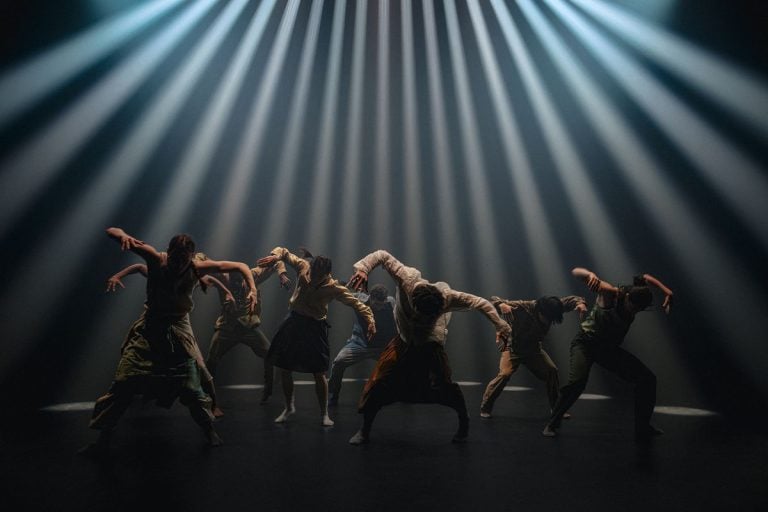
The work starts reflectively, with two dancers exploring all of the above in low lighting with an atmospheric soundscape of what sounds like a combination of mosquitoes and white noise. Elsewhere this element might sound jarring, but here it emphasises the importance and physicality of what Soulier and his dancers are discussing.
The work keeps a steady pace that builds and diminishes without fanfare, and includes all manner of set-ups – solo, duo and group work. To go back to the title, it’s the ‘In’ you feel more than anything else. As Soulier’s reflective, studious approach to creation requires focus, but never demands it – you just feel quietly immersed in the concentration the valuable dance asks for. Almost trance-like.
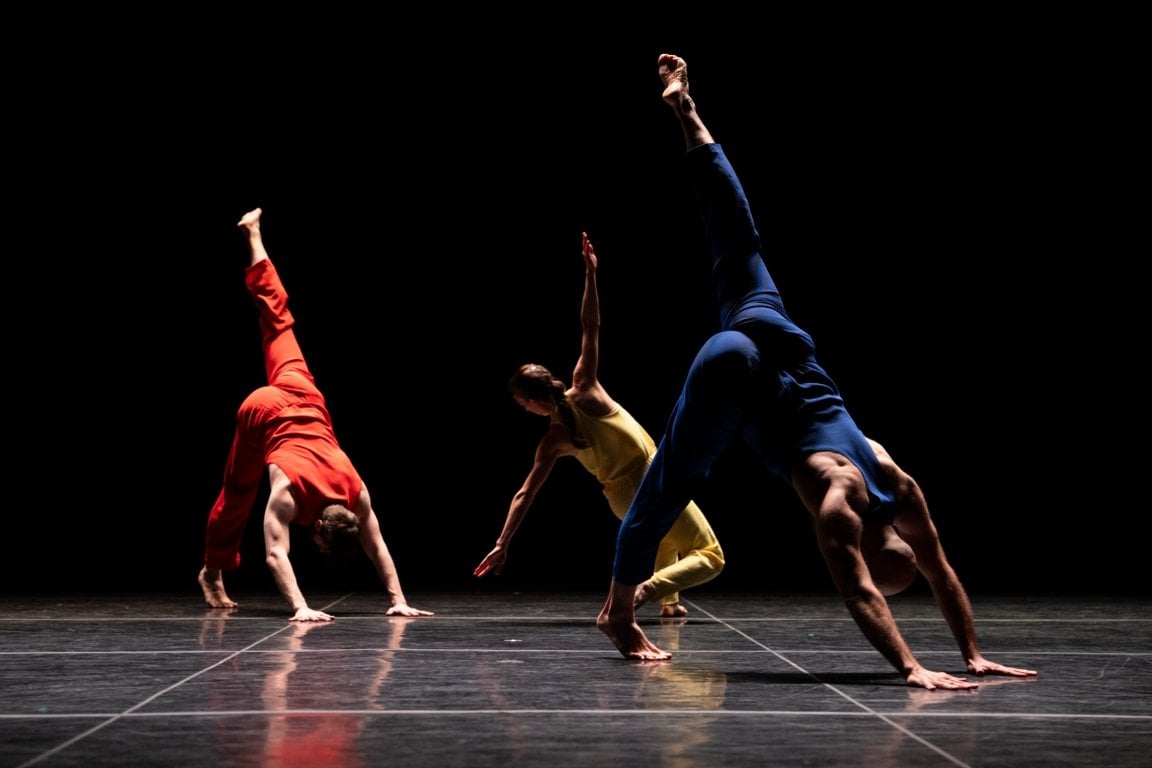
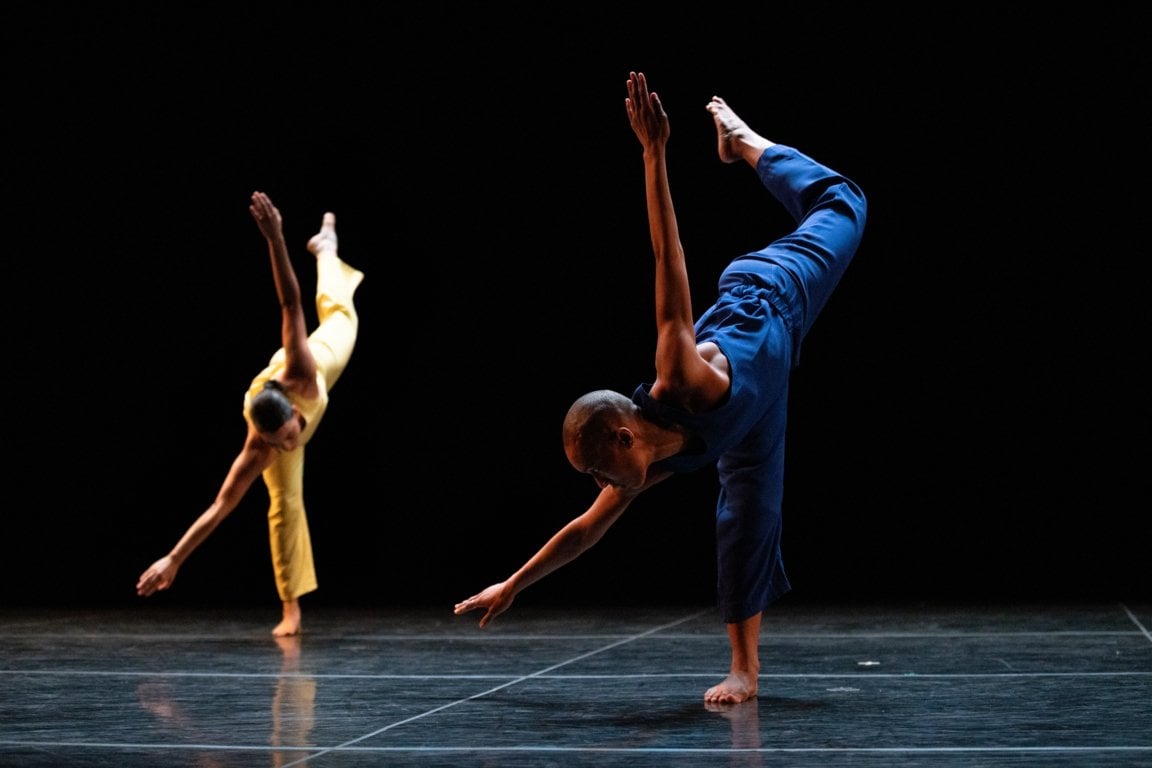
The dancers wear block, primary colours as they move in the black box setting, yet somehow we don’t miss an instance of their movement. This is due to a combination of brilliant execution and movement that has no option other than being delivered with both precision and articulation.
The whole work is my idea of heaven, but three key points stuck out – the way Soulier includes unison as a physicalisation of harmony using both time and space; how on place movement exploration takes on a new, deeper level of kinesthetic awareness; and the use of suspension. The latter is shown in the most beautiful handstand motif I have ever seen – think of the legs stunningly stretched in a 90 degree angle with the dancer applying just the right amount of momentum to hit the form at the top of the suspension arc. I could weep.
So I think I’ve made my point. Soulier is the absolute dog’s bollocks, and is undoubtedly the kind of choreographer ballet companies should be commissioning, as he’s a maker that considers context over personal agenda, or at least that’s what his work suggests. Heaven.

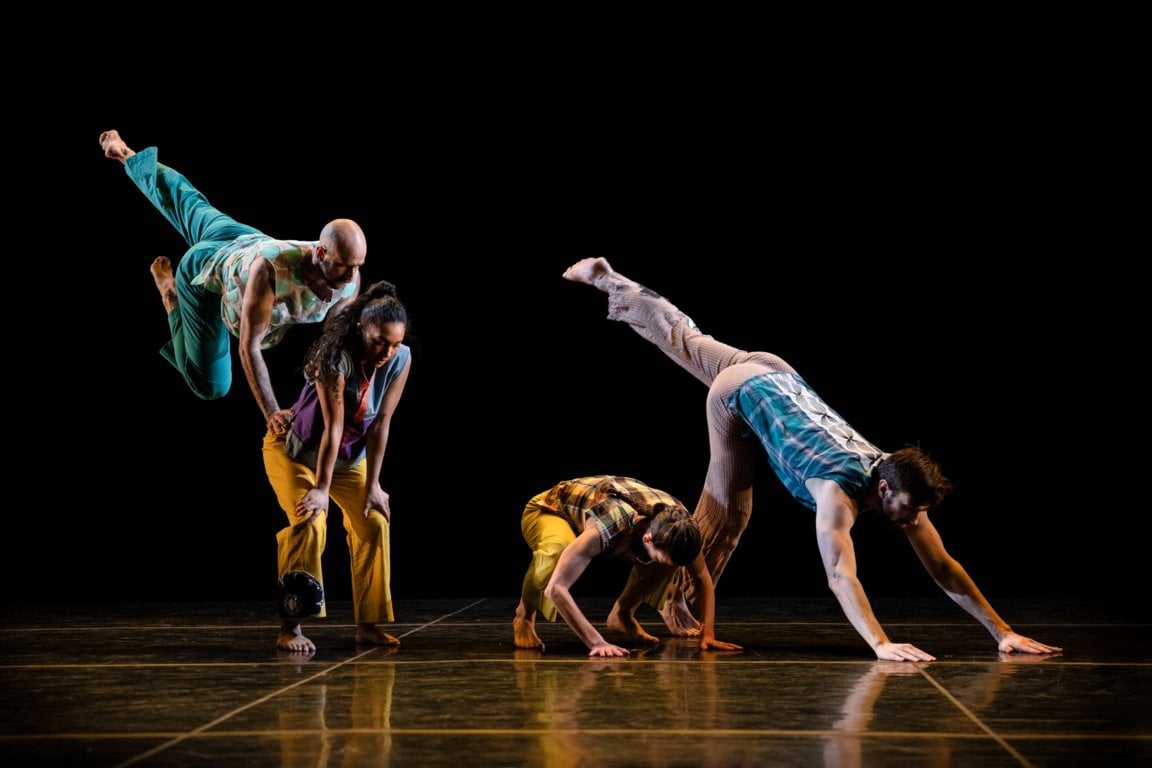
The second work was by Brown herself: Working Title from 1985. The piece is a brilliant example of Trisha’s groove, and it’s something you’d definitely find in the organic aisle at the supermarket… in both feel and look.
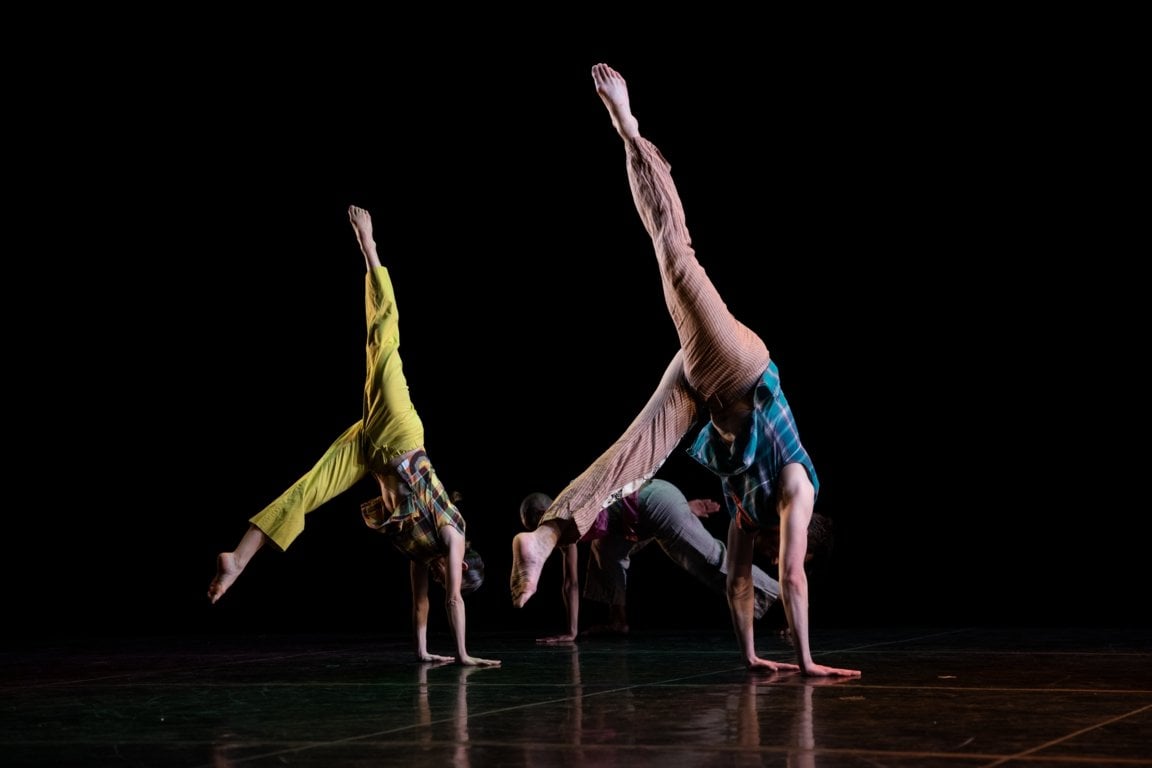
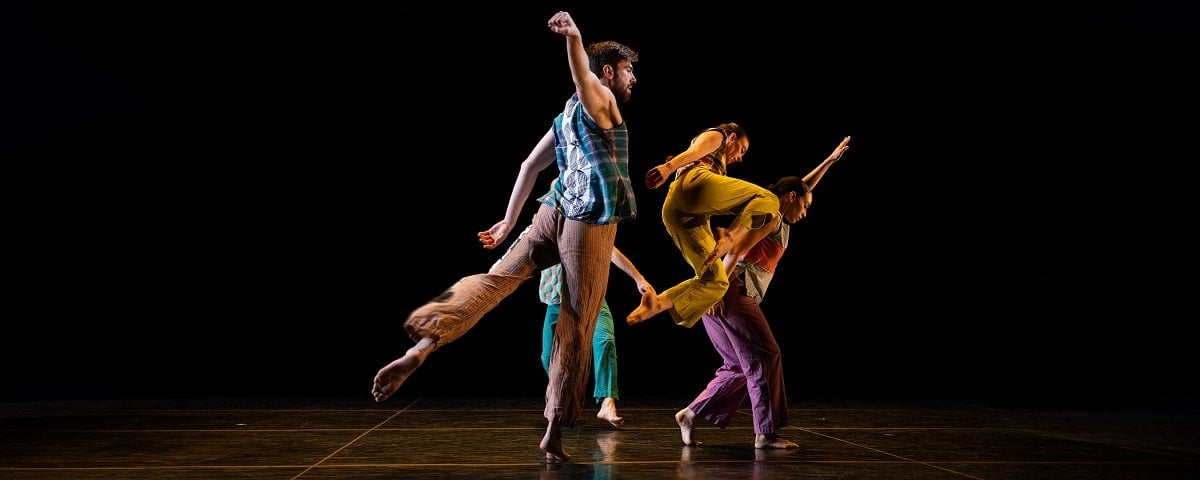
Somehow, I kept seeing San Francisco more than New York. The easy feel of the movement, the hippy-esque costuming of patterned fabrics, rainbow coloured lighting, and funk-informed world music all screamed Haight-Ashbury more than Manhattan.
The piece takes a moment to get accustomed to, dare I even say I found the beginning a tad dated in the initial few minutes, but then I came to the party, and realised Trisha had been there all along.
What’s the secret to ‘Trisha’s Groove’? I’d say swing and opposition in the most basic sense. And the fact that all of the material has a sense of connectivity and flow, even when the phrasing is made up of numerous, individual articulate movements.
Another key motif is how Brown uses movement to travel through space. This sounds too obvious a point, but she does. Where others might run and then dance, Brown utilises all moments of travel to explore and build the groove. Her phrasing also includes lots of jumps, often small and inconsequential, yet acting as a foundation for a movement language that verges on lolling around, or trying to shake out a shiver as you go about your business – just endless easy, breezy grooving.
The dancers evidently love doing her work, as any moments where they could catch each other’s eyes resulted in natural, flashing smiles. And due to Brown’s interweaving, circular in style choreographic pathways, there’s lots of interactions to be had “hey dude”, “hey babe” etc.
All in all, this was a brilliant night at the Wells, where dance could be savoured, and it’s future felt secure and necessary because it’s past was acknowledged and referenced.

Matthew Paluch was awarded a place at The Royal Ballet School in 1990 where he graduated in 1997. His first four years as a professional dancer were spent working with London City Ballet, Scottish Ballet, K-Ballet and English National Ballet, becoming a full-time member of ENB until leaving in 2006.
Matthew graduated from the Royal Academy of Dance, Professional Dancers’ Teaching Diploma in 2007, and was formerly on faculty at The Royal Ballet School. He completed his Masters in Ballet Studies at Roehampton University in 2011, has been a freelance writer since 2010 and currently works in the Law Sector.
He is a member of the Dance Section of The Critics’ Circle.