Review: English National Ballet’s R:Evolution – not one for the books

Matthew Paluch sees an alternative cast to that of opening night in ENB’s mixed bill – but something was missing?
| Title | 42nd Street |
| Company | English National Ballet |
| Venue | Sadler’s Wells, London |
| Date | 8 October 2025 |
| Reviewer | Matthew Paluch |
English National Ballet opens its 25/26 season with a quadruple bill, of which three pieces made up a former triple bill last seen in the autumn of 2023. Joining the roster is a female choreographer, Martha Graham. And specifically, her 1947 work Errand into the Maze.
George Balanchine created Theme & Variations in the same year, and the work continues to challenge dancers of this century. 8 October saw Julia Conway and Daniel McCormick reprise the principal roles they debuted in 2023, and considering this is only their second outing of shows, they both danced with ease and confidence. Is there more to discover? No doubt – but their initial and ongoing achievements shouldn’t be underestimated.
Overall, from principals to corps de ballet, the dancing was certainly acceptable, but not groundbreaking. There was something missing that one experiences when seeing the New York City Ballet perform Balanchine. Speed, clarity, attack, risk? All of the aforementioned? I’d also ask dancers to be aware of overusing the mouth – in the other works as well – and to acquire more awareness of hip direction in alignment – specifically ouvert. I know I sound like a bore, but it’s true and important, I believe!
Next followed the Graham work with Anna Ciriano as the Woman and Jose María Lorca Menchón as the Creature of Fear (Minotaur). Errand into the Maze would’ve made more impact if London audiences hadn’t seen it merely seven months ago at the Royal Ballet and Opera in Natalia Osipova‘s project at the Linbury Theatre. That said, Ciriano and Menchón tapped into the tussle and depths of their characters, making the experience a gripping one. I wonder if the whole piece was a little too dark, as their detailed movements couldn’t always be fully appreciated. I’m also tempted to argue that the work is more suited to a smaller stage, as less unused space heightens the intensity of the narrative and proximity.
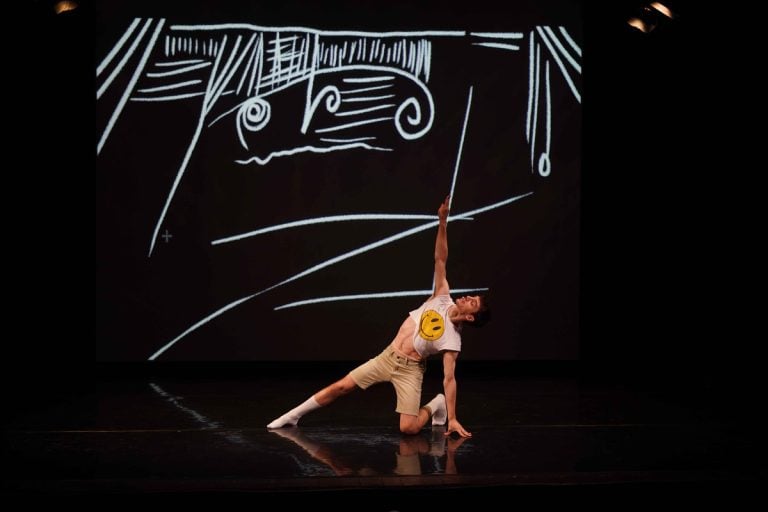
I’m a fan of (earlier) William Forsythe work, so seeing his 1992 Herman Schmerman (Quintet) is far from a chore, but Forsythe’s repertoire can feel predictable when it keeps popping up in programming. The cast of five featured both the old(er) guard and new blood, but the performance took an almost immediate unlucky turn. Martinho Santos, who was debuting, hurt himself and ultimately had to be replaced during the show. The rest of the cast coped brilliantly but, of course, were on tenterhooks for the wrong reasons.
That said Precious Adams brought coolness by the bucketload and Ashley Coupal was extremely fun to watch because she was having fun! Herman Schmerman (Quintet) is the perfect mix of rigour and irreverence, and will surely keep satisfying dancers and audiences alike for a while to come.


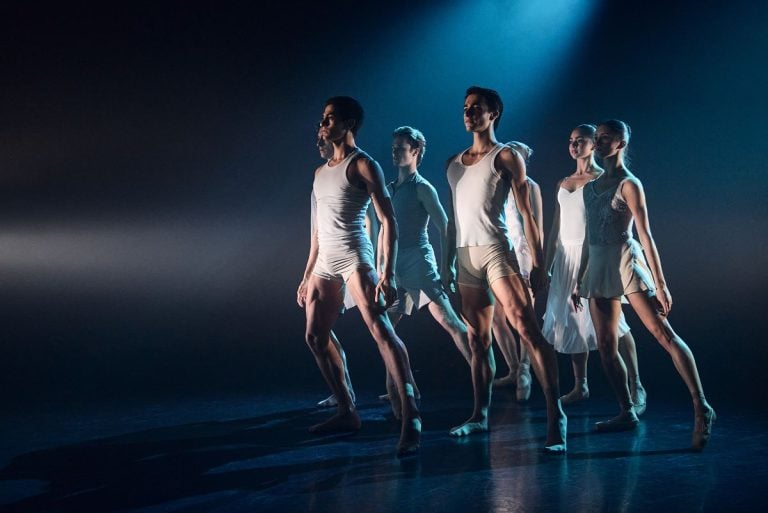
David Dawson created Four Last Songs for the original 2023 triple bill and my review for that season can be found here. In 2025 one can still appreciate Dawson’s skill but also find fault in the work. Madeleine Pierard singing the Strauss is a wonderful presence, but dynamically the score can feel one-dimensional. This in turn impacts the choreography, which is a beautiful, emotionally charged adagio throughout but little else.
The cast did Dawson proud finding the space and drama he’d want realised in his movement, so one can indeed sit back and relish for a while. Fernanda Oliveira brought bravery where it was needed and both Angela Wood and Emily Suzuki communicated otherworldly articulation. The men are of course present, but largely act as lifting mechanisms. Very ripped ones.
On this Wednesday evening performance the house wasn’t packed, so at times the energy felt a little low in the auditorium. The same can’t be said on the stage, yet somehow the experience didn’t feel like one for the books. Art is fickle – but I suppose that’s what keeps us all in the game. Onwards.


Matthew Paluch was awarded a place at The Royal Ballet School in 1990 where he graduated in 1997. His first four years as a professional dancer were spent working with London City Ballet, Scottish Ballet, K-Ballet and English National Ballet, becoming a full-time member of ENB until leaving in 2006.
Matthew graduated from the Royal Academy of Dance, Professional Dancers’ Teaching Diploma in 2007, and was formerly on faculty at The Royal Ballet School. He completed his Masters in Ballet Studies at Roehampton University in 2011, has been a freelance writer since 2010 and currently works in the Law Sector.
He is a member of the Dance Section of The Critics’ Circle.