Review: Ballet Black’s Shadows – More of this please!

Lucía Piquero sees Ballet Black’s double bill Shadows, by female choreographers Cassa Pancho and US-based choreographer Chanel DaSilvas.
| Title | Shadows: A Shadow Work & My Sister, the Serial Killer |
| Company | Ballet Black |
| Venue | Sadler’s Wells, London |
| Date | 26 November 2025 |
| Reviewer | Lucía Piquero |
Ballet Black presented a double bill in their long-overdue Sadler’s Wells debut last Wednesday, with works by director Cassa Pancho and US-based choreographer Chanel DaSilva and a strong-looking company of dancers.
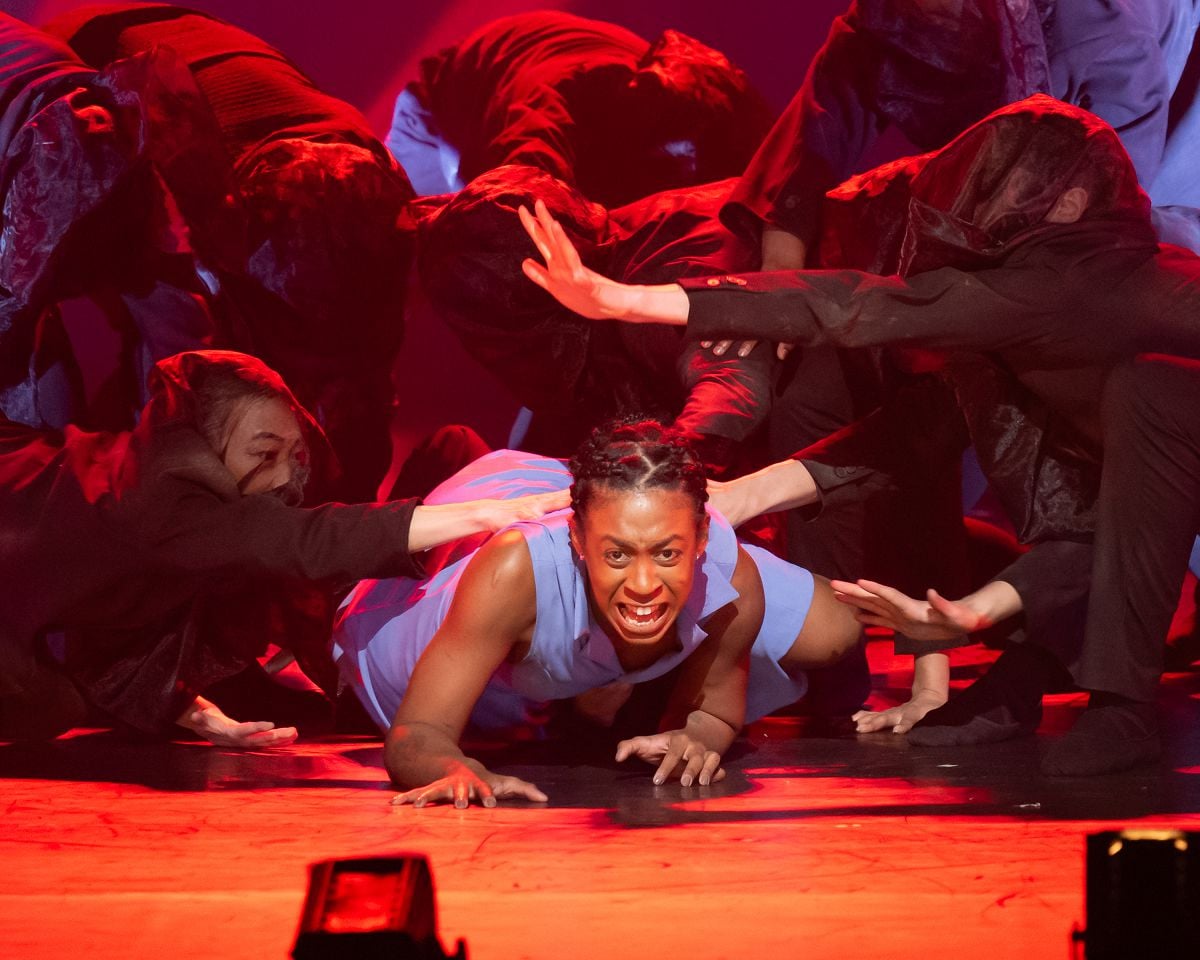
DaSilva’s offering, A Shadow Work, is an exploration of repressed memories and therapeutic endeavours through ballet, with a Jungian analysis perspective and a penchant for literal interpretation. The dancers look strong, but I don’t believe the choreography serves them very well – they lack flow and feel less connected to the steps and to each other. We follow the amazing Taraja Hudson as the one engaging with her psychological “shadows”, from a very soft eery start to a series of exchanges with the contents of her psyche, one would assume, which are embodied by the company in scenes of different emotional tones.
It is in the scenes with stronger dynamic power that the dancers shine, and in the movements where DaSilva’s choreography digresses from the more codified ballet or acrobatic movement into more seemingly heartfelt material like hunched over rebounds or chest-hitting gestures. Perhaps letting go of more of those coded steps, and even potentially of the pointe shoes, which didn’t feel necessary, would have strengthened the work overall. The 70s/neon/game aesthetic of lights and music, together with the literal musicality which is used throughout much of the work, leave us feeling like there is more potential to the work than what we saw, that perhaps some of the dancers’ strength and the depth of the topic indeed remained in the shadows.

In opposition, My Sister, the Serial Killer, Pancho’s offering based on the homonymous novel by Oyinkan Braithwaite, is a powerful end to the night. In an unexpected revival of something closer to ballet d’action, this is a refreshing take on ballet and narrative: the steps, the music, the costumes, the props, all completely serve the story, which is equal parts hilarious and surreal, with a sister who kills all her boyfriends – seems to hunt them for that in fact – and another who is a medical practitioner and very handy if you need to get rid of a body. Isabela Coracy as Korede, the caring sister, and Helga Paris Morales as Ayoola, the killer sister, are both superb as dancers and actresses.
I was a bit worried when I saw dancers dressed as a river, but even the moments when the most literal engagement with narrative is clear, it works in favour of the light-hearted, albeit deep, take on the dark story. Indeed, Pancho hits a lot of sweet spots with her humour, which also oscillates between the ‘simple’ dance theatre repetitive gesture (the work made me think of Kurt Jooss’s The Green Table at points, perhaps on the topic of shadows and darkness) and the exaggerate pantomime, all of which is beautifully performed by the company as they look equally strong in a groovy moment and in a technically accomplished pas de deux.
They look more engaged, more comfortable in this material, somehow augmenting the projection of ideas through their expressive bodies – with an especially notable performance in this sense by Ebony Thomas as the doctor.
Ballet Black are a joy to watch – and they make sure joy is in the building with the music playing happily before the show, in the intermission and even in the curtain call – and this performance is a clear testament to both the vital work of the company, and Pancho’s, and the fresh approach they offer to ballet. Couple this with the double bill of female choreographers and I can only say: more of this please!


Lucía Piquero Álvarez was born in Asturias, Spain, where she trained in Classical Ballet and read for a BSc in Psychology. She moved to London where she trained in contemporary dance (LCDS), also getting an MA in Choreography (Middlesex University). Lucía has been an independent dancer and choreographer since 2007, her choreographies have been presented internationally and she has been commissioned by choreographic centres, national companies and festivals.
She was lecturer and head of the Dance Studies Department at the University of Malta, and Senior Lecturer at Dance City (Newcastle), and is currently lecturing at Trinity Laban and English National Ballet School. She completed her PhD at the University of Roehampton. Her main research interest is on embodied emotion and cognition in dance, she has presented in conferences and directed workshops and practice research projects internationally, and published articles and chapters in diverse platforms as well as her own monograph.