Review: Marco da Silva Ferreira’s F*cking Future – mesmerising force

Graham Watts sees F*cking Future and finds himself warming to the work of Marco da Silva Ferreira.
| Title | F*cking Future |
| Company | Marco da Silva Ferreira |
| Venue | Sadler’s Wells East, London |
| Date | 4 June 2026 |
| Reviewer | Graham Watts |
I was expecting a show called F*cking Future to be an anarchic rebellion based on a polemic about future technology, AI maybe, robot wars or the rise of extremist, nationalist politics. These expectations could not have been further from the truth.
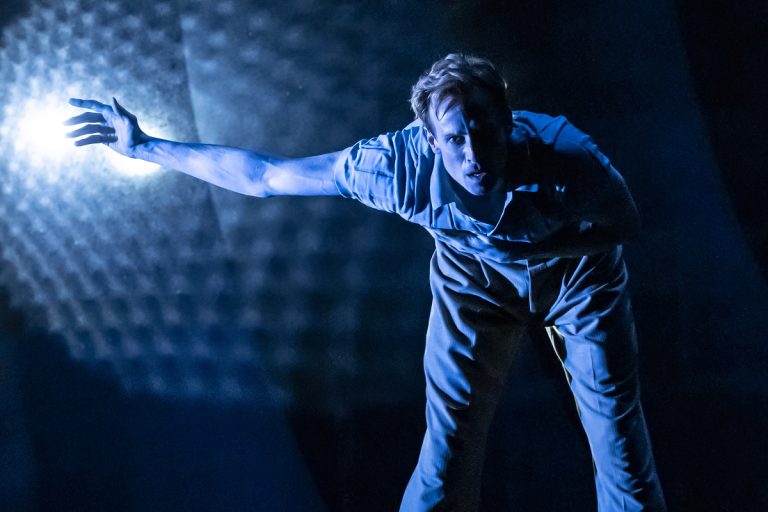
Instead, it was a highly disciplined and challenging exercise in controlled dance for an ensemble, which included the 40-year-old choreographer himself, anonymously contained within a group of eight identically dressed performers. I particularly remember the loose chain-mail tops and dramatically reflective black trousers, seeming like a kind of oilskin. I couldn’t detect a designer credit, and so I assume that the choreographer was also responsible for the designs.
Marco da Silva Ferreira was one of the four choreographers selected to compete in last year’s Rose International Dance Prize at Sadler’s Wells, with CARCAÇA (the Portuguese word for CARCASS), which featured the choreographer’s highly stylised and innovative movement technique, built around four Portuguese folk dances but with a thoroughly contemporary twist. It didn’t win, but it clearly – and with good reason – marked da Silva Ferreira out as choreographer to watch and got him this quick return gig to a Sadler’s Wells venue.

The bespoke, pulsating 40-minute score by Rui Lima and Sérgio Martins built an intensity through a gradual escalation of the beats-per-minute, raising the tempo from a beat per second to 240 beats in a minute. The effect of minimalist choreography that had a quasi-militaristic flavour, sometimes in metronomic marching, was hypnotic, and the precision in the unified control of the dancers’ movement added to that mesmerising force.
The work was performed on a light-reflecting black floor, a rectangular area surrounded on all sides by the audience, providing both an intriguing concept of deconstruction because my view would not have been the same as that of the audience on the three other sides, and a mechanism for control, one which the dancers initially respect, then negotiate and sometimes fight against.
The spectacle was enhanced by a lighting design also conceived by the choreographer, but in association with Teresa Antunes and Rui Monteiro. It’s a rare performance where the same creative mind directs, choreographs, performs and designs costumes and lighting! Ferreira is obviously a multi-talented artist.


Despite the military discipline of the choreography – it also occurred to me that it might have some reference to team systems in sports – I struggled to grasp either the relevance to the controversial title or the stated intention of exploring the friction between ‘militancy and militarisation, exploring and challenging the systems that shape bodies and behaviours’. Interpreting this dynamic in movement was a difficult concept to grasp, although structured changes in pace and direction gave a hint of rigid and unified forms being challenged by insurgency.
There is no striking dénouement, which we also might have expected from the title. Instead, the movement language becomes more fluid and the dynamic shifts from the group to the dancers as individuals,
While F*cking Future gave me the expectation of something trenchant and hostile, the performance was cool and dreamy, albeit with some hotter moments. I’m gradually warming to the work of Marco da Silva Ferreira!


Graham Watts is a freelance writer and dance critic. He writes for The Spectator, Tanz, Shinshokan Dance Magazine (Japan), Ballet Magazine (Romania), BachTrack and the Hong Kong International Arts Festival and has previously written for the Sunday Express, Dancing Times, Dance Europe, DanceTabs, London Dance, the Edinburgh International Festival and Pointe magazine (USA). He has also written the biography of Daria Klimentová (The Agony and the Ecstasy) and contributed chapters about the work of Akram Khan to the Oxford Handbook of Contemporary Ballet and on Shobana Jeyasingh for the third edition of Routledge’s Fifty Contemporary Choreographers.
He is Chairman of the Dance Section of The Critics’ Circle and of the UK National Dance Awards and regularly lectures on dance writing and criticism at The Royal Academy of Dance, The Place and (until the war) for Balletristic in Kyiv. He was a nominee for the Dance Writing Award in the 2018 One Dance UK Awards and was appointed OBE in 2008.