Review: Carla with Love – a royal tribute to Carla Fracci in Turin
In the Swiss Guards’ hall of Turin’s Palazzo Reale, Martina Arduino and Jacopo Bellussi trace Fracci’s life from wartime dance halls to Giselle – with a forgotten Rodrigues pas de deux along the way.
| Title | Carla with Love |
| Company | Italian Royal Experience | Francesco Borelli |
| Venue | Palazzo Reale, Turin |
| Date | 21 October 2026 |
| Reviewer | Graham Spicer |
A tribute to Carla Fracci was staged at the Reggia di Venaria, a vast Baroque royal palace just outside Turin, and the Palazzo Reale di Torino (Turin’s Royal Palace), once residences of the Royal House of Savoy, the family that would rule Italy from the unification in 1861 until the 1946 referendum that ended the monarchy. Both are now open to the public as museums.
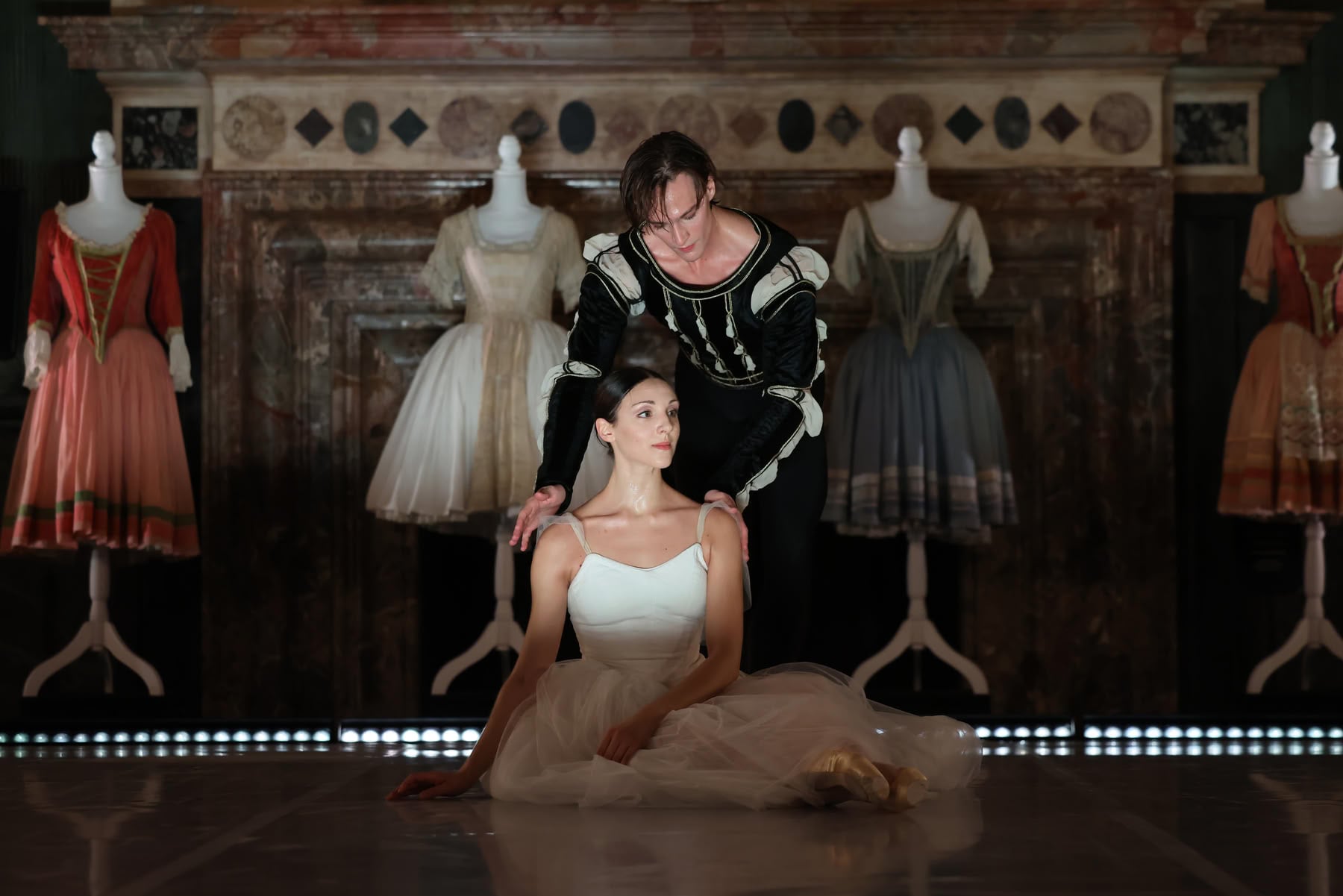
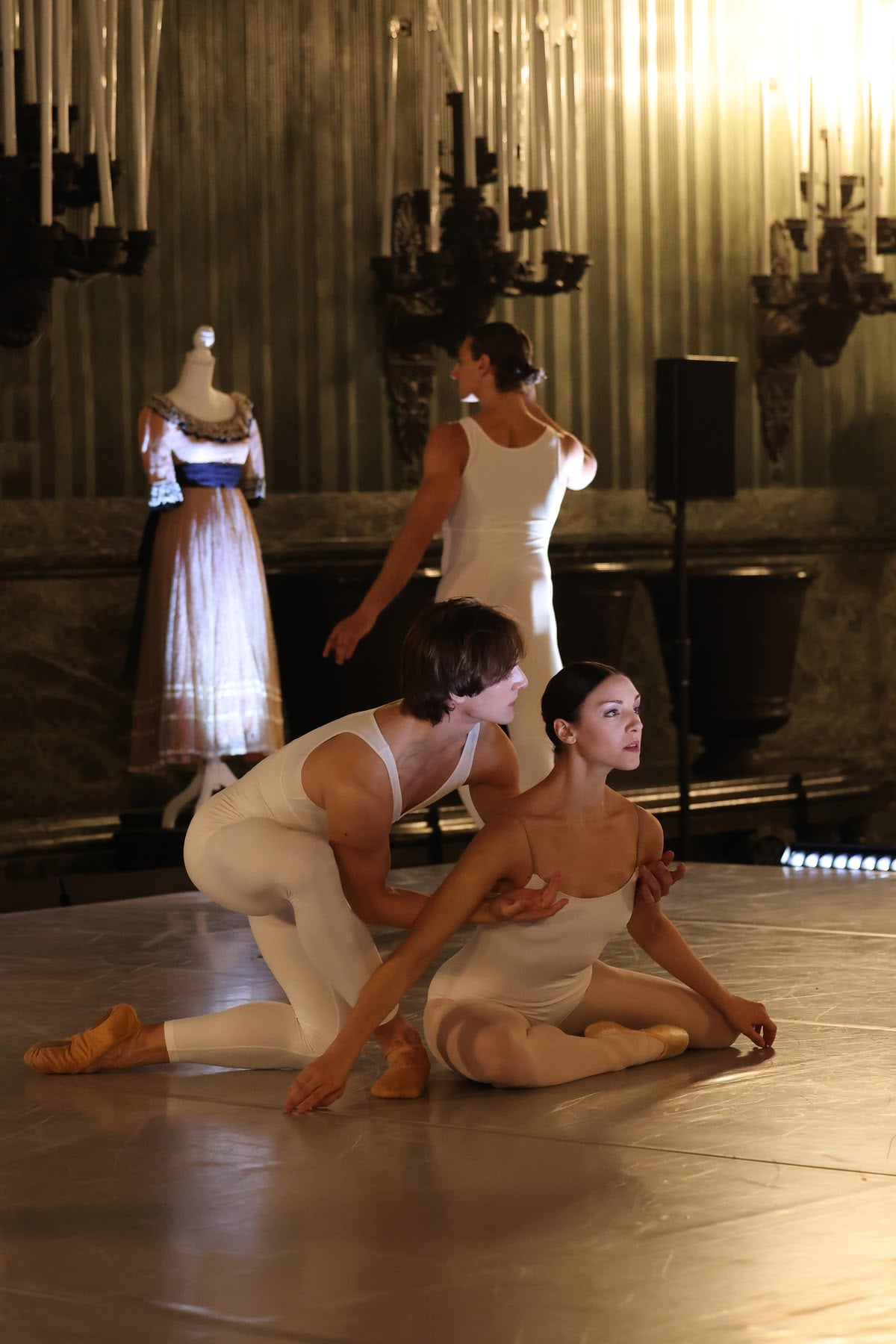
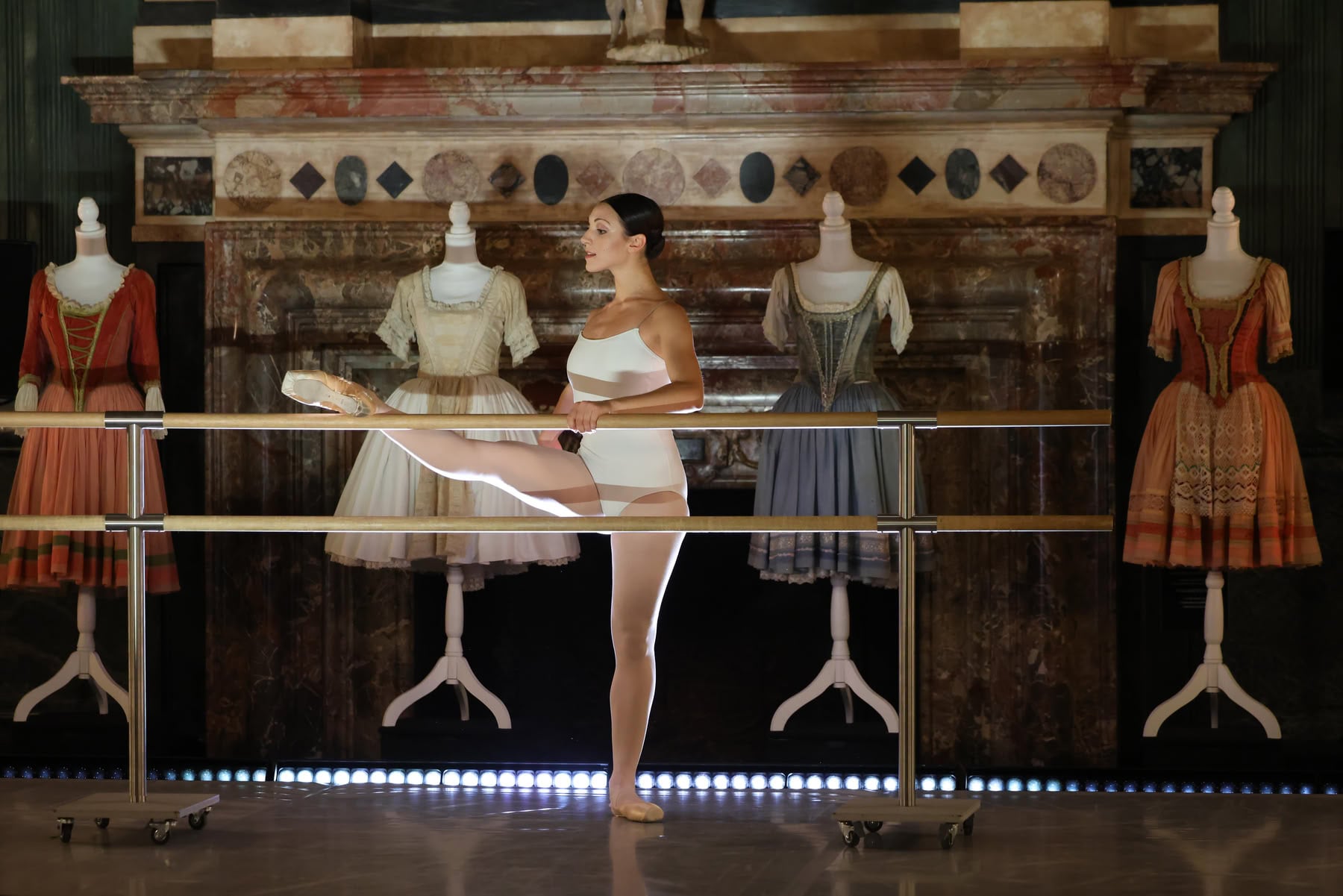
The astounding opulence of the Palazzo Reale – which would make even Trump’s gilded Oval Office look restrained – saw the second performance of Carla with Love, with the small audience being given free rein to roam the state rooms – the Armoury, the Throne Room, the Dining Room, and the Ballroom. Unfortunately, the Ballroom was deemed too delicate to house the stage and lighting, so the show was presented in the magnificent Hall of the Swiss Guards (Salone delle Guardie Svizzere). Six of Fracci’s costumes decorated the space.

The evening dedicated to the great Italian ballerina was the brainchild of Francesco Borelli, a former dancer who is now a teacher and manager. It was born of a conversation he had with Fracci during a car journey, and he also produced Carla with Love.
La Scala dancer Stefania Ballone has choreographed for many years, and here she also directed. La Scala principal Martina Arduino danced Fracci, and Jacopo Bellussi played her husband, Beppe Menegatti, her father and other figures from her life.
The concept was simple. In more or less chronological order, and without words (except for a recording of Fracci’s voice towards the end), we saw scenes from a life: foxtrots and rumbas as a child with her parents in wartime dance halls; her father, the tram driver, dropping her off outside La Scala; scenes at the barre; her first principal role as Cinderella (just out of school and standing in for Violette Verdy); at home with Menegatti; with Maria Callas; rehearsals… La Sylphide and Romeo and Juliet were hinted at, and other elements of her career were touched on: her Charlie Chaplin number, Sleeping Beauty, and her famous interpretation of Gelsomina in the ballet based on Fellini’s film La Strada, among others.


Mirko Maria Matera deconstructed the music, so we caught snatches of familiar scores before they dissolved into something new. There were three closed numbers: pas de deux from Cinderella, which Ballone recreated from Alfred Rodrigues’ 1955 choreography for La Scala; Giselle, an obvious choice and fortuitous as Arduino had been dancing the role at La Scala until a few days earlier; and a new pas de deux by Ballone to ‘Il nostro concerto’, a 1960 pop hit that Fracci adored.
The overall effect was winning, though dressing all the dancers in white Lycra as a base costume was an odd choice; some added costume elements would have been more forgiving. There were also some empty moments, perhaps because the piece had to be adapted to a space with no wings, and the dressing-room area, while not far away, involved a little more zigzagging to reach than it would in a theatre. These were only niggles in an otherwise enjoyable evening.
Giulia Gemma Manfrotto, Martina Scaglione, Cristian Prebibaj, and Raffaele Sibilio supported the two leads, with Scaglione standing out in particular for her bright-eyed presence. Arduino and Bellussi, however, dominated the evening, with Arduino offstage only when changing costumes.


She acted well, up close and personal; there was never a moment of distraction, even with the inevitable uncertainty of dancing in such an unusual space. There were many exposed but convincing moments, such as when she, as Fracci, was alone in the rehearsal studio, practising with determination and without music.
The second-act pas de deux from Giselle was expertly adapted from La Scala’s expansive stage to the 8 × 8 m platform. From my seat, just around the corner from the ‘front’, I saw it as if from the wings. While not ideal for classical choreography, it offered an interesting perspective for someone familiar with the ballet.
The South African choreographer Alfred Rodrigues (1922–2002) danced with Sadler’s Wells Ballet where he met his future wife Julia Farron, who became one of the first principal dancers of The Royal Ballet (as the company was later renamed). After choreographing for Sadler’s Wells Ballet, he went to La Scala in 1954, where he created the choreography for Luchino Visconti‘s production of La Vestale with Maria Callas. From there, he embarked on a career as an international choreographer, creating two major works in Italy in 1955, both for La Scala Ballet and both starring Violette Verdy: Romeo and Juliet at the Verona Arena and Cinderella in Milan.


His ballets have since largely been forgotten, so it was good to see this pas de deux from Cinderella, which made a strong case for revival – it was fresh, charming and nuanced, and beautifully danced by Arduino and Bellussi.
The evening’s highlight and closing piece was Ballone’s own choreography to Umberto Bindi’s song ‘Il nostro concerto’. Fracci was particularly attached to this song, as Bindi wrote the music for Menegatti’s staging of Carlo Gozzi’s Turandot and appeared alongside Fracci on its 1965 summer tour. The show included this 1960 hit, which had spent more than two months at number one.
Ballone is a true choreographer, and her work is musical without simply mirroring the score; it balances repetition and surprise, and it suited her dancers, Arduino and Bellussi, perfectly. The song is dramatic, verging on histrionic, and vocally demanding, yet Ballone inserted surprising, skittish, playful moments alongside the expected passion and intensity.
Bellussi is a charming onstage presence, with an appealing, boyish, open-eyed quality that makes his intentions easy to believe. Arduino has a flashing smile with a slightly naughty glint behind it. They made an attractive couple.
Apparently, the piece is set to tour major theatres, as it should. A few small tweaks could be beneficial, but the premise and structure are sound, the music is well judged, and Ballone’s work merits a wider audience.