Daniele Cipriani, producer and artistic director of the Les Étoiles galas in Italy, is bringing the format to Milan for the first time. Simkin – an audience favourite – has already participated several times in Rome, Ravenna, and Venice, and he will be in another Les Étoiles gala at the Teatro Comunale Nouveau in Bologna on 28 and 29 December.
Simkin has been applauded worldwide for his technical prowess, and he will be performing one of his pièces de résistance in Milan – the grand pas de deux from the third act of Don Quixote. I asked him how he keeps it fresh.
The Don Quixote pas de deux is the penultimate classical pas de deux with the highest levels of technical challenges for a classical male dancer. Also, for a young male dancer it’s the usual go-to variation to challenge yourself… maybe it’s the catchy music? [He grins.]
Having the possibility to perform the pas de deux in a gala is an honour and a privilege, since it means you have the responsibility to give the audience something physically extreme, almost inhumanly possible, but also, ideally, extremely tasteful, with a personal style that comes from within. You have to walk the fine line between doing something showy that the audience expects, but not to succumb to simple showmanship for technique’s sake. You must perform with honesty, even in a gala. If done right, the beginning of the pas de deux is a great setup of the relationship between the two dancers.
As with most classical ballet, it’s very square, frontal, and very exposed – very quantifiable. So inevitably with each rendition you compare yourself, on the one hand, with the greatest dancers that came before you who performed this exact segment and, at the same time, with the next generation of dancers and their technique, who use this choreography to push themselves to new heights. If done wrong, these classical pas de deux, out of context, can seem like a meaningless circus. I think of them more like vignettes of striving for the advancement of the human condition, and I try to approach them like that – striving for perfection at the height of your physical technical limits.
Have you performed many versions?
I’ve performed more or less the same version of the variation over the course of my career, but in Japan this summer I took a new version of the variation – Mr Baryshnikov’s iconic DonQ from the movie The Turning Point, where he dances with Gelsey Kirkland. I wanted to change things a little in order to keep it fresh and to push myself with a new challenge.
Sometimes these challenges have surprising origins. The 540-kick used in martial arts – which involves a rotation of approximately 540 degrees in the air – was adopted into dance. Simkin was one of the first to execute a 540 in ballet.
I don’t think I was the first to execute a 540 – or, as some would call it, a revoltade to the front – but I believe I was the first one to do them consecutively.
I love challenging myself with ballet technique – the whole process of R&D [Research and Development], playing around in the studio, including elements in daily class for them to be consistent, and then deciding on placement in the choreography for them to be tasteful.
It’s pretty much a system to develop of new elements and, to be honest, I also like being also the first one to be able to accomplish them… with consistency and hopefully, with style.
Julio Bocca told me that when he was dancing Basilio there was friendly rivalry among his male colleagues.
Of course that exists in every generation. Friendly competition, with a sense of play, in class and during performances – it is necessary for a healthy vibe in an environment. I love being in class with such friends as Osiel Gouneo and Kimin Kim who, in certain ways, have better technique and physical capabilities than I do. Being pushed by your contemporaries is essential to staying on top of your own abilities a dancer and friendly competition, to me, is fuel to do your best possible work.
Bocca also said that doing these extreme physical feats sometimes led to injury.
I am lucky enough to have had only one major injury to my ankle, many years ago. Ever since, my body has been good to me and has not given up, despite my sometimes-difficult schedule. You are in a permanent conversation with your body, and if you listen attentively, then it tells you how much you need to not push beyond your limits. In German there is an expression of ‘Gratwanderung’, which means to walk on a tightrope, so to speak – it’s a balancing act. Pain as a tool of communication with your body is an essential part of our work but it takes some time to be able to interpret it and learn to understand it.
Are there times when you think, “I’ll do something simpler tonight,” because you feel that it could be dangerous?
If you plan your physical shape and ramp up your physical stamina in the right way, you ideally peak physically on the evening of the show. I try to do everything in my power during the preparational work to not give the audience a ‘lesser’ result. As a freelancer, it becomes easier as you create your own schedule and have less extraneous responsibilities, so you can focus on the work at hand and approach the task with the highest level of control possible – to give it your best.
Do you feel the pressure from audiences always expecting you to ‘wow’ them?
The goal of a ballet dancer, in my opinion, is to transcend technique. Technique should be a backdrop for expressiveness and emotion in dance. While the technical expectations of the audiences are always very high as I’m usually performing pieces that have high technical demands, I would hope that the audience goes home thinking about ‘how’ I did something instead of ‘what’.
I’m currently in the process of preparing new repertoire that presents me in a different light as well as giving the audience something that they might not expect, but nevertheless find compelling. In my opinion, on the one hand, as a dancer, you have to give the audience what they came for, but on the other hand there is also great potential to educate the audience, and for them to grow to understand different aspects of our art and to give them something that they maybe didn’t know they’d appreciate.
When you are dancing a full-length ballet there are many more facets of you as a dancer to be seen. How much do you enjoy acting, for example?
Tremendously. Telling a story and portraying a character onstage throughout a full-length evening is one of the most satisfying aspects of my work. Each time I get to be someone else onstage, it lets me discover a little part of myself in the character at hand, and hopefully this transmits to the audience on what this character could be.
I notice that when you prepare before a show, you do not follow the class, but you have your headphones on, and warm up by yourself.
I use music as a tool to provide me with a certain energy during a warm-up class, which I prefer to do before a show, no matter if it’s a gala or a full-length performance. I prefer to do my own warm-up class as I don’t know what I’ll get from a teacher who, most of the time, I don’t know. Also, I don’t have the head to remember combinations at that point – not that I ever do, but oh well [he laughs].
I’ve been doing the same warm-up class for the past 19 years, and it works. “Never change a running system!”
I listen to electronic music with a beat during these warm-ups to provide me with motivation and energy to get through the things I have to get through in order to be ready for the show. It’s all about calibrating and priming your body and mind for the task at hand.
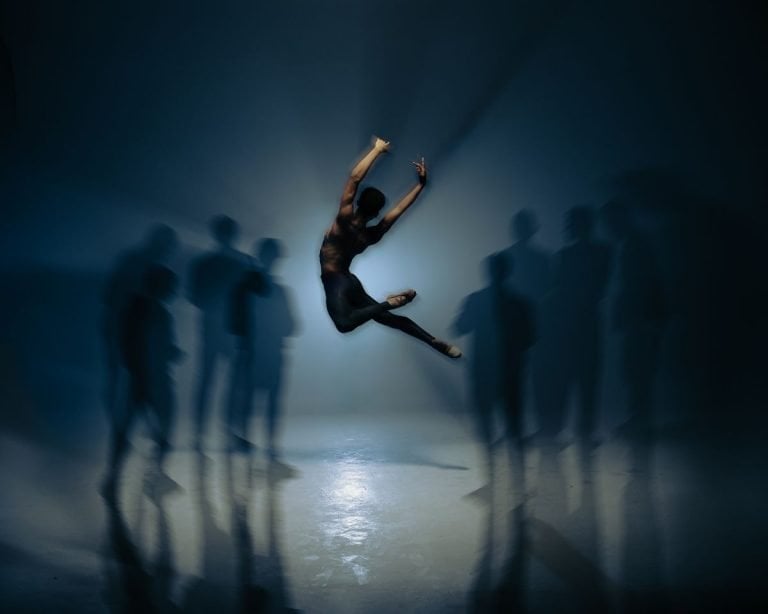
Simkin’s first piece of the evening is by Spanish choreographer Alejandro Cerrudo. Pacopepluto has Dean Martin crooning “In the Chapel in the Moonlight” and is backlit with an (almost) nude Simkin.
Pacopepepluto is a solo from a triptych of three solos of the same name for three male dancers. It embodies the idea of dancing and singing for yourself in the darkness, with people not fully seeing you, but peeking almost through a keyhole and seeing an internal monologue instead of an outward expression. It’s great fun and cheeky.
Like many dancers, Daniil Simkin is passionate about photography. His work can be seen on his Instagram page @daniilsees.
Back in the day, I photographed quite extensively backstage as I found the light and the atmosphere in the wings beautiful. Nowadays I use photography more as a diary in order to remember my life and my travels. I realised I remember events better when I have a visual reference which captures not only a moment but also a feeling.
Your interest in the visual arts led to Studio Simkin.
With Studio Simkin I am trying to create for myself a role in the institutional system that currently doesn’t exist. I am Creative Director of projects that push the understanding of what kind of dance experiences can exist in our contemporary world. I would like to expand on the current creations on structures that are geared towards creating for the proscenium stage. The stage that we’re so used to is itself a technology, and as a technologist I see potential for dance as an art to become more meaningful through evolving it through various new concepts.
Through the use of novel technology, immersive aspects and combining it with other visual arts, I believe dance can become more three-dimensional and combat a certain sense of contemporary disenchantment that I feel but, I suspect, so do many people of my generation. Through the right way of framing dance, a very corporal way of expression, I believe we can reconnect to something very primal that we are currently in the process of losing in our modern world. No to sound too cliché, but the notion of a ‘Gesamtkunstwerk’ comes to mind, discovering new combinations of elements to create art, with dance at its core, that inspires and unifies through meaning.
One of Studio Simkin’s recent projects was one, choreographed by David Dawson.
We showed one, which is a cinematic dance experience, at both in its inaugural screening at the Library for Performing Arts at Lincoln Center and later in the year at the Dance On Camera Film Festival. While people can currently watch the final result on Youtube, it is made to be presented on a big screen and with a great sound system. It is meant to expand on the notion of dance as language through the medium of film – if produced in the right way, it still has the potential to evolve into a meaningful experience. We realised in the pandemic that there is potential for exploration in that direction as the framework for dance on film is different than the usual proscenium stage works.
How do you see Studio Simkin going forward?
I have several projects in the works – but I cannot talk about them yet – which push the notion of what I want to do in the future and illustrate my vision through my work. Basically, I’m in the process of building my portfolio.
On the one hand, I see us at Studio Simkin being a partner for institutions to realise daring and novel concepts. Besides partnering up with institutions, which is what I’m currently doing, my goal would be to eventually have commercial clients who would fund our artistic endeavours to not create advertisements, but meaningful art in collaboration.
Dance still has great ‘soft power’ in our cultural Zeitgeist, but the execution of the implementation of our art, in context, quite often falls short because of the sensibility that is needed not to dilute the element of dance in the bigger context. There are obviously exceptions where things work out and magic is created – for example, in Wayne McGregor’s or Damian Jalet’s explorations – but on the whole I still see a lot of potential for ventures with great collaborative spirit to create more meaning with our art for society.
Visuals are so linked with social media… how do you use social media?
I had the privilege to be in the first generation of dancers to grow up with social media and it obviously has changed tremendously over time. While it started out as an innocent and beautifully naive outlet of expression back in the day, there was a big shift to algorithmic decision-making and it changed the course of so many things, approximately ten years ago.
Now it’s a way to stay visible and a necessary evil for our profession. It changed the value system that the new generation of dancers are exposed to and therefore I feel – while I hope not to sound too bitter – it changed how our art form is perceived. It’s one thing to see a technical feat, it’s another to see a full piece of a choreographer or a full-length ballet. Even my own attention span and brain changed, and I wonder what the developments will be in the future.
Nowadays I see my social media channels more like an archive of things past and meaningful to me. I try to post only things that I hopefully will not want to remove in a few years’ time. Also, I try to post full variations as, for the context of the medium at hand, it’s a good format for a snapshot of a performance, which is of course bigger than a single technical element that we do.
What do you like about having that contact with your audience?
A performance onstage is a beautiful exchange of energies between performer and audience. I revel in performing and ‘giving’ in that moment and receiving a response from the audience in return. It’s the most honest way of exchange. I see less of an exchange with social media, but more of an update, so that people can follow my life and my career. It’s a sharing of curated elements of my work and life, while keeping my personal life rather private.
We were first in contact about this interview when you had returned to Berlin from Hong Kong before heading off to Cuba. How is the travelling life?
Being a freelancer full-time comes with the perks of seeing the world. This year I’ve been to Seoul, Charlotte NC, Sydney, Ulan Bataar, Tokyo, London and Havana, among other places.
Where do you call home?
Home is currently in Berlin, where I live and have an apartment. Unfortunately, I don’t spend much time there though as most of the time I’m there just to repack and continue on my journey.
‘Home’ is a loaded question at this point.
Daniil Simkin in Les Bourgeois – photo Giovanni Daniotti
Graham Spicer, aka ‘Gramilano’, is a writer, director and photographer based in Milan. He was a regular columnist for Opera Now magazine and wrote for the BBC until transferring to Italy. His articles have appeared in various publications from Woman’s Weekly to Gay Times, and he wrote the Danza in Italia column for Dancing Times magazine. Graham was the historical advisor on Codice Carla, the 2023 documentary on Italian ballerina Carla Fracci.
Graham also works as a dance photographer, and his photos have appeared in many books, theatre programmes, and magazines, including Dancing Times, Dance Spirit and Ballet2000, as well as all the major Italian newspapers.
He is a member of the Dance Section of The Critics’ Circle.
Kathrina Farrugia-Kriel talks with choreographer Helen Pickett on the eve of the opening of her ballet Emma Bovary – “Be the rebel. Be daring. Take Risk.”
What a wonderful interview. Such an intelligent artist. Grazie Daniil, grazie gramilano.
Katherine Grainger
1 year ago
What an intelligent man. “If done wrong, these classical pas de deux, out of context, can seem like a meaningless circus.” “It’s one thing to see a technical feat, it’s another to see a full piece of a choreographer or a full-length ballet.” “You must perform with honesty, even in a gala.” Bravo Daniil and thank you for the pleasure you keep giving us.
Sumie Ogiwara
1 year ago
Loved your article as always. I saw Daniil’s new version of DonQ with the powerhouse Madoka Sugai from Hamburg Ballet this summer in Tokyo, which was absolutely fantastic. Looking forward very much to seeing him dance again here in Béjart’s “The Nutcracker” with The Tokyo Ballet in February next year.
Alta van Zyl
1 year ago
Non vedo l’ora di vedere Daniil e tutte le stelle sabato. Posto in prima fila.





Great interview!
What a wonderful interview. Such an intelligent artist. Grazie Daniil, grazie gramilano.
What an intelligent man. “If done wrong, these classical pas de deux, out of context, can seem like a meaningless circus.” “It’s one thing to see a technical feat, it’s another to see a full piece of a choreographer or a full-length ballet.” “You must perform with honesty, even in a gala.” Bravo Daniil and thank you for the pleasure you keep giving us.
Loved your article as always. I saw Daniil’s new version of DonQ with the powerhouse Madoka Sugai from Hamburg Ballet this summer in Tokyo, which was absolutely fantastic. Looking forward very much to seeing him dance again here in Béjart’s “The Nutcracker” with The Tokyo Ballet in February next year.
Non vedo l’ora di vedere Daniil e tutte le stelle sabato. Posto in prima fila.