
Review: The Paris Opera Ballet in Paquita – “I didn’t feel the magic”

Matthew Paluch sees The Paris Opera Ballet in Paquita: “If honest, I found it a tad boring and lacking in identity. I need a lot more from narrative ballet.”
| Title | Paquita |
| Company | Paris Opera Ballet |
| Venue | Palais Garnier |
| Date | 14 December 2024 |
| Reviewer | Matthew Paluch |
Not one but two theatres. 154 dancers! It’s little wonder the Paris Opera Ballet can run two productions simultaneously.
Currently showing at Opéra Bastille is Pierre Lacotte’s 2001 production of Paquita and at the Palais Garnier, Play.
Depending on your background, many will know Paquita as a Grand pas classique – a lead couple, numerous soloists and a corps de ballet. I’m no expert, but I’m pretty sure there are hundreds of versions floating around. People enjoy the grandeur and Ludwig Minkus’ epic score.
To be clear, Paquita was originally created in 1846, in Paris by Joseph Mazilier to music by Édouard Deldevez. Marius Petipa then created the Grand pas classique additions in 1881 to Minkus. Lacotte brought the two concepts together and re-choreographed the whole ballet.
So, what of the Lacotte experience? If honest, I found it a tad boring and lacking in identity, and now I fully understand why the classique survived and nothing else did.
The storyline is very generic – a love triangle and lost identity, which causes the characters to convey as one-dimensional. In this situation one needs dancers who can really tell a story, build depth of character etc. Not the case I’m afraid. Across the board also. At certain points, the stage was heaving with corps de ballet characters and extras, and they were all motionless statues. Talk about tedious. And when dancing, the majority were too busy wrestling with Lacotte’s unnecessarily complex enchaînement to be able to convey anything apart from panic.
As Act 1 unfolded on a bare, setless stage I kept thinking I’d rather watch Danish or French classroom settings. Why? Because then we can all focus on the dance – style, execution etc – rather than observe a weak story being communicated weakly.
Frankly speaking Paquita as a ballet lacks the romanticism of Giselle, the heat of Don Quixote and the comedy of La fille mal gardée. It lives somewhere in between, and not even obviously in Spain. Location can do a lot for cultural vibes.
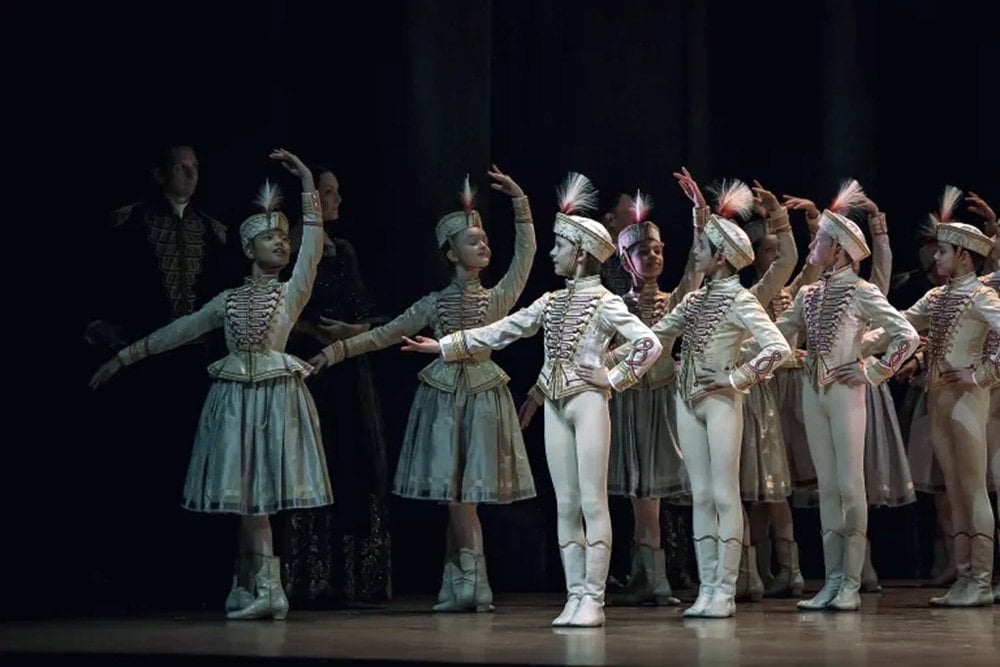
Act 1 is long with two scenes, lots of empty dancing and hammy mime. The execution isn’t bad by any means, it just lacks… what does it lack? This made me contemplate the highly renowned French style. Articulation abounds, but breath is lacking. Perhaps this primarily comes down to Lacotte’s choreography, but most of the evening felt one dynamic pace. And yes, we all love a brisé, but talk about overload.
The best bit about Act 1 was the pas de trois. The cast of Eléonore Guérineau, Elizabeth Partington and Jack Gasztowtt was very enjoyable, emitting fresh faces and some risk-taking. This felt like dance. Though Gasztowtt needs to find more fluidity in the current, verging on rigid solo execution.
The Act finishes with Paquita and her love interest (French officer, Lucien d’Hervilly) escaping the tyrannical, verging on murderous Roma chief, Iñigo. It sounds better on paper, and by this point, I had little to zero empathy with any of the main characters.
Act 2 takes us to a Palace setting – cut to endless, generic waltzes and mazurkas. Here we find out Paquita’s true identity is in fact aristocratic, not Romani, so she can indeed marry her cousin (!) d’Hervilly. Joy abounds.
Lacotte has choreographed a tasteful love pas de deux, and the leads – Sae Eun Park and Paul Marque – start to shine at this point. Cue another costume change and the pas classique begins. Act 2 even has a bit of a set – a portrait of Paquita’s father and an unsubstantial staircase at the back. This I’d rethink – sets can do wonders – especially if one’s dealing with a weak story and flat mise-en-scène.
Park and Marque do a more than acceptable job with the demanding choreography, though I must admit their performances didn’t move me. Technically they were both 99% there, but it’s the 1% that can be the deal maker. I also didn’t feel the magic that classical ballet can allow for. Where dance carries the observer to another realm via skill, musical connection and expression.
That said I don’t hold them exclusively responsible for my detachment. The ballet plays a big part, as do they as individual dancers. It’s the first time I’ve seen either of them live, and they aren’t in-your-face, bombastic dancers. Park is ease personified, with understated power, and Marque is precise and suave, and I’d be more than intrigued to see them both in alternative repertoire. They also communicated an evident bond, though less as the characters they were portraying, but more as two Étoiles finding support from each other during a highly pressured moment. This was very endearing to witness.
Come the end, the packed audience seemed very happy, and that’s probably more important than any of the above. I need a lot more from narrative ballet. In the interval, a fellow patron asked me if I was enjoying the experience. I politely suggested maybe not, and they immediately said, “Oh, you don’t like classical ballet.”
Note the full stop. It wasn’t a question. I’ll leave you with that to ponder over.


Matthew Paluch was awarded a place at The Royal Ballet School in 1990 where he graduated in 1997. His first four years as a professional dancer were spent working with London City Ballet, Scottish Ballet, K-Ballet and English National Ballet, becoming a full-time member of ENB until leaving in 2006.
Matthew graduated from the Royal Academy of Dance, Professional Dancers’ Teaching Diploma in 2007, and was formerly on faculty at The Royal Ballet School. He completed his Masters in Ballet Studies at Roehampton University in 2011, has been a freelance writer since 2010 and currently works in the Law Sector.
He is a member of the Dance Section of The Critics’ Circle.

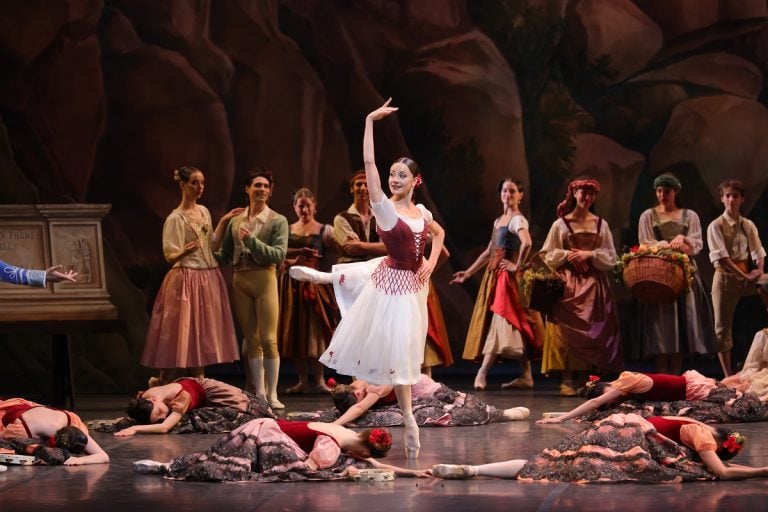


As a longterm and experienced viewer of classical ballet, and having been part of the audience at Opéra Bastille on December 14th, I strongly disagree. I felt the magic, it was in every aspect a splendid performance!
Even more so the live-streamed performance of „Paquita“ from December 17th, with Guillaume Diop and Valentine Colasante, to be watched on play.operadeparis.fr until January 21st.
Thank you Paris Opera Ballet!