Review: Olga Smirnova is Lady Macbeth in Helen Pickett’s new ballet in Amsterdam

Kathrina Farrugia-Kriel sees the Dutch National Ballet in the world premiere of Helen Pickett’s new ballet with Lady Macbeth “telling her side of the story”.
| Title | Lady Macbeth |
| Company | Dutch National Ballet |
| Venue | Dutch National Opera and Ballet, Main Stage |
| Date | 5 April 2025 |
| Reviewer | Kathrina Farrugia-Kriel |
American choreographer Helen Pickett premiered her full-length ballet, Lady Macbeth, for the Dutch National Ballet (April 5) in Amsterdam. Pickett, now into her third decade as a choreographer and onto her fifth major full-length work, is no stranger to narrative ballets. Her calling card in Europe was The Crucible (2019) for Scottish Ballet, a fine work which cleverly tackles Arthur Miller’s play, with much gravitas towards a love triangle for the lead characters. Other recent works by Pickett include Emma Bovary (2023) for the National Ballet of Canada, and Crime and Punishment (2024) for American Ballet Theatre, an equally ambitious work though maybe less lauded for a major North American company. Pickett is driven by re-telling narratives, finding new ways to explore, in some cases rethink, the plots of these iconic literary works. Lady Macbeth was a calculated gamble – the prospect of a ballet focussed on a woman’s insight into the Shakespearian narrative is both appealing as well as dangerous in its deeply-rooted heritage in literature circles.


Any gamble associated with this new ‘ballet drama’, as it was advertised by the company, paid off. Pickett’s collaborative (and established) team brought together renowned composer Peter Salem, dramaturg James Bonas, lighting designer Bonnie Beecher, video artist Anouar Brissel and costumier Luis F. Carvalho. The strength of the collaboration supported the successes of this unique narrative but, in equal measure, deflected some of the areas which could have been developed further. Pickett and her collaborators re-imagined the trajectory of Lady Macbeth as she moves between her lust for power and her final moments. Every component of the collaboration spoke to the concepts of the ballet. If you’ve seen previous Pickett ballets, you’ll notice the importance of video installations, as well as the totality of the performance. The score itself is a masterful work. The textures and the tones offered rich and electrifying moments. Under the baton of superb Koen Kessel, Salem’s score is intensely punctuated with electronic and classical tones. It is the foundation of the ballet, upon which Pickett masterfully shapes her work.
A short but necessary prologue offers a clever cut into the narrative. A lonely figure, Macbeth, writes to his wife. The visual projections of birds in flight, and the first connection with the three witches, take us on a different journey, one in which Shakespeare’s narrative is re-envisioned. Act 1 commences with the presence of Olga Smirnova, elevated on a platform with an enormous red cape that is raised up and beyond the light trusses. Smirnova is powerful and authoritative in her introduction as Lady Macbeth. This opening image of a power-hungry presence is the start of her narrative, and Smirnova brings her intense qualities as both an actress and a technician. What ensues over the next two acts is Pickett’s astute shaping of the choreography, where every gesture matters. Smirnova unfastens her cloak; the cape disappears above her head in dramatic ‘visual effect’ style. With expressive hand gestures, angular arms and legs that move liberally around Smirnova, Pickett’s choreography for Lady Macbeth delivers a wealth of characteristics. There is also an easiness to the narrative, in reconciling that Macbeth (her husband), danced by the equally powerfully present Timothy van Poucke, unveils and decides her downfall. The contrast between the Macbeths’ duets in the two acts is visceral. Their duets move between the early, lustful and passionate intertwining choreography, to the dark and terrible betrayal. In Pickett’s choreography, meaning is close enough to keep the audience moving between the impossibility of the Shakespearian story, the troubled marriage of the Macbeths, and Lady Macbeth’s fate.
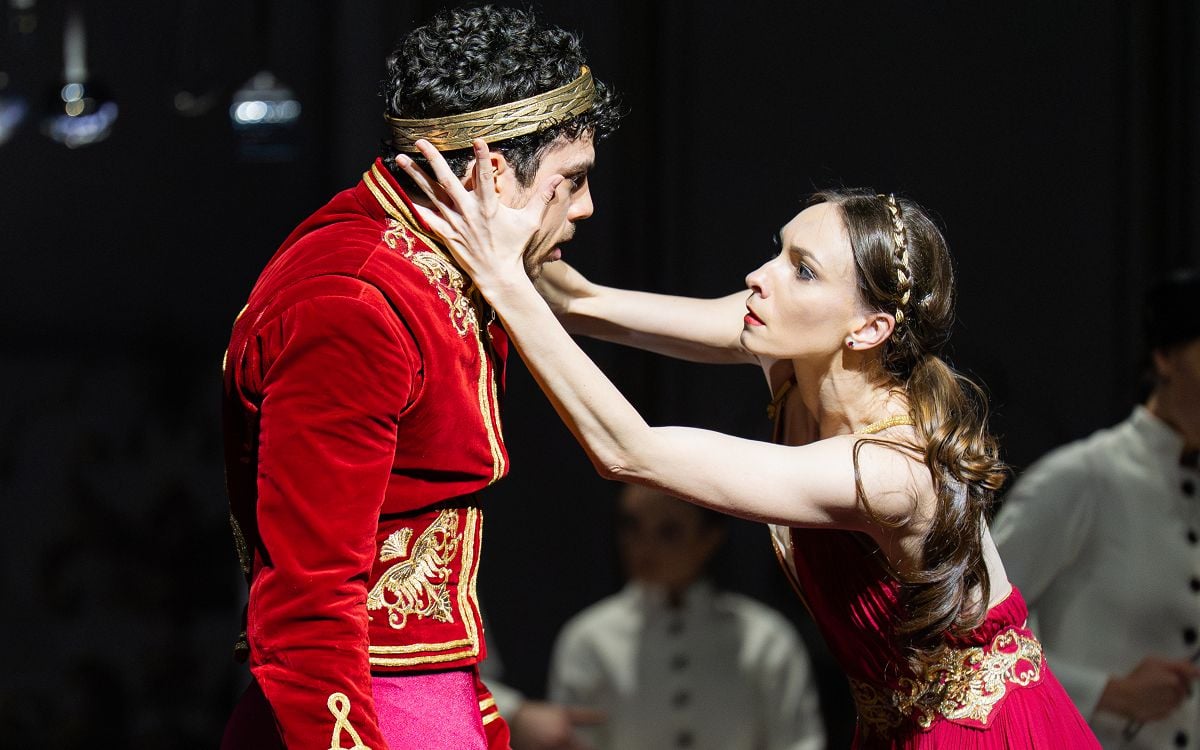

The ballet is also supported by characters like Lady Macduff, whose choreography in Act Two showcases the incredibly expressive Floor Eimers. In Pickett’s world, character development is key; secondary characters like Macduff become interesting explorations. For me, this was a highlight of the ballet. The three witches, as iconic ‘trouble’ in the Shakespearian play, are effective in both their video installations and their physical presence on stage. The witches are short roles, but when they appear, they are present to fulfil their role. This can also be said of the choreography for the doctor and nurse (danced superbly by Emma Mardegan and Conor Walmsley); Pickett uses a rich palette of movement qualities (their steps are weirdly aloof and different to any of the other characters). The doctor’s steps are stretched yet discorded, while the nurse’s pointework is stilted (there’s a strong connection to some of the steps in Pickett’s The Crucible).
Pickett and her team deliver a ballet that is both engaging and relevant. There is much dystopia in the plot, and the ballet is a reminder of troubles in contemporary times. Of course, this is not a ballet without its flaws. The ballet does push to almost an hour for each act, and there are some minor moments which I would say weren’t the strengths of collaboration (the kitchen scene isn’t a favourite moment of mine, but that’s the joy of engaging with creativity – it’s all subjective). There is a splendid but underdeveloped movement motif for a group of corps de ballet dancers, reminiscent (and celebratory) of Pickett’s days in Ballett Frankfurt under the direction of William Forsythe. Her work is not derivative; rather there is much homage to her roots and heritage. This group phrase could have been developed with more breadth and depth, and a return to this ensemble work at the end of Act 2 needed a similar expansion. Carvalho’s unitard designs, both altering the function and form of this style, reveal the space needed for this short but limited scene. Nevertheless, the stage design is a beautiful reminder of the possibilities of creating contemporary narratives on a proscenium stage. There was an intelligent use of the set that transformed each scene into spaces that brought the story to life and sustained this from the opening moments to its final fade out. The deaths of the two women (Macbeth and Macduff) reflect Pickett’s feminist insights into retelling these marginalised characters and placing their stories centre stage. This ballet merits to be seen again, if given the opportunity.


Dr Kathrina Farrugia-Kriel is a dance scholar, educator and published author. She is a graduate of the Royal Academy of Dance (2003), the Universities of Durham and Surrey, and London Metropolitan University (2013). Her doctoral research focussed on Bronislava Nijinska’s Les Noces (1923), and the re-imaginings by contemporary choreographers Angelin Preljocaj and Mauro Bigonzetti. Kathrina is a former director of the Society of Dance History Scholars (now Dance Studies Association). Her scholarship on ballet histories has been published in peer-reviewed anthologies and journals, as well as newspapers, high-end magazines, and online blogs. She has authored a book on the legacy of Nathalie Poutiatine and ballet in Malta (Fondazzjoni Patrimonju Malti, 2020) and co-edited an extensive and pioneering anthology titled The Oxford Handbook of Contemporary Ballet (Oxford University Press, 2021).