
Review: Astana Ballet Theatre in Two Carpets – “amongst the best new full-length narrative ballets that I have seen”
Graham Watts sees Two Carpets, the new ballet for Astana Ballet Theatre – an outstanding new entry to the global ballet repertoire.
| Title | Two Carpets |
| Company | Astana Ballet Theatre/ Mosaic Del Arte |
| Venue | Astana Ballet Theatre, Kazakhstan |
| Date | 17-18 October 2025 |
| Reviewer | Graham Watts |
New full-length ballets are hard to find and those that hit the stage with instant success are as rare as hen’s teeth. So, I had to travel to Kazakhstan for the pleasure of finding a world premiere to savour and it was not a fruitless journey. Astana Ballet Theatre’s performance of Two Carpets is amongst the best new full-length narrative ballets that I have seen.
Astana is a relatively modern city that became the capital of Kazakhstan in 1997. With just 1.5 million citizens, it has two major ballet companies: the one that resides in the impressively humungous Astana Opera House has an ensemble of 130 dancers, and the other in the smaller but similarly opulent Astana Ballet Theatre numbers 81 dancers. It is a remarkable sign of the nation’s appreciation of culture that more professional ballet dancers ply their artistry in Astana than in almost any other city outside of Moscow or St Petersburg.
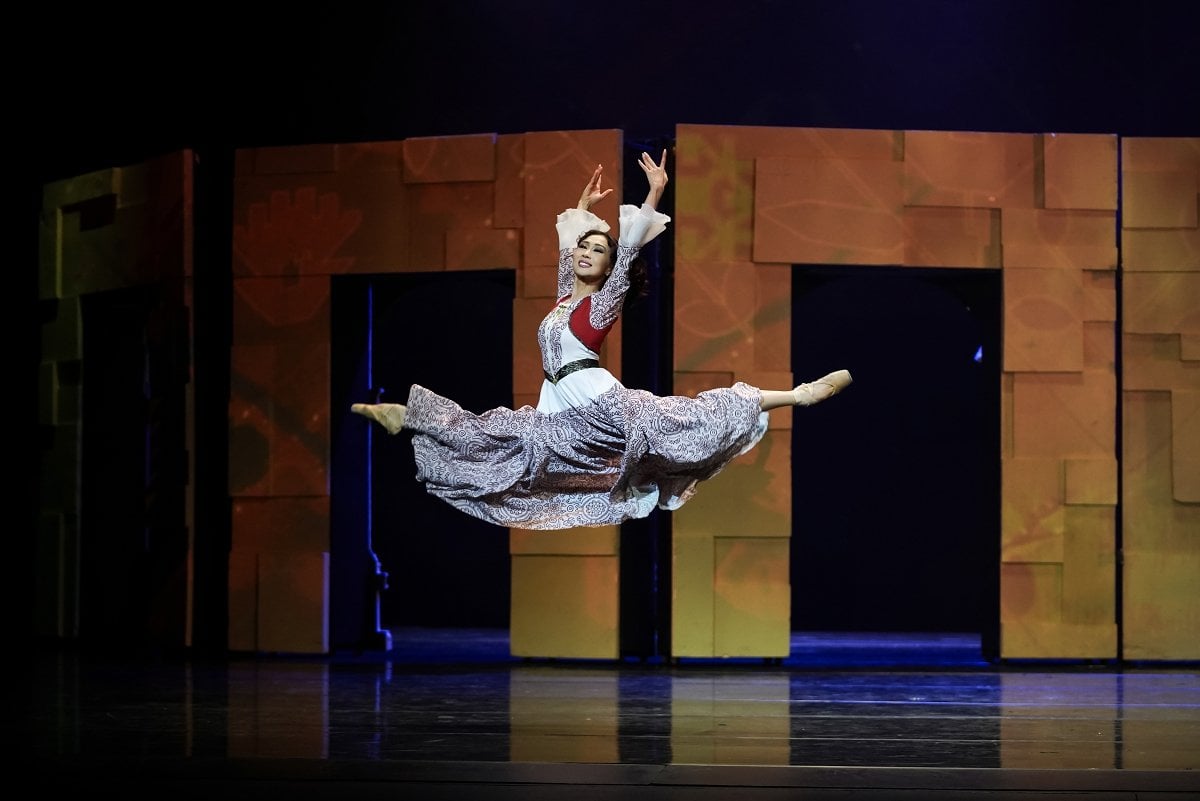
Two Carpets may seem a low-key title for a ballet when seen from a Western perspective, but carpet weaving in the Southern Caucasus and particularly in Azerbaijan (where this narrative begins) is a much-revered and ancient art form, a demonstration of which was on view in the theatre’s lobby, alongside an exhibition of several beautiful carpets. The story is a representation of the Shirvan carpet kept at the Louvre, which holds within its threads the legend of the life of the woman who weaved it: the excitement of her early experiences is shown in bright colours but the grief that dominated her later years is illustrated in black threads.
This new ballet was the brainchild of Valery Kopeikin, building on his success with last year’s premiere of Blind Forgiveness in Athens. Kopeikin is a pioneer of a new economic model for ballet. In an era where the art survives largely on simply repeating nineteenth-century classics in a financial model that (outside the USA) depends heavily on diminishing state subsidy, his company, Mosaic Del Arte, is creating new full-length ballets with private funding and partnering with theatres and ballet companies (such as here with Astana Ballet Theatre). It’s a model that they are clearly delivering with outstanding success, as evidenced by this latest venture.
As with Blind Forgiveness, Kopeikin also wrote the libretto for Two Carpets, and it is the simplicity of his dramaturgy that has created the bedrock of the ballet’s triumph. The action begins in late-nineteenth century Baku and unfolds in epic, cinematic fashion through a poignant love story that takes the audience to St Petersburg, the battlefields of Europe, to Vienna and then back to Baku.
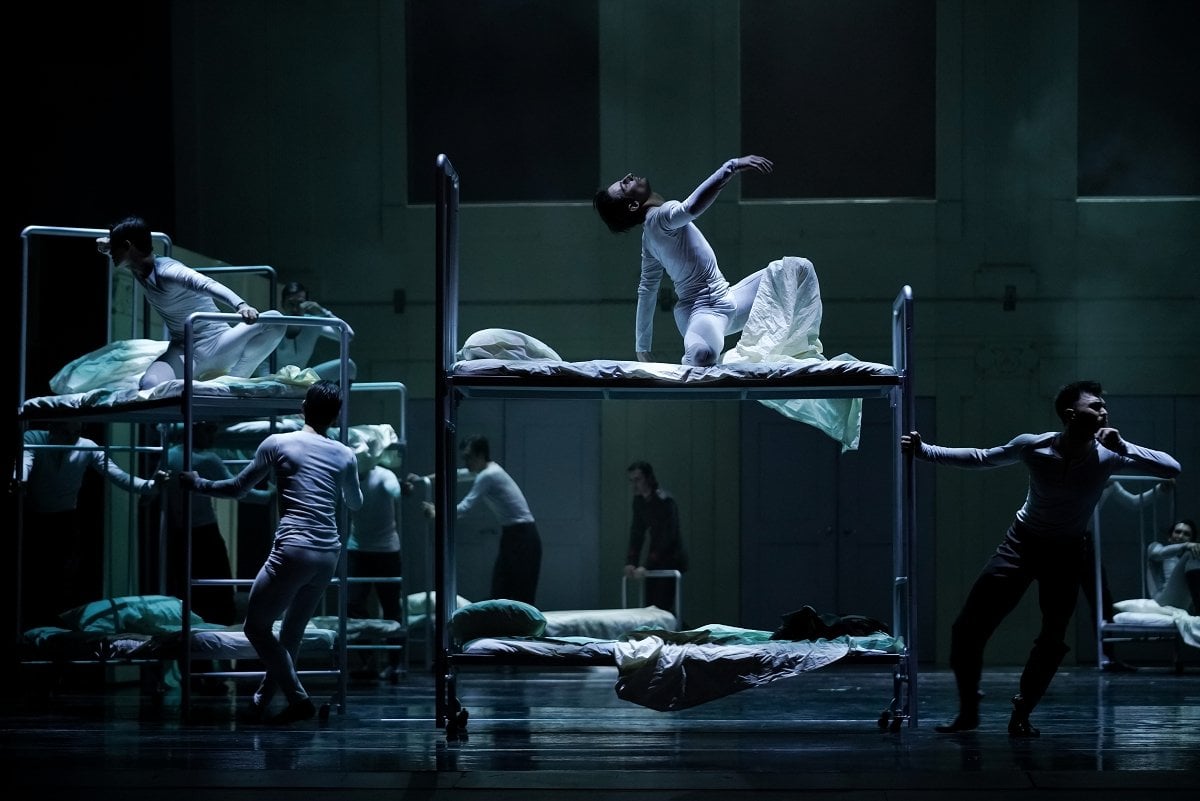
Samir and Leyla meet as children in Baku’s marketplace where he bravely defends her against a bunch of hoodlums. Their friendship develops into an innocent adolescent romance, which is interrupted when Samir follows family tradition to enter the military academy in St Petersburg.
Samir is severely wounded and blinded in the war and mistakenly declared dead. This scene is very effectively rendered with the horrors of Samir’s wounding shown in a red circle of light on a platform above the stage, contrasting with the domesticity of Leyla’s carpet weaving below, an example of Anastasia Kapustina’s outstanding set design (Igor Chapurin’s eclectic period costume designs were similarly noteworthy).
In the war’s aftermath, blind and suffering amnesia, Samir is working as a groundskeeper in Vienna when he tries in vain to save a rich and beautiful widow, Margot, from a band of thieves. Margot and Samir develop a mutual attraction, but his memories gradually return, finally prompted by Margot’s purchase of a carpet that brings Leyla back to his mind. The pain of his parting from Margot is overshadowed by the joy of reuniting with his true love in a final joyous pas de deux. Not quite the final act of the ballet since the curtain call was an uplifting and fully choreographed epilogue!
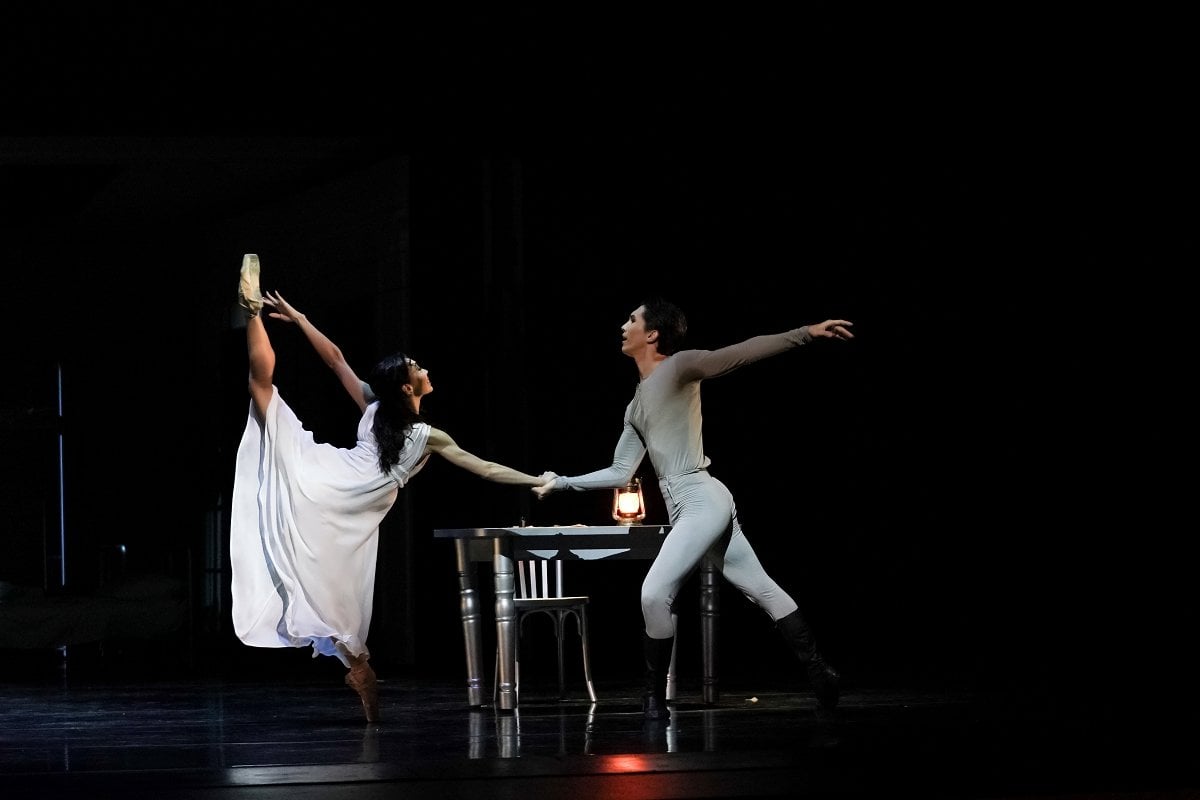

This all-to-brief synopsis illustrates the many overlapping emotions of heroism, love, comedy, loss, despair, grief and joy that flow through the ballet, all of which are perfectly aligned with a magnificent new score by Arseni Smirnov, providing lyrical melodic accompaniment for the four main pas de deux and the general romantic, comedic and dramatic themes, including impressive military marches for the cadet corps and explosive music for the warfare scenes. The orchestra of the Astana Ballet Theatre was superbly conducted by Arman Urazgaliyev. His curtain call applause was the loudest, which is testament to the excellence of Smirnov’s new score and its orchestral performance but also demonstrates the level of musical appreciation in Astana and Urazgaliyev’s popularity.
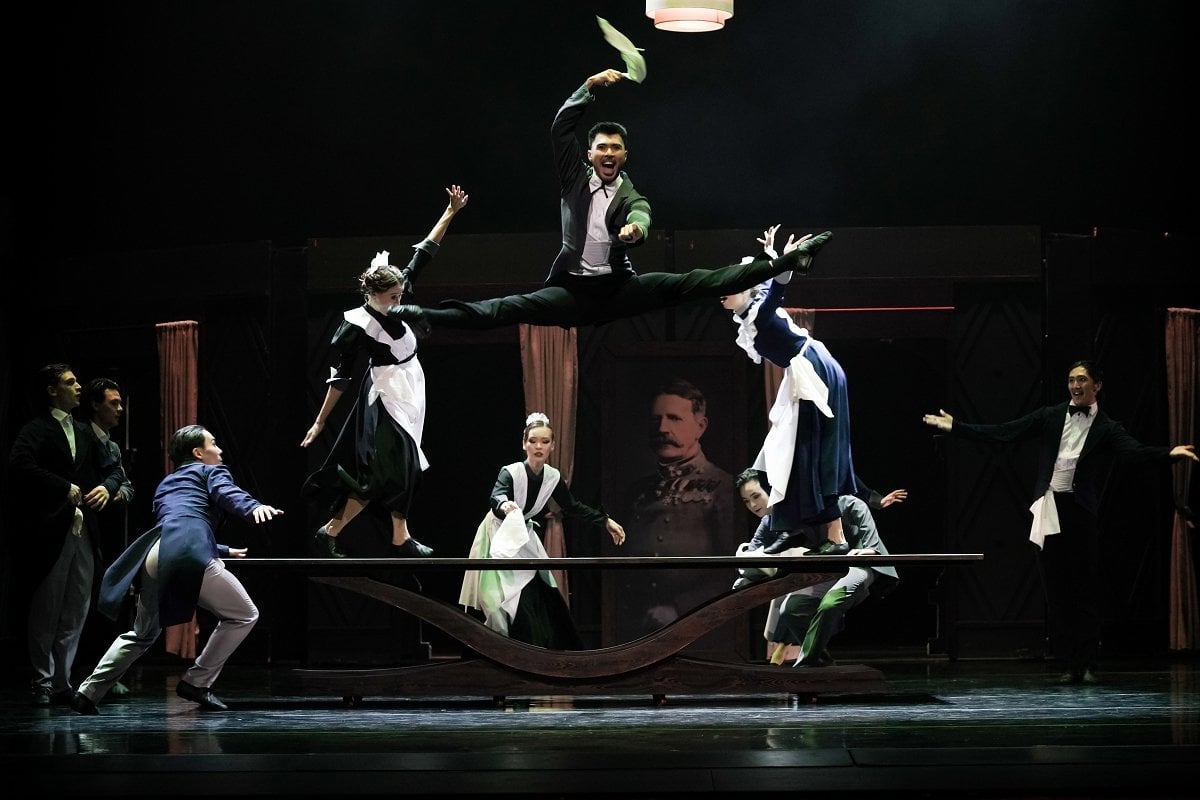
Kudos is similarly due to the choreographic achievement of Alexander Mogilev who has provided a sweeping tapestry of movement, a worthy representation of the Shirvan carpet, ranging from superbly performed uniform patterns from the corps de ballet to those poignant and romantic pas de deux. Mogilev cleverly incorporates the manipulation of props into his choreography with the army cadets showing synchronised, juggling dexterity in their manipulation of simulated rifles to integrate a feeling of army drill into their movement formations, and the women similarly dextrous with scarves and other material. The scene where Margot invites Samir to tea is uproariously comic with her domestic staff urgently setting the table, swerving around each other with piles of crockery. Having done so, one of them unwittingly pulls the tablecloth and all the plates fall to the floor!
Despite the poignancy inherent in the tale, it is balanced by such comedy. Another example is when Margot and Samir begin to show signs of mutual affection at that afternoon tea, the staff try to cover the eyes of her late husband’s portrait. The main comedic role is that of the cadet corps’ commanding officer, a portly, rambunctious personality with a kindly heart concealed by a disciplined exterior, splendidly played by the strutting Eldar Sarsembayev who routinely lit up the stage with bursts of surprisingly impressive virtuosity (he put me in mind of a hybrid of Sancho Panza and Puck).

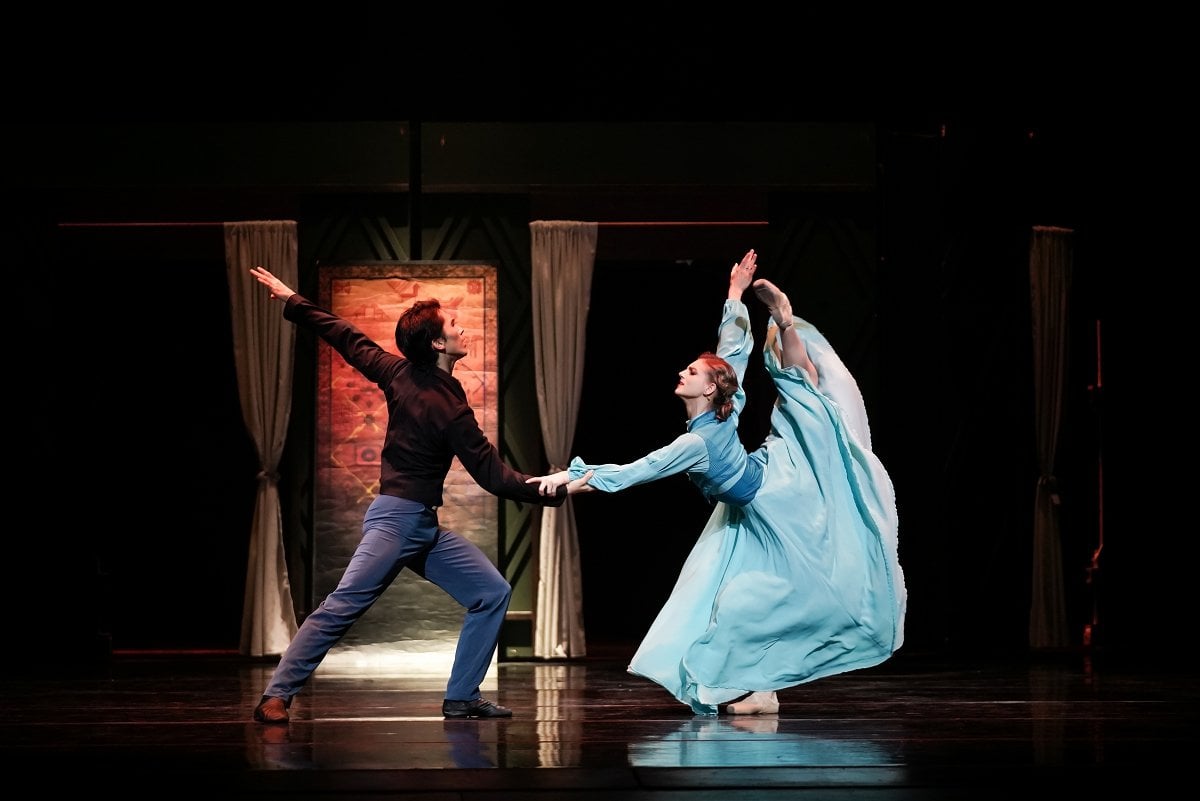
One of many great memories from these performances is to add Tatyana Ten to my A-list of wonderful prima ballerinas. As the adult Leyla, her expression was wistful and romantic, grief-stricken and joyous; and her dancing was deliciously understated in its robust and elegant classicism. She partnered two men on consecutive evenings as the adult Samir: Sundet Sultanov took the premiere, followed by Erkanat Ermagambet. Both were suitably heroic and contrastingly downtrodden as the blind sweeper in post-war Vienna, and both showed remarkable strength in the longest presage (or angel lift) that I may have ever seen, making the ballerina appear weightless.
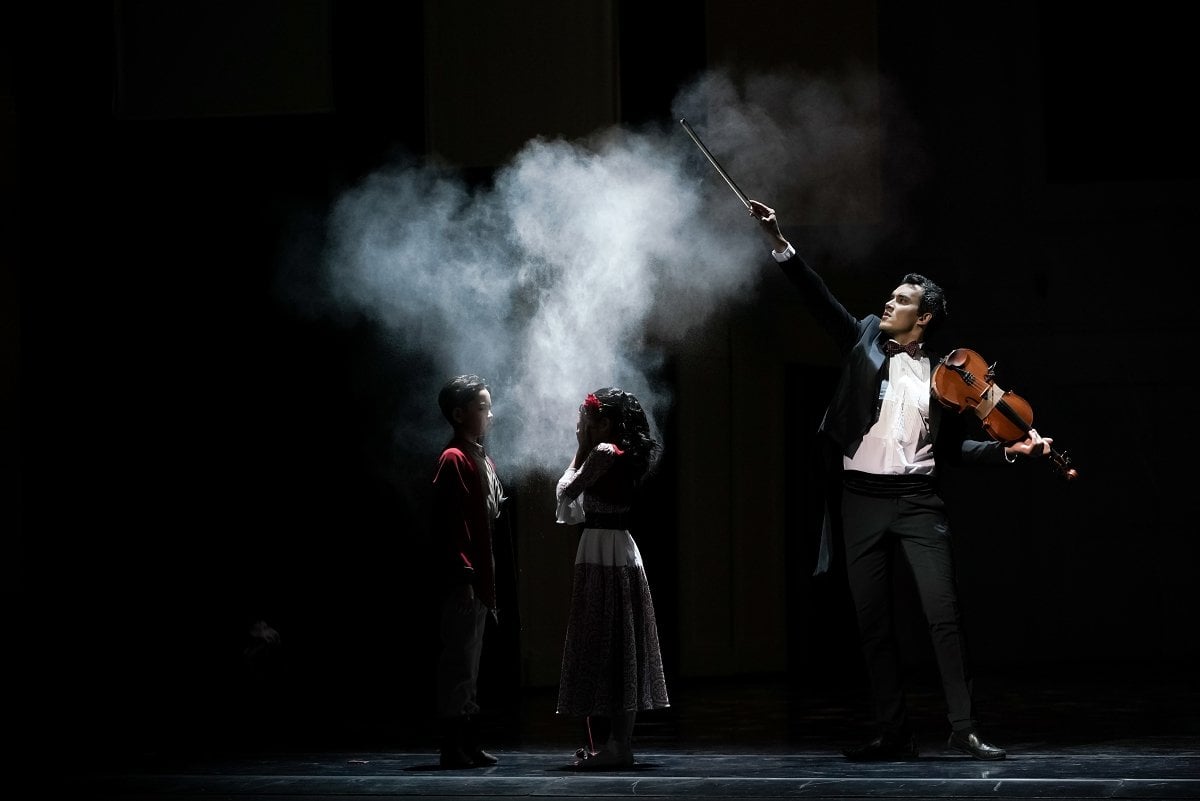
Brazilian ballerina Natalia Fernandes Menes provided the dancing link back to Blind Forgiveness, performing here as Margot with a heady mix of vulnerability and allure. She appeared in only a few scenes early in the second act but nonetheless provided indelible memories. The marketplace action (in Baku and Vienna) also included an onstage violinist (Diar Kassenov) who acted as a kind of musical narrator. A prologue featured two actresses, Linda Nigmatulina (as Leyla) and Viktoria Maslova (as Margot) reminiscing their mutual love for Samir. Tamirlan Nsanbai caught my eye throughout the ballet, not least as the carpet seller who awakens Samir’s memory; and four Romany women (Milana Bukanova, Zhaina Bayan, Altynay Zhussupova and Assel Zhangaskayeva) provided a leitmotif, appearing at key points in Samir’s story, rather like the harlots in Kenneth MacMillan‘s Romeo and Juliet.
Children play an important part in this story, and the final plaudit goes to Arlan Eldosuly (who performed Samir as a child in both casts) with Fatima Nauryzbai and Aishabegim Kurmanbek, alternating the child role of Leyla. They were not just cutesy decorative children but excellent performers. I don’t know how old Eldosuly is (I’m guessing no more than ten) but he already has serious ballet virtuosity and excellent expression.
This is unashamedly a long review, but every integrated aspect of this outstanding new ballet deserves to be suitably recognised, as does the excellence and simplicity of what could have become an unduly complex narrative. On so many occasions, new ballet scenarios fall into the trap of over-complication (even in the most revered of companies) and it was so refreshing to appreciate the elegant clarity of this outstanding new entry to the global ballet repertoire. And well worth the long journey to Astana for the privilege of that experience.
(The author attended the performances of Two Carpets as a guest of Mosaic Del Arte)


Graham Watts is a freelance writer and dance critic. He writes for The Spectator, Tanz, Shinshokan Dance Magazine (Japan), Ballet Magazine (Romania), BachTrack and the Hong Kong International Arts Festival and has previously written for the Sunday Express, Dancing Times, Dance Europe, DanceTabs, London Dance, the Edinburgh International Festival and Pointe magazine (USA). He has also written the biography of Daria Klimentová (The Agony and the Ecstasy) and contributed chapters about the work of Akram Khan to the Oxford Handbook of Contemporary Ballet and on Shobana Jeyasingh for the third edition of Routledge’s Fifty Contemporary Choreographers.
He is Chairman of the Dance Section of The Critics’ Circle and of the UK National Dance Awards and regularly lectures on dance writing and criticism at The Royal Academy of Dance, The Place and (until the war) for Balletristic in Kyiv. He was a nominee for the Dance Writing Award in the 2018 One Dance UK Awards and was appointed OBE in 2008.





Straight onto the bucket list! Thank you, Graham.