Review: ODEC, One Dance European City – a celebration of dance in two countries, one city

Graham Spicer sees ODEC, One Dance European City in two countries, but one city – Gorizia in Italy and Nova Gorica in Slovenia.
| Title | ODEC, One Dance European City |
| Company | VISAVÌ Gorizia Dance Festival |
| Venue | Various in Nova Gorica and Gorizia |
| Date | 18 October 2025 |
| Reviewer | Graham Spicer |
One of the highlights of the VISAVÌ Gorizia Dance Festival was an itinerant event comprising nine performances in nine venues in Nova Gorica (in Slovenia, previously part of Yugoslavia) and Gorizia (in Italy) – the two sides of a city divided after the Second World War, but now form this year’s European Capital of Culture.
A quick timeline: in 1947 the Paris Peace Treaty established a new border between Yugoslavia and Italy. Slovenia declared itself independent from Yugoslavia in 1991 and joined the EU in 2004. Nova Gorica was newly joined with Gorizia in 2011, and now it is possible to stroll across the unguarded border.
ODEC (One Dance European City) is an international project that uses dance and the performing arts to explore the cross-border conurbation between the two sides of the city. The event – by coach and on foot – began in Slovenia in the mornings, and alternatively in Italy in the afternoons, and lasted about three hours.


The afternoon sequence, with about forty participants, began in a performance space in what was once a shop, still with its 19th-century shopfront intact. Arianna Kob and Albert Carol Perdiguer from the outstanding Aterballetto company performed a pas de deux from Angelin Preljocaj’s Near Life Experience. Ten beautifully executed minutes of close-up dance. Literally. To stretch out a foot would have tripped them over. They exhibited great control, intense connection, and Kob has such a captivatingly beautiful face that I was won over even before the electronic score (by the French group Air) began.


Unfortunately, Diego Tortelli’s Gig was cancelled because of illness, so on to Ina Lesnakowski’s Platform 02 in the art gallery of the Gorizia Savings Bank. In its large white marble foyer was a white sculpture consisting of cuboids of various types. Gadór Lago Benito (also from the Aterballetto company) slowly added to the structure until she was balanced on top of its peak in a strong, confident performance.


A coach took the group to the Istituto Madri Orsoline, a private school housed in the Sant’Orsola monastery, which was on the verge of closure a decade ago until rescued by a workers’ cooperative formed by its teachers. Much of the 17th-century building was destroyed by bombs during the First World War, but from inside the surviving school, two almost 300-year-old doors opened onto an inner garden where we watched Pablo Girolami through the doorway. His extraordinarily flexible body danced his own choreography, KUXAPHE, which grew from the nature he was immersed in, and to which he returned, almost disappearing into the long grass as yellow leaves fell in the distance. Girolami is part of the House of IVONA company, which creates site-specific and urban projects.


Back to the coach and on to Piazza Transalpina, also known as Europe Square, which has a symbolic metal plate at its centre where once there was barbed wire, yet now one foot can be in Italy and the other in Slovenia. Close to the imposing railway station in the square was an open space with children clambering over a steam locomotive and firemen showing people around their fire engine. Here a group of 20 or so performed Eppur si muove (Yet it Moves) created by Francesca Lattuada for Aterballetto with students from the Collegio Uccellis in Udine. This upper school has a Liceo Coreutico, which is a state school that combines the usual subjects but with the addition of classical and contemporary dance studies. Most will never become dancers yet it is an admirable addition to the school system in Italy where the arts are often overlooked in the home of Verdi, Raphael and Blasis.

Nearby, in Nova Gorica, is the modern Eda Center building, and Daša Grgič had created choreography for its wide perron. Three dancers from Studio Za Svobodni Ples Ljubljana graced its flight of steps. The company is based in the Slovenian capital and was the country’s first independent contemporary dance group. Mojca Majcen and Anja Möderndorfer with Grgič performed De Gratiis, She Walks up the Stairs Three Times dressed in white, with the late afternoon sun making it seem as though they were performing under follow spots. We were given headphones to hear music and narrated passages about encounters and dialogues, both of great importance to Nova Gorica/Gorizia. The contrast between the dancers’ softly floating skirts, animated by a light breeze, and the harsh, grey granite steps, was strikingly beautiful.


Nova Gorica’s town hall was built in 1948, and entering it is like going back in time. Except for some security cameras and monitors at the entrance and signs for disabled toilets, I guess not much has changed in 77 years. Desy Falletta, Piera Gentile, Anna Savanelli, and Riccardo Socionovo from the company Arearea in Udine were dressed in semi-transparent, pleated bodices and skirts that covered their whole body, including their heads, like mummies. NLOCC – Nexus Luminoso Oltre i Confini del Corpo (Luminous Nexus – Beyond the Boundaries of the Body) by Anna Savanelli was a fascinating exercise in adapting a piece to an environment, in this case, one with many columns. The twisting forms found by the dancers were captivating, as they moved around each other, the walls and the columns. It was an intense piece, and when they undid the zips in front of their faces and gulped down the air, so did we.


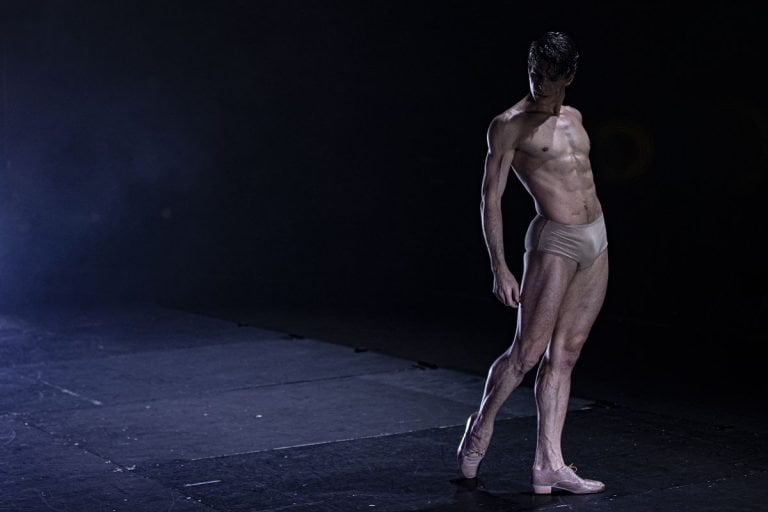
Aterballetto’s Matteo Fiorani performed Philippe Kratz’s Afterimage in a small white three-sided box in a backstage area of Nova Gorica’s Slovene National Theatre. Kratz is an extraordinarily inventive choreographer, even when restricted to the confines of a 6-metre square performing space. Fiorani stretched and turned and crouched in his cell with projections illuminating him and the white box – a skilful performance.


Again, in the Slovene National Theatre was the final work, which was by Compagnia Bellanda from Monfalcone, near Gorizia. With femicides dominating the news in Italy recently, Dira Libido by Giovanni Leonarduzzi, who performed it with Claudia Lia Latini, was a punch in the stomach. We, the audience, were so close – in the confines of a round, bright marble foyer – yet did nothing As he cruelly manipulated her body, all we did was watch. Latini is a magnificent performer, Leonarduzzi was suitably frightening, and the athleticism of the choreography on the hard marble floor was admirable and impressive.
It was too short a piece to dampen the mood. We walked out into the late afternoon sunshine, with the shadows of the trees stretching long over the bright green lawn in front of the theatre. It was one of those “it’s good to be alive” moments. An uncommon afternoon of dance in two countries, but one city.