Review: The Royal Ballet’s Like Water for Chocolate – a cast full of debuts
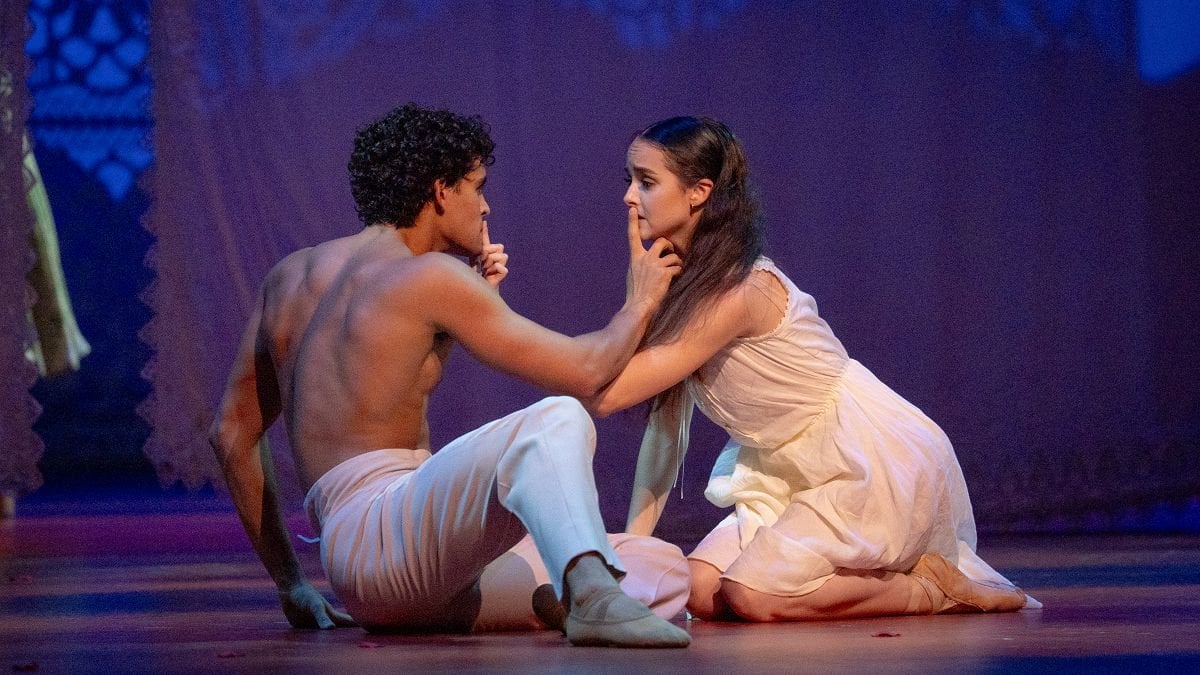
Lily Hyde sees a young cast in Christopher Wheeldon’s Like Water for Chocolate with The Royal Ballet – dancers to watch in an uneven ballet.
| Title | Like Water for Chocolate |
| Company | The Royal Ballet |
| Venue | The Royal Opera House, London |
| Date | 23 October 2025 |
| Reviewer | Lily Hyde |
The phrase Como agua para chocolate which gives Laura Esquivel’s fantastical novel its title, comes from an idiomatic phrase meaning ‘your emotions are in danger of boiling over’. Adapted into a ballet by Christopher Wheeldon, Esquivel’s tale of Tita, a woman who cannot help but imbue the food she makes with her emotions, the issue is not that Tita’s emotions are in danger of boiling over, but that they are completely unconvincing.
Revived for the first time since its premiere in 2022, as the piece approached the end of its run, a more junior cast took to the stage, starring Ella Newton Severgnini, starting her third year at the Royal Ballet and already a First Artist, having danced Olga in John Cranko’s Onegin and the titular role in Wheeldon’s Alice’s Adventures in Wonderland last season. Her Tita is frothy, ebullient, and girlish when dancing with Pedro, brought to life with suitably roguish energy by Soloist Francisco Serrano.
The pair bring a musicality to Wheeldon’s jaunty choreography, swinging their legs like pendulums and spinning playfully across the stage, until they are interrupted by Mama Elena, Soloist Isabel Lubach in a star-making turn.
Cold, austere, and contemptuous, Lubach steals the show, creating a menace on stage that is both spectral and physical. Her power is evident, and though she succeeds in contorting and twisting her children into her supposed ideal, we get the distinct impression they will always fall short.
Equally impressive was Nicol Edmonds as Dr John Brown, who brought a considered strength to Wheeldon’s arabesques and lifts as well as the gentle, stalwart energy he brought to Prince Gremin in Onegin earlier this year. He’s such a pleasure to watch that I couldn’t understand why Tita doesn’t make it work with him.
The rest of the cast were on fine form; Sumina Sasaki brought a despondent fury to her Rosaura, and Marianna Tsembenhoi as Gertrudis was a burst of vitality and technical aplomb, but neither character is given enough space within the ballet to make a meaningful impression.


Wheeldon’s pacing has never been his strongest suit; there are minutes in his ballets in which nothing happens, and seconds in which everything happens. In Like Water for Chocolate, this is to the detriment of the story. Some sequences, like Gertrudis’s rose-petal frenzy, go on for far too long, but major plot points like Roberto’s death pass by in seconds. Ultimately, it renders a story about the powers of emotion and the devastating consequences of suppressing them strangely unemotional.
As many reviewers before me have pointed out, Laura Esquivel’s magical-realist novel hardly screams ballet, but I think the world presented is believable and compelling; Bob Crowley‘s peach melba production design brings the Mexican heat to a rainy London, and Joby Talbot’s score might be his most accomplished to date, but a soundscape of buzzing insects and squabbling babies seems to suggest that even Wheeldon finds his world lacking.
The ballet has an awkwardness to it, be it the seemingly endless transitions of corps de ballet members bringing out tables and chairs or the continual flood of Tita’s emotions, which is so overwhelming that, despite being the intended anchor of the piece, it actually threatens to unmoor it.
It takes a very strong cast to navigate you through the story’s emotional arc, and unfortunately, I think the performance buckled from the weight of so many debuts and would have fared better with a more balanced cast containing dancers with a variety of experiences.
As successful as some double debuts have been in the past, I think both Newton Severgnini and Serrano would have benefited from debuting with a more established partner. There was a slight uncertainty, which meant I didn’t really believe in their relationship, and, unfortunately, without a compelling central dynamic, the ballet somewhat collapsed in on itself.


Of the three full-length ballets Wheeldon has created for the Royal Ballet, Like Water for Chocolate is by far the weakest; it is ill-paced, clunkily staged, and the corps are used more effectively as stagehands than they are dancers.
Having closed the 2024/2025 season with a revival of Wheeldon’s Alice’s Adventures in Wonderland, staging Like Water for Chocolate as this season’s inaugural production only highlights how many shortcomings they share: an overly-long first act, a lack of clear emotional definition, and self-referential, meandering choreography. Watching these two productions back-to-back, it is easy to arrive at the conclusion that Wheeldon is a choreographer who has failed to undergo any meaningful development in the last fifteen years.
That is not to say that the ballet or the performance I saw was without merit. Newton Severgnini and Lubach have confirmed themselves as dancers to watch, and the ballet flourishes in moments of conciseness; the third act is an incredibly strong and exhilarating twenty-five minutes. The ballet’s climactic pas de deux was phenomenally danced and thrilling to watch. Beautifully supported by Guest Singer, Nancy Holt, Newton Severgnini and Serrano brought an exultant relief and devastating intimacy to their dancing – what a shame those aspects weren’t baked in earlier.


Lily Hyde is a cultural and dance writer based in London. Her writing has appeared in The Fence and The Creative Independent, and she runs the cultural newsletter, Falling Upwards. She is currently writing her first novel.