Interview: Meet Nikisha Fogo, San Francisco Ballet’s new Principal Dancer

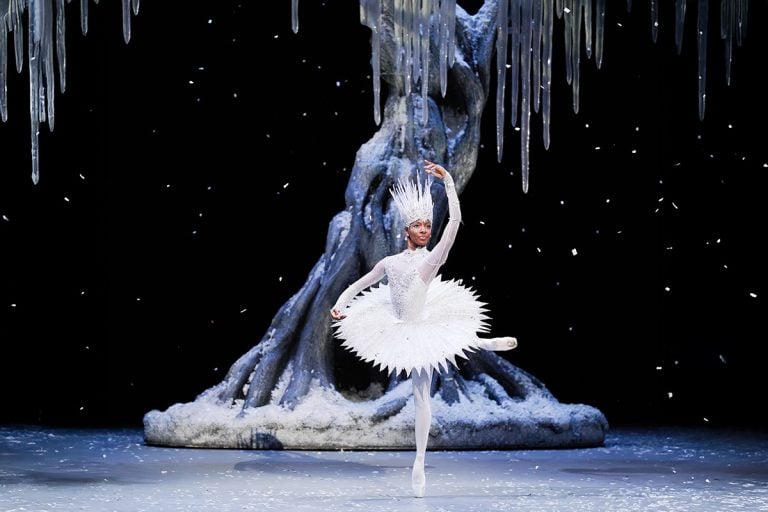
Swedish ballerina Nikisha Fogo will soon take up a new position at a new company when she becomes a principal dancer at San Francisco Ballet. After seven years with the Vienna State Ballet, passing through the ranks from the corps de ballet to the company’s highest rank, first soloist, director Manuel Legris‘ decision to leave the company after ten years (he will take over at La Scala in December 2020) was a stimulus for her to move on.
When the Opera House in Vienna cancelled its performances from 11 March, Fogo stayed in Vienna, unsure whether it would be possible to finish the season, unable to go home to Sweden, or head to San Francisco to find an apartment and settle in.
Lockdown
Strange times, Nikisha!
Especially for dancers. We’re used to moving in big spaces and being able to jump around, and that’s not possible at the moment. But at the same time, it’s been an interesting journey: everyone’s in it together, and I think there’s a chance to grow with having more time than we would normally.
At the beginning of the lockdown, I just took my time to relax and just chill a little, but now I’m doing classes at home, and there was even the chance to be in the studio in Vienna because the company organise Zoom classes with just one dancer, one pianist, and one teacher. So that was really nice to be back in the studio – alone, but with my colleagues watching me through the camera.
It’s a surreal time. What are your plans now for moving to San Francisco?
It’s all a big question mark. Now I’m in Vienna as we weren’t allowed to leave because we didn’t know what would happen. So we are waiting, the whole company is waiting to know when we can come back to work. There’s also the question mark regarding going to San Francisco. I’m supposed to start in July, and I finish in Vienna at the end of June, so let’s see.
I don’t have an apartment or anything yet in San Francisco. It’s really strange not knowing when you can go and also where are you going. And when I can leave, will I be able to go home to Sweden beforehand? With all my luggage?
Beginnings

When people ask me where I’m from, and I say, “Oh, I’m from Sweden,” I always get a funny look because I don’t look typically Swedish: my mom is Swedish, and I was born in Sweden, and my dad was born in England, but his parents are from Jamaica.
Fogo is my father’s name and means ‘fire’ in Portuguese, and I feel like it’s a fitting name for me, especially when I’m on stage: energetic and fiery. In Sweden, I was probably the only Nikisha, but when I went to Jamaica last summer to dance, there were more Nikishas, which was different for me. I’m used to standing out and being a little bit different.
Both my mom and dad were dancers. Not ballet dancers, but show dancing and hip hop, and sometimes background dancers for artists. They met in London when my mom worked there, and when they decided to move to Sweden, they opened the first, or at least one of the first, hip hop dancing schools in Sweden.


Because of their background, my sister and I were always dancing. There was music playing all the time at home, and we danced and danced, sometimes in front of the mirror… it was always kind of a party at home. It was very happy. I went to dance school to do hip hop, tap, and all of that, and I really enjoyed myself.
My sister doesn’t dance anymore – she’s a singer, and I’m really proud of her. But I wanted to dance even more, and going to the Royal Swedish Ballet School meant I could dance also during school hours, which was really interesting for me.
So you left behind hip hop and tap for good?
If I’m with my friends and there’s dancing, I do, but I don’t take any classes. If I slipped on a pair of tap shoes now, I could do it, but I’d be very rusty!
Why ballet?
I was always interested in ballet from watching the Vienna New Year’s concert every year. I was fascinated by the ballerinas. Ballet is a good beginning for all dancers, giving a good ground to stand on. If you have ballet, you can move forward in any direction in dance, and that’s one of the reasons why I thought it was a good idea to go to the ballet school. When I started, I fell in love and just focused on ballet.

When Fogo was nine, she started attending the Royal Swedish Ballet School, but her life changed dramatically in 2011.
You participated in the Prix de Lausanne, just after your 16th birthday.
I went to Lausanne, and although I didn’t reach the finals, the competition gives you the chance to show yourself to different schools, so I got offered a lot of different scholarships, and I’m really grateful for that opportunity. I didn’t get any prize, but if you don’t win it doesn’t mean you can’t make it. Gailene Stock, the director of the Royal Ballet School at the time, spotted me and offered me the chance to come to the school.
They put me up a year, so I did the second year and third year of the Upper School. I was with Marcelino Sambé, Matt Ball, Anna Rose [O’Sullivan], Esteban Hernández… a lot of talented people. We were a very good year; we pushed each other to be better, and we learned from each other. It was a really good time.
Then came auditions, as your time at The Royal Ballet School was coming to an end.
The Vienna audition was the first audition that I did outside of England. It was very nerve-wracking because I did the open audition. There were a lot of people there, and auditions are a stressful situation to be in, but it was fun in the end. Manuel [Legris] let me get through to presenting my solo, and then I made it through having a talk with him. He told me he was interested and would let me know. Two or three weeks later, on 18 January, which is my birthday, I got the call to say that I had got the contract. That was a really nice gift! I started in September.
Vienna


So in September 2011 you became a member of the Wiener Staatsballett.
I began in the corps de ballet, and I worked my way up the ranks.
The company has a similar, mixed repertoire to San Francisco Ballet. The interrupted current season includes new commissions, works by Forsythe, McGregor, Duato, Van Manen and Kylián, alongside modern classics by MacMillan, Ashton, Cranko and Balanchine, as well as the 19th-century classics Coppélia, Le Corsaire, and Sylvia.
I feel really lucky, as in Vienna I’m doing everything. I am happy that I’ve been able to have a part in almost every piece. I guess I’m kind of used to jumping from contemporary to classical and vice versa – it’s hard, but it’s also very exhilarating.
Going from contemporary to classical actually feels like it helps me with the classical. Sometimes it’s nice to break away from the typical ways of doing things and maybe see things in a different way and approach classical steps with different eyes. I always find that after I’ve come back to the classical, I’ve improved in some way by even not doing classical work. Maybe going from classical to contemporary can be harder because you’re used to being formal.
Your ‘big break’ came in 2018 when you were chosen to dance the title role in Legris’ new production of the ballet Sylvia.
Manuel is very good at seeing the potential in people and then giving them the chance to explore and prove that they can do something. He encourages a lot of young dancers.
I was the first person to do the role of Sylvia, which was very special – to have a role created for you is incredible. Not many people can say that. The ballet is very demanding, but I love that… I love the challenge.
Legris must have had great faith in you because it’s a long and difficult role, requiring a lot of stamina – so many jumps!
Jumping is kind of my thing, so that was ok, but it was my first full-length ballet. To carry a whole ballet is different than if you come in to do one solo and so on. Knowing when to push more and knowing when to hold back was challenging for me in the beginning, because I was just pushing through with everything I did. This is also good, but in the long run, you want to be able to do the last part of the ballet well too! It was something new for me, and I really learned a lot from that.
Yet after seven years with the company, you’ve decided to move on.
I’ve really had a good time in Vienna, and I feel that I’ve developed nicely. I’ve never been given something that I couldn’t handle, and I’ve had chances to dance many nice things, including Balanchine, which I really enjoy.
I love working with Manuel because he’s a great coach. If you get the chance to be in the studio with him, you learn so much, and he knows how to pull out the best of you. I really enjoy that, and I’m going to miss that a lot. But who knows what the future will bring?
I’m going to miss the company too, because I have a lot of really good close friends, and I mean, after seven years in a place, it’s kind of like home. But I’m really excited to explore San Francisco and to meet new people and new friends and learn new things from the company too.
San Francisco

I found out that Manuel was going to leave Vienna, though I didn’t know where – no one knew where he was going for a long time. So, I thought, yeah, ok, I’ve been here a while now, and I think it’s time to explore new places and learn new things.
Last year, San Francisco Ballet was on tour in London. I’d already seen the company when they were in Paris before. I thought, wow, this is such a good opportunity for me to actually do an audition in London because it’s quite hard to do auditions overseas when you’re working. I had some days free from performances, and so there was the possibility to go. It just felt right. So, I went for it, and I took company class in London, and [company director] Helgi Tomasson was there. I got a contract.
So you have a contract as a principal dancer, yet apart from Sylvia, Legris’ production of Le Corsaire and Pierre Lacotte’s Coppélia, you haven’t danced other leading roles in full-length ballets – it will be a steep learning curve in San Francisco.
Yeah. It’s going to be really exciting. I’m excited about that challenge. And I also know that the working process is very different there than in Vienna, for example, or in Europe. We would rehearse for something and then, directly after three or four weeks rehearsing it, we’d perform it. In San Francisco, they have a performing season, so they start by learning all the pieces in the season. So that’s also going to be interesting.
Your moving date is now up in the air, but you went to San Francisco last year.
I went for the first time last summer. I was dancing in a gala in Mexico and thought that it was a good opportunity to check it out. I was there for four days, but unfortunately, I got food poisoning from a restaurant, so I couldn’t do class, and then when I did a tour of the building, I was feeling so bad that I don’t remember anything I saw, as I was just concentrating on not being sick!
Well, they say a bad dress rehearsal means a great opening night.
Yes! But it’s going to be tough… especially in the beginning. It’s exciting, though also sad because I’m leaving friends and family such a long distance away.
I’m looking forward to exploring new roles and different roles from the ones I’ve done so far. And artistically, I’m really excited too because each company has its own character and energy, and I’m eager to explore that. Obviously, it’s a big deal to become a principal, and I’m excited to take on that task and work really hard.
You have a strong technique, but you are also blessed with big eyes and a wide smile: an expressive face is such a useful tool for a dancer.
I find that when you can express the joy or whatever emotion you’re trying to give off from the dancing, the audience can see when you’re truly feeling it. Also, for me, it’s essential, when you’re with another dancer, to have a connection and communicate with each other, not only through the stepsyou’ve been given. The audience knows when an expression is just stamped on. It’s very important to me, and luckily it comes naturally to me, too.
San Francisco is lucky to have you.
I feel lucky too. I’m looking forward to growing not only as a dancer but also as a person.