Cecilia Bartoli triumphs at La Scala amidst catcalls and boos

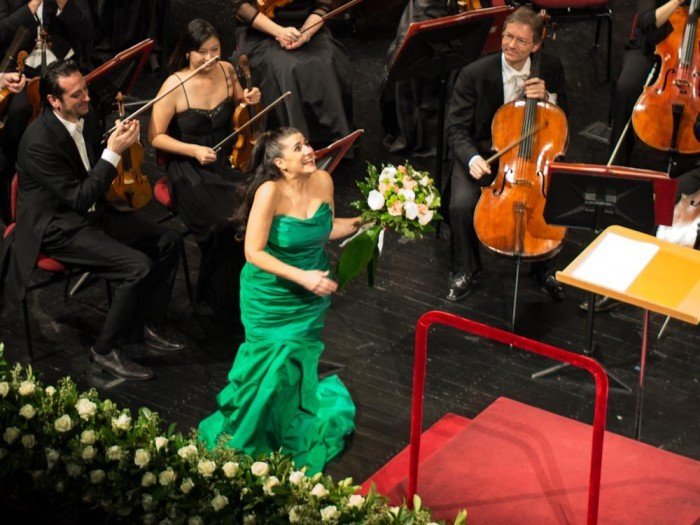
After nineteen years, Cecilia Bartoli‘s return to Milan‘s La Scala tonight was long overdue. Daniel Barenboim was the instigator of the event, the opening of the La Scala Philharmonic‘s season.
An obviously tense Bartoli immediately illuminated the theatre with her smile, though her voice needed a little longer to give the audience what they were expecting. The Handel arias went well, Mozart’s Exultate, jubilate even better, and after the interval she was on top form with two Rossini arias: the Willow Song and prayer from Otello were extremely touching, and with Non più mesta from Cenerentola the vocal fireworks shot in all directions.
However, already during the interval, dark forces were at work!
At La Scala there are groups of (mostly) men, many now white-haired, who plot and plan to destroy an opera, or an artist’s, performance even before entering the theatre. The famous loggionisti (those in the gallery) of La Scala are the opera fans who may come night after night and, in contrast with many in the lower part of the house – corporate seats, tourists – they know the operas, the notes and the libretto, and will praise those who meet their standards of performance and shower whistles (good in a stadium, but not in an Italian opera house where they express an indisputable thumbs-down) on the performer who disappoints. A number of loggionisti however, are far from objective and choose who to promote (many times it’s the overlooked second cast singer) or those to destroy, daring the management to invite them to ‘their’ theatre again (often those who sell many discs, steal the headlines, and have glamorous CD covers). Bartoli has too much commercial success and does not have a ‘big’ voice.
So, distributing themselves carefully around the upper galleries, the bad boys of the gallery waited for Bartoli’s last note to die away before booing and whistling. When Barenboim decided to encore the rondo finale from Cenerentola they started shouting “Poor Rossini”, “Go home”, “Shame on you”, “Not in falsetto this time”, and so on.
Bartoli’s many fans started yelling back and the slanging match continued for five minutes or so. Barenboim put a stop to it by telling everyone to shut up – “This is a concert; tutti zitti!” – and Bartoli got on with her encore. By now a veteran of the stage, she played with the coloratura and indicated her throat as if to say, “Now this is hardly falsetto!” to the handful of booers and thousands of cheerers. The applause was overwhelming.
Bartoli certainly won, but it sort of ruined the party. Bartoli and Barenboim were having such fun together, and the audience was delighted to be in their company. Except for the old men who, sadly, can’t get to grips with the idea that, as Callas is never going to return to this theatre, they ought just to stay at home and play their worn-out LPs.
Footnote:
Italy‘s most important newspaper, Il Corriere, reported that someone called out “Vergogna in tempi di crisi!” (Shame on you in this time of crisis!) referring to Bartoli’s high fees. However, Gramilano heard “Povera Grisi” in response to the loggionsiti‘s cries of “Povero Rossini”, referring to a group of opera ‘fans’ who call themselves after the great Milanese opera singer Giulia Grisi (the first Adalgisa in Bellini’s Norma, Elvira in Bellini’s I puritani and Norina in Donizetti’s Don Pasquale). This group apparently organises booing sessions at La Scala by telephone on the morning of a performance, and then it queues for the cheap day tickets. I wonder if I heard correctly…
Update:
Reuters news agency posted an interview with Cecilia Bartoli on 27 December:
Your concert recital earlier this month singing Handel, Rossini and Mozart with Daniel Barenboim conducting at La Scala in Milan, with a chorus of boos and whistles in the second half, was perhaps less of a success?
This story is repeating what happened to Carlos Kleiber, one of the greatest conductors of our lives, also to (Maria) Callas, (Luciano) Pavarotti. The concert was magnificent – Handel, Mozart, Rossini – and then I believe at the very end there was a very Fellinian situation. You think these things don’t happen anymore, that they only happen in the movies of (Federico) Fellini but actually, no, this is happening. And it seemed like a parody but the next morning I opened the newspaper and (Silvio) Berlusconi is back (in Italian politics). And so I said, ‘Yes, of course.’
I think living in Italy is difficult but living without Italy is impossible.