
Review: Las Estrellas in Rome, with “some of the most brilliant dance and music talents of Spain”
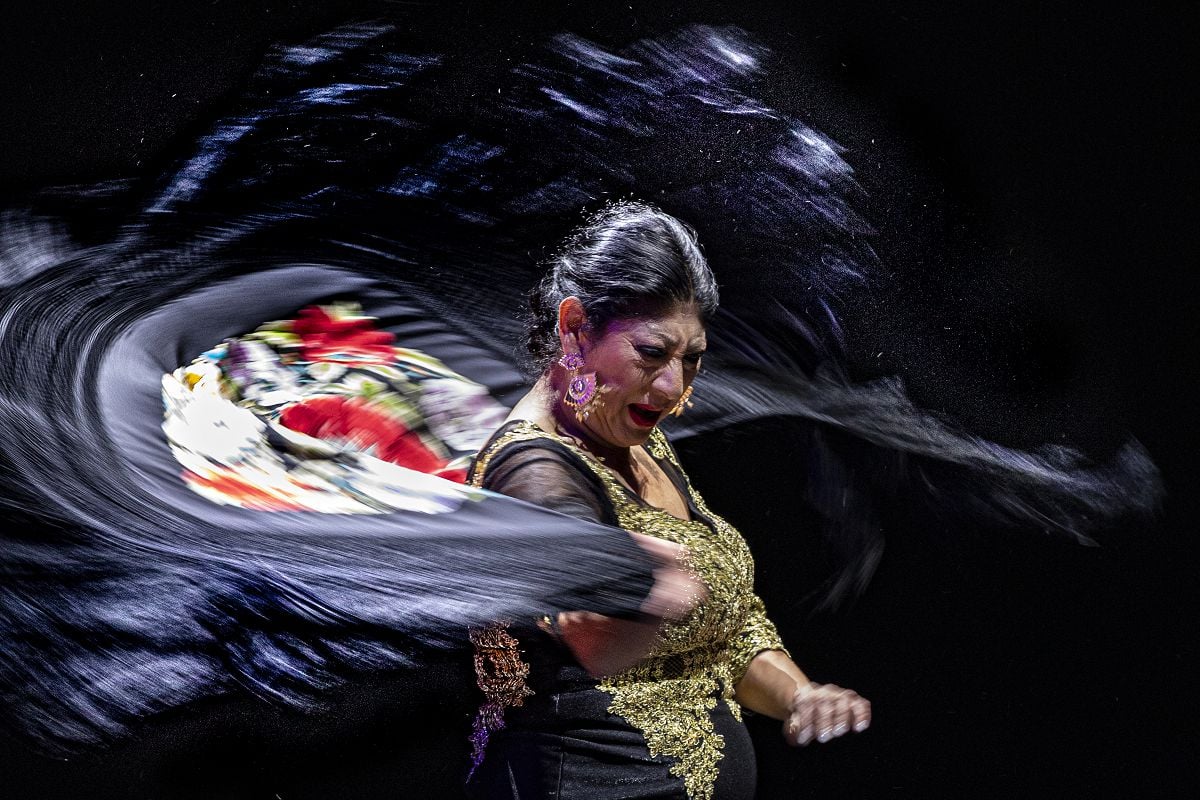
Donatella Bertozzi sees the Las Estrellas gala in Rome featuring a dizzying array of flamenco talent.
| Title | Las Estrellas |
| Company | Daniele Cipriani Entertainment |
| Venue | Auditorium Parco della Musica Ennio Morricone |
| Date | 19 January 2025 |
| Reviewer | Donatella Bertozzi |
Ever since ‘flamenco‘ became synonymous with ‘Spanish dance’ – an unfortunate yet popular misunderstanding alas virtually impossible to eradicate – generations of experts, teachers, scholars, intellectuals, and not least dance critics, have sought to re-establish the notion that ‘flamenco’ is a triadic entity consisting of singing (cante), dancing (baile) and music (toque) and, from a dance perspective, just one component of the rich tapestry of traditions in Spain’s dance heritage.
An event like Las Estrellas – a gala evening that gathered together some of the most brilliant dance and music talents of Spain – was a welcome opportunity to refresh the idea of a multifaceted Spanish dance tradition, while also bringing one up to date with how it is constantly evolving.
Seven leading dancing personalities – Miguel Angel Berna, Sergio Bernal, Manuela Carrasco, Marco Flores, Manuel Liñán, Olga Pericet e Antonio Najarro (in strict alphabetical order) – together with eight fine dancers of Najarro’s own company, and fifteen exquisite musicians (cantaores, tocadores) plus several composers and choreographers, contributed to the evening. The celebrated Spanish pop-rock singer Luz Casal also contributed three songs from her repertoire.
Produced by artistic director Daniele Cipriani, for two consecutive evenings – 19 and 20 January – the programme filled the huge Sala Santa Cecilia (2,800 seats), the largest of the three concert halls in Rome’s Auditorium “Ennio Morricone” designed by Renzo Piano.
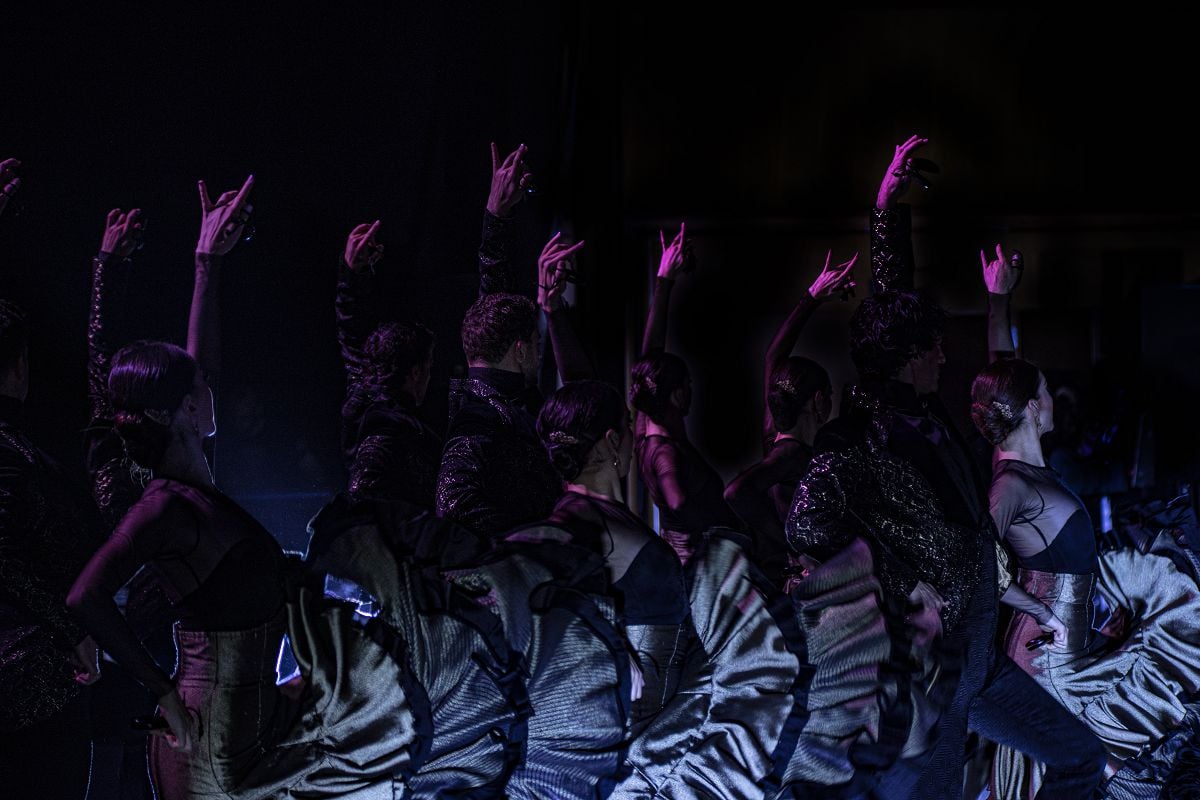
The evening was quite a marathon. It began with a delicate cuadro, almost restrained, in the 19th-century balletic style of the ancient (now rediscovered) escuela bolera, which was beautifully danced on demi pointe by dancers from Najarro’s company, who are also exceptionally skilled in the art of castanet playing.
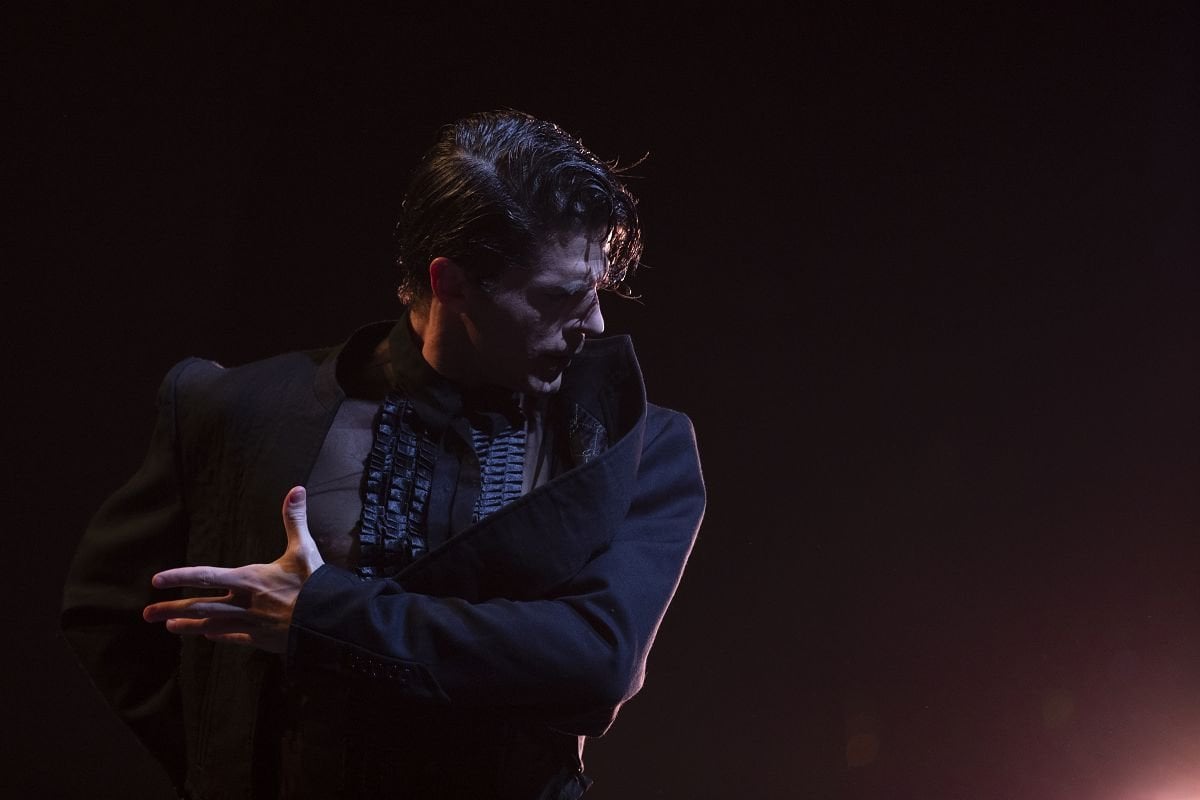
Sergio Bernal, a fine, versatile and talented dancer as well as a convincing choreographer (formerly a star with the Ballet Nacional de España) danced a soléa por buleria, accompanied wonderfully (one should probably say ‘chased’) by the unforgettable flamenco voice of Paz de Manuel, together with guitarist Daniel Jurado and drummer Javier Valdunciel.
Bernal is a skilful technician and embodies a very formal, almost unemotional, kind of flamenco dancing. A similar unemotional formalism was shown in the short solo he composed especially for the song Piensa en mi, sung by Casal with two other songs at the end of part one of the programme. However, later in part two, I found Bernal to be much more interesting, both as interpreter and as choreographer, in his solo Rodin il pensatore inspired by Auguste Rodin’s masterpiece Le penseur (The Thinker). Here the composition had a circular pattern, iconically starting and ending with Rodin’s bronze form which was then poetically blended into dance through a beautiful and effective fusion of movement languages combining flamenco and other forms of dance.


Minute and extremely feminine, like a little flamenco queen in red, Olga Pericet danced a paso a dos with Marco Flores. Flores is an excellent dancer but he, like Bernal, was too formal and affected. Both Flores and Pericet gave their best later in the programme – Flores with Farruca y bulerías, wonderfully and closely ‘chased’ by the formidable trio of musicians, guitarist José Tomás and cantaores Miguel Lavis and Manuel de la Nina. Olga then swiftly changed costume to a pair of assertive, masculine trousers to dance and sing a Siguiriya y Guajir with powerful temperament.
Miguel Angel Berna, a distinguished dancer and choreographer, who specialises in reviving and propagating the ancient culture of jota – a regional form of music and dance still widely practised, especially in Aragona (jota aragonesa) – joined forces with flamenco choreographer Antonio Canales for A tientas and with contemporary choreographer Cesc Gelabert for Jota de Liszt. Powerful and emotional, his solo dancing and exquisite castanet playing received a similarly powerful and emotional response from the audience. I particularly appreciated his second solo – composed to an arrangement of Franz Liszt’s Rhapsodie espagnole – for the elegant mixture of contemporary texture and ancient movement rhythms, with recurring images of the horse’s step. Berna once observed, that if the harsh and savage taste of bullfighting permeates many of the images of male flamenco dancing, it is the elegant gait of the horse that sparkles behind the oldest jota figures).


Manuel Liñán en travesti moved our hearts in Taranto. A bailaor of outstanding qualities, in the first twenty years of his career he reaped success after success and national and international awards. But from when he was a little boy, he had dreamed of performing in the colourful dancing dresses of the bailaoras. He finally realised his dream in 2019 with ¡Viva! a show about queer identity in flamenco that won him the Olivier Award for Outstanding Achievement in Dance in 2023. In Taranto, a witty and finely sarcastic embodiment of decades of the female art of baile, he reminded me of the soulful, universal artistry of Lindsay Kemp. I was not equally enthralled by Liñán’s second solo, Alegrias, accompanied by the same formidable trio of musicians – Francisco Vinuesa (guitar), Juan de la Maria and José Manuel Fernández (cante). Equally sarcastic, but too long and repetitive, the dance became a sheer test of endurance for the both the dancer and the public.


Najarro’s company contributed two more lively cuadros in the style of the so-called danza estilizada, a relatively modern style that adds to the three other Spanish traditions – the escuela bolera, the escuela flamenca and the regional dances. In Najarro’s compositions this is a glamorous form, bordering on television show dancing, properly sanitised of any male-female sensual tension and eroticism, and more akin to the elegant, mischievous frivolity of Broadway. And yet the technicalities were executed perfectly and the castanets played lavishly with endearing bravura.
El duende – that elusive, impregnable spirit of flamenco that any artist yearns to evoke – finally got kindled on stage with the appearance of Enrique El Extremeño, his ancient voice resounding from the depths of Extremadura, one of the cradles of el cante. He introduced the diva (la diosa) of flamenco, Manuela Carrasco, together with five excellent musicians, and suddenly the holy balance of the gypsy flamenco soul, entered. Carrasco, in a black and golden monumental dress, was scarcely moving at first, letting only her wildly free hands follow el cante. Then after a long while of only following the voice she confronted the music, taking full command. And there and then, the potentially endless dialogue of singing, dancing and playing that informs flamenco opened its wings.
In the traditional Fiesta finale, the commanding forces of Carrasco (who had come back on stage in a blazing red dress) and El Extremeño, led the colourful mass of dancers and musicians to bathe repeatedly in well-deserved rounds of applause.



Donatella Bertozzi, dance critic and journalist, has been writing about dance since 1980.
A keen watcher of all sorts of dance performances from an early age, while still completing her professional training as a dancer – studying both classical ballet and modern dance techniques in Rome and London – she began writing dance reviews for various daily newspapers. In 1986 she joined the Performing Arts desk of the Rome daily Il Messaggero as chief dance critic. Besides reviewing national and international dance performances, she was later asked to write a daily dance column covering dance events in Rome which she then went on to compile for twelve years (2002-2014). In 1988 thanks to a British Council scholarship she attended the London Laban Center, studying with Valerie Preston Dunlop, Clement Crisp and Alastair Macaulay.
In over forty years as a dance critic she has contributed to numerous Italian, and some international, magazines, tv and radio programmes and lectured extensively about dance and dance history.





So well informed. Thank you.
Not having seen the production, but based on the few photographs , the sets and costumes are a refreshing change from the awful , kitschy schlock that one usually sees in this ballet …….