Review: Ballet Nights 007, Pillars & Pioneers – new work by regular contributors and fascinating new finds
Graham Watts sees the seventh iteration of the Ballet Nights brand – inevitably a mix of hit and miss but the hits are well worth it.
| Title | Ballet Nights 007 – Pillars & Pioneers |
| Company | Ballet Nights |
| Venue | Cadogan Hall, London |
| Date | 1 April 2025 |
| Reviewer | Graham Watts |
This was the seventh iteration of the Ballet Nights brand, and one must pay tribute to Jamiel Devernay-Laurence and his team for persevering with a project that must be as commercially fragile as it is artistically appealing (well, mostly).
The Cadogan Hall is not generally regarded as a venue for dance and there are plenty of reasons for that. There are no wings and only very limited opportunities for set and props. Although I appreciate the commercial limitations, the early iterations of Ballet Nights worked much better in the mix of big stage and intimate surroundings at the original and rather quirky home of the Lanterns Studio Theatre.
That space included a Yamaha piano donated by Elton John and somehow the space and the instrument added something special to Viktor Erik Emanuel’s traditional musical opener, which created added value. Ironically, in this concert venue, that was not so much the case: Emanuel appeared to start a little nervously in his opening performance of Liszt’s Grandes Etudes De Paganini although his virtuoso pianism picked up with the work’s progression; but frankly I could really have done without Antonio Bazzini’s Dance of the Goblins in which Emanuel accompanied the violinist, Michael Bochmann. In keeping with the nature of the event, the exuberant Bochmanndanced around the stage like an eager violinist negotiating the tables at an old Budapest café, but the output was sometimes barely audible up in the gallery. Why waste up to 20% of the performance time in an event entitled Ballet Nights with non-dance contributions?
This Ballet Nights iteration was sub-titled Pillars & Pioneers and the USP of Devernay-Laurence’s curation is to mix new work by regular contributors with fascinating new finds that are rarely if ever seen in London.
The UK debut performance of the 20-year-old Ballet X from Philadelphia met this gold standard of newness. It’s probably stretching a point to call it a UK debut of a 16-strong, full-time ensemble when the performance was simply a duet, but the muscular, passionate, fluid dancing of Francesca Forcella and Jared Kelly to three songs by Amy Winehouse in an excerpt from Big Ones, choreographed by the fast-rising Trey McIntyre, left me eager to watch the full ensemble in the complete ballet; so it’s either saving for a trip to the States or hoping that someone (hello, Dance Consortium) sees the sense in bringing the whole company here. Fingers crossed!


The second breath of fresh air came with Blacbrik’s excerpt from Death of the Bachelors. This pair of extraordinary dancers are Nahum Mclean and Darius Drooh, and I have some previous with them having seen their performance of Episodes of Blue in The Place’s Resolution festival, last year. They genuinely seem to be rubber-limbed, and their harmony seems spontaneously intuitive. They are experts in the whole-body emphasis of Horton technique which although US-based draws influences from world dance. I will beg or borrow any ticket to see Blacbrik dance again. They are the coming trend, and it was the highlight of the show.
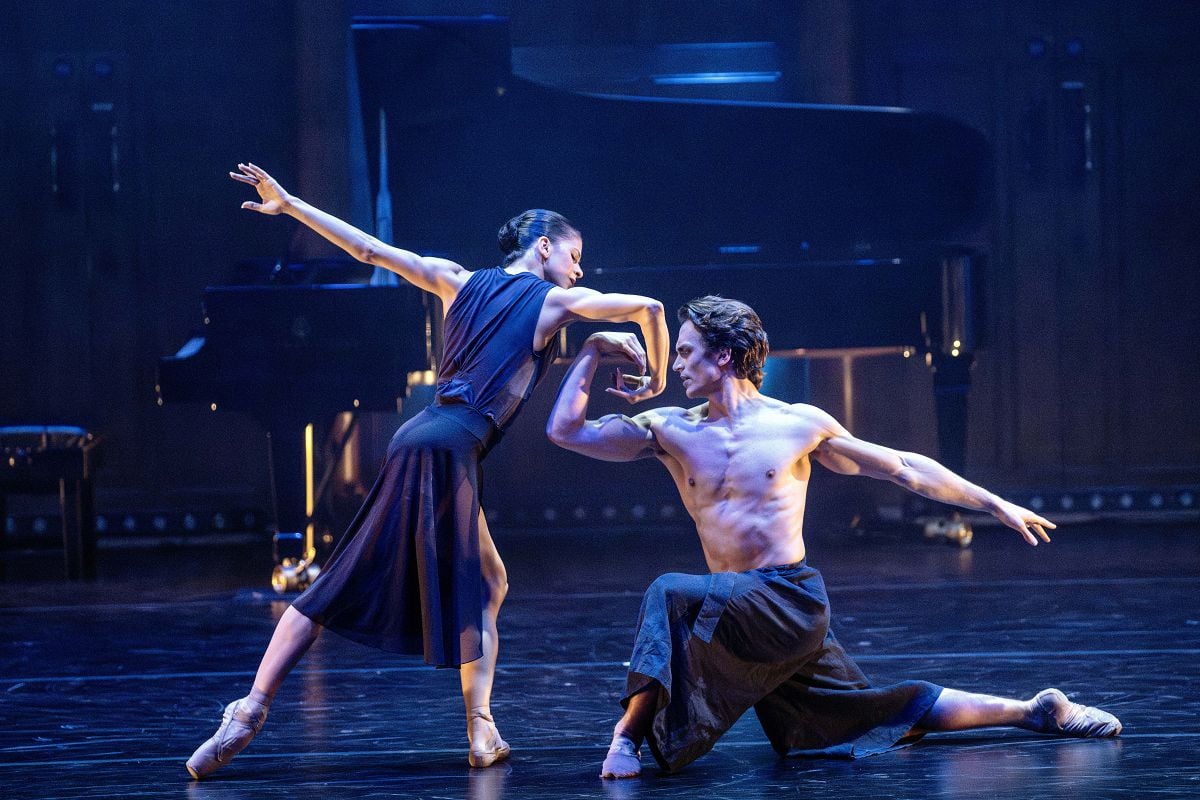
Another noteworthy performance came in Matthew Ball’s (Re)Current, which closed the show, self-performed by Ball and his partner, Mayara Magri. Unlike Ballet X they are hardly new to the London stage (in fact I had seen them both perform at The Royal Ballet in recent days) but Ball doesn’t get much opportunity to show his prowess as a choreographer and on this evidence (coupled with To and Fro at the recent Ballet Icons gala) he has an outstanding ability to make exceptional partnered dance on a small scale. It helps to have complete confidence in each other, but the pair produced some breathtaking lifts – one transition from the floor into a complete overhead, upside-down lift was so seamless that it seemed super-human. I’m looking forward to more of this and I hope Ball gets the chance to make some work on his home company.


Another plus was the opportunity to see 18 students from the Rambert School dance a long extract encompassing several episodes from Sir Richard Alston’s Roughcut, which coincidentally, the current school director, Amanda Britton, performed in when it was first created. We rightly rave over Merce Cunningham as one of the great contemporary choreographers of the 20th Century and I think that Alston stands right up there alongside him. His work – as here – sometimes has the structural feel of a later Cunningham piece but firmly embossed with Alston’s own inimitable neoclassical seal. The Rambert students did the work and the evening proud, fitting in alongside the professional dancers with aplomb. As an aside, I still feel very aggrieved at the way Sir Richard appeared to be discarded by the UK dance community. Quite rightly, we rage against a plethora of “isms”, but ageism seems to be alive and well in the UK dance scene.
Another plus was James Wilton performing an extract from his own choreography to Bach Reimagined partnered on the dance floor by Sarah Jane Taylor and at the side of the stage by electronic cellist, Raphael Weinroth Browne, whose long hair danced along with the piece. It took a while for him to set up the sundry equipment necessary to play the looped sound, but the wait was worth it. Again, the duo gave a wow factor in dance of extreme physicality.
Two other pieces came and went quickly in the first act, beginning with Madeline Squire’s Echo Echo, danced by her colleagues at Scottish Ballet, Kayla-Maree Tarantolo and Harvey Evans. The (uncredited) lighting effect was interesting, and it was an intriguing fresh take on the structure of a pas de deux. This was followed by Mara Galeazzi’s solo (Safe From Sleep by Marco Pelle) to the ubiquitous music of Arvo Pärt. It’s 33 years since Galeazzi joined The Royal Ballet (and twelve since she left) and she is still performing memorably. Her port de bras is a masterclass for all aspiring dancers.


Ballet Nights tries to set itself apart from the run-of-the-mill gala (and does it generally very well) so why on earth bother not even with a full black swan pas de deux but – believe it or not – just Odile’s variation, shorn of all its context other than the black tutu. I have never seen this cut-down capsule attempted before and I hope never to see it again. This is no slur on Shiori Kase who rattled the variation off as well as could be expected in these diminished circumstances, but honestly, it was hardly worth getting changed for.
Victor Caixeta gave a longer account of Eric Gautier’s ABC, a parody of ballet told against the recitation of the alphabet. I’m a fan of Gauthier and have often laughed at his Ballet 101 piece, which has long been a gala favourite of virtuoso male dancers. I’m not sure if that piece has run out of steam but ABC is – uniquely – a parody of his own work since structurally and conceptually it is identical to Ballet 101 (the narrator’s voice is even the same) and there is a similar mid-piece joke (no spoilers here). Caixeta danced it with appropriate verve.
The consistent star of Ballet Nights is the dapper figure of Devernay- Laurence himself as an enthusiastic and charismatic compere, introducing each act with a mix of interesting information and hyperbole. He was a prominent soloist at Scottish Ballet and dancers are not often (if ever) confident in the role of public speaking. Devernay- Laurence does it excellently and in doing so brings another significant air of contrast to the Ballet Nights brand. It is inevitably a mix of hit and miss but the hits are well worth it. Long may it continue, even at this new home venue of Cadogan Hall (I need to get into training for all those stairs)!