
Review: Momentum with London City Ballet – astonishing maturity
Graham Watts sees London City Ballet’s return to London with Momentum – the company deserves every success.
| Title | Momentum |
| Company | London City Ballet |
| Venue | Sadler’s Wells, London |
| Date | 13 September 2025 |
| Reviewer | Graham Watts |
For a part-time company entering just its second season – after a 30-year hiatus – there is an astonishing maturity about London City Ballet, as evidenced in all four of these works, but none more so than with an outstanding performance of Alexei Ratmansky‘s Pictures at an Exhibition.
Ratmansky made this 35-minute work, in 2014, for New York City Ballet, partly as a retirement vehicle for Wendy Whelan (after 30 years with the company) and Whelan subsequently staged the work for Pacific Northwest Ballet in Seattle, in 2017. I was privileged to see a revival of the PNB production, slightly revised by Ratmansky following the Russian invasion of Ukraine (the ending featured a Ukrainian flag as a backdrop). And I can give no better credit to Christopher Marney‘s fledgeling company than to say that this performance was at the same level of maturity as that of an established 50-year-old company of some 50 dancers.
The ten dancers of LCB caught the quirky diversity (sometimes classical, sometimes casual), vivacity and building momentum in this visual interpretation of Mussorgsky’s masterpiece, in the solo piano reduction, played here superbly by Reina Okada, situated slightly disconcertingly at the front of the orchestra stalls.
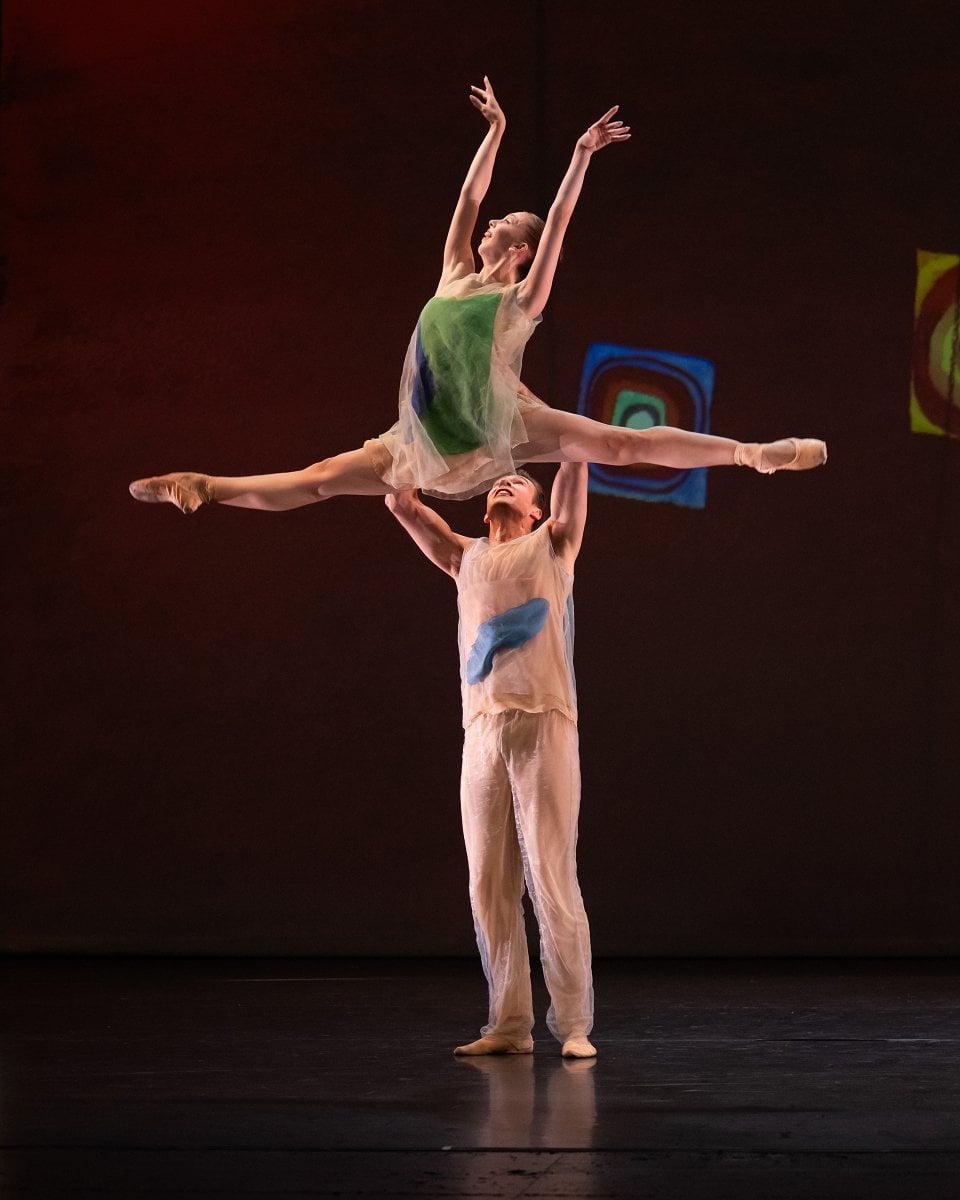

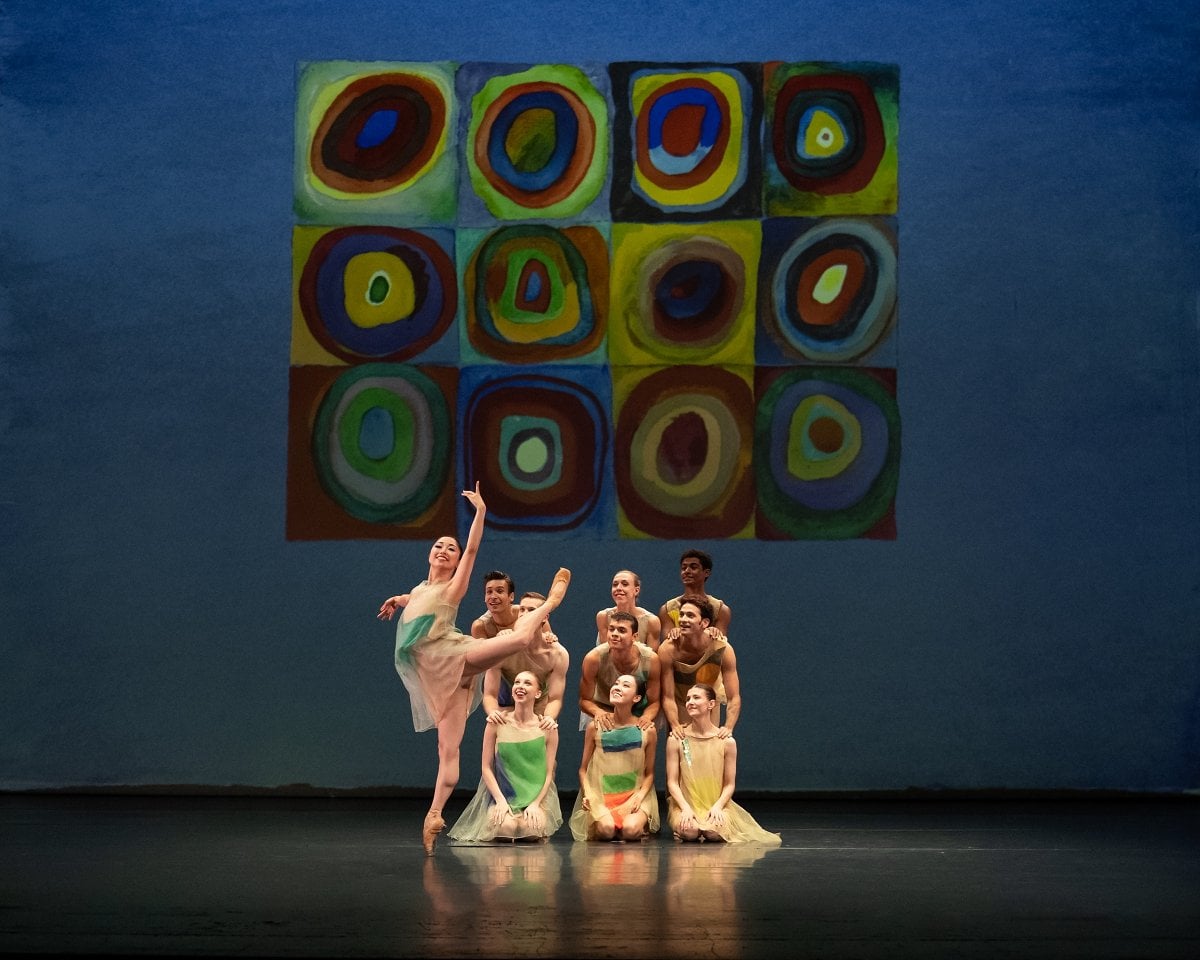

Pictures at an Exhibition was composed as an elegy to the painter Viktor Hartmann, a friend of Mussorgsky’s who died, aged just 39, in 1873. His life is celebrated by the composer in an aural tour around a gallery of his pictures, which are evoked in Ratmansky’s ballet by a changing backdrop of colourful projections by Wendall K. Harrington (his musings on Wassily Kandinsky’s watercolour, Color Study, Squares with Concentric Circles). The colours conveniently allow for a merger into that Ukrainian flag at the end, aligning naturally with the closing movement of The Great Gate of Kyiv and adding extra significance and poignancy to the work.
It says something about the choice of repertoire that, for me, the weakest work was Balanchine’s Haieff Divertimento, another ensemble piece, danced by five couples wearing black and white rehearsal clothes. Set to five movements (over fourteen minutes) created by the little-known Russian American composer, Alexei Haeff, it was made by Balanchine in 1947 and stayed in the repertory of Ballet Society (forerunner of New York City Ballet) for just five years, being reconstructed in 1981, 1994 and 2020.


To be frank, these disappearing acts and periodic revivals are for a reason, giving credence to the idiom that even the greatest artistic geniuses produce work that is not always of the same level. It has a certain free-flowing charm, and the dancing was never less than elegant, if generally unmemorable, washing over me like a nice warm shower on a cold day. The lead couple, Jimin Kim and Alejandro Virelles, danced beautifully in the Aria section; and Kim again impressed in the later Lullaby solo.
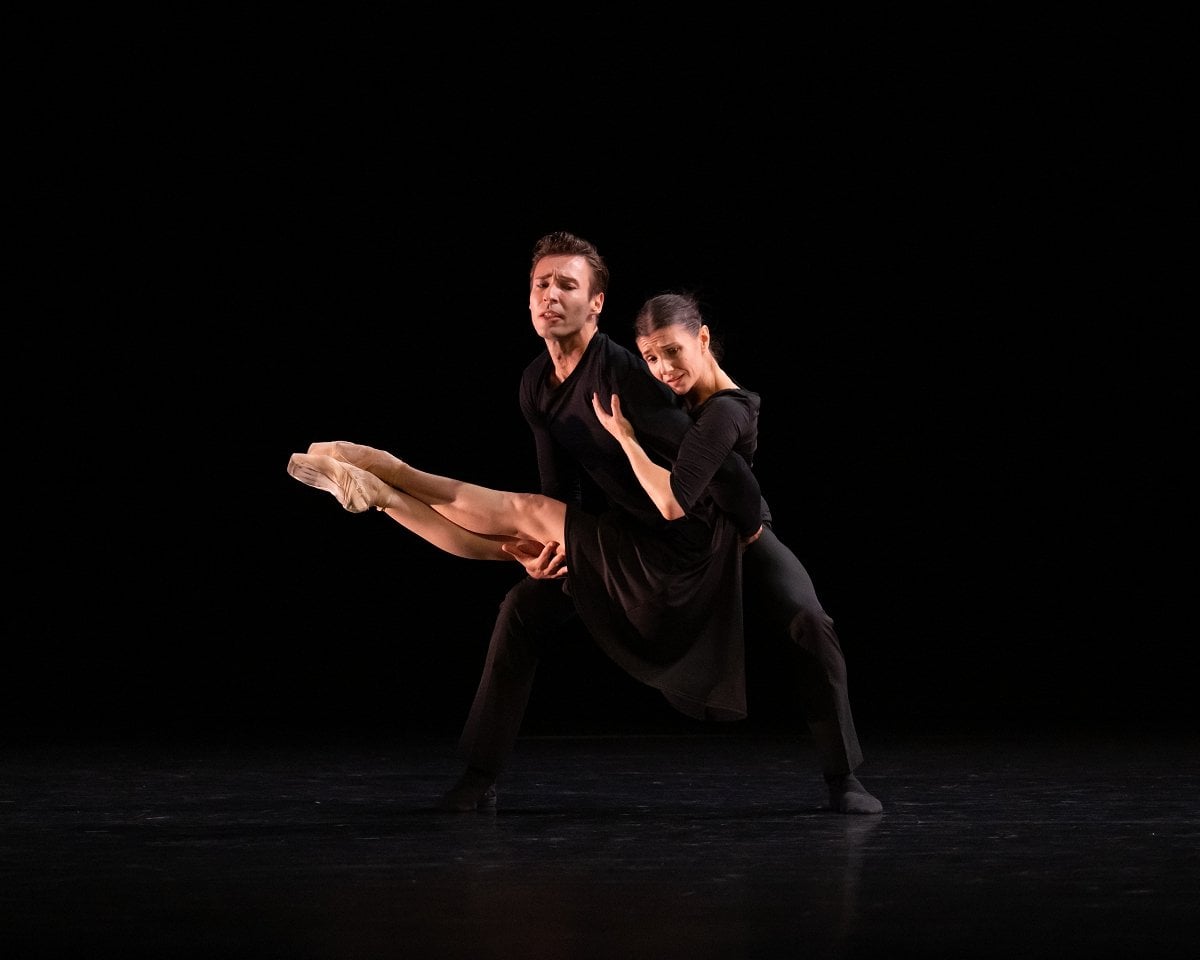
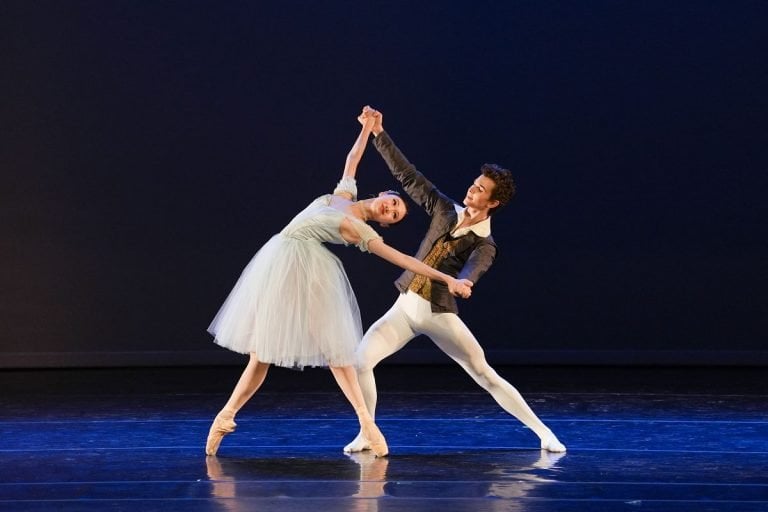
It is wonderful that – four years on from the tragedy of his death – we are seeing more of Liam Scarlett’s work once again and Consolations and Liebestraum was a timely reminder of his choreographic genius and the sadness of what was lost. LCB may be a pop-up company for only part of a year, but it has a roster of outstanding elite dancers, none more so than in the perennial artistry of Alina Cojocaru who opens and closes the work and brings mesmerising dancing and dramatic, poignant expression to Scarlett’s haunting choreography.


Four other superb dancers ended the first act in Soft Shore, a new work by a fresh choreographic talent, Florent Melac, a premier danseur at Paris Opera Ballet. It is set to two melancholic works by Beethoven whose music is often described as undanceable. But like Hans Van Manen, Uwe Scholz and Mauro Bigonzetti (to name but three) before him, Melac has had the courage to take on the composer’s uniquely complex structures. His delicious swirling, floating choreography for two couples was full of dramatic lifts, interweaving fluidly and elegantly in mesmerising alignment with Beethoven’s music. Constance Devernay-Laurence and Alejandro Virelles were stunning together, as were the male pairing of Joseph Taylor and Arthur Wille, who is surely an emerging dancer to savour.
Part of LCB’s business model is that it only operates for one brief season each year and I doubt that any company has made such an indelible impact in such a short space of time. This all-too-brief Sadler’s Wells season is the eighth of a 20-venue tour between June and November that also travels to Portugal, France and Spain. The company deserves every success and with this degree of quality across the board, I can only see its sphere of operation widening in future.

Graham Watts is a freelance writer and dance critic. He writes for The Spectator, Tanz, Shinshokan Dance Magazine (Japan), Ballet Magazine (Romania), BachTrack and the Hong Kong International Arts Festival and has previously written for the Sunday Express, Dancing Times, Dance Europe, DanceTabs, London Dance, the Edinburgh International Festival and Pointe magazine (USA). He has also written the biography of Daria Klimentová (The Agony and the Ecstasy) and contributed chapters about the work of Akram Khan to the Oxford Handbook of Contemporary Ballet and on Shobana Jeyasingh for the third edition of Routledge’s Fifty Contemporary Choreographers.
He is Chairman of the Dance Section of The Critics’ Circle and of the UK National Dance Awards and regularly lectures on dance writing and criticism at The Royal Academy of Dance, The Place and (until the war) for Balletristic in Kyiv. He was a nominee for the Dance Writing Award in the 2018 One Dance UK Awards and was appointed OBE in 2008.



Just “hear hear”, Graham!
Sounds marvellous