
Review: Hofesh Shechter’s Theatre of Dreams – magical and compelling
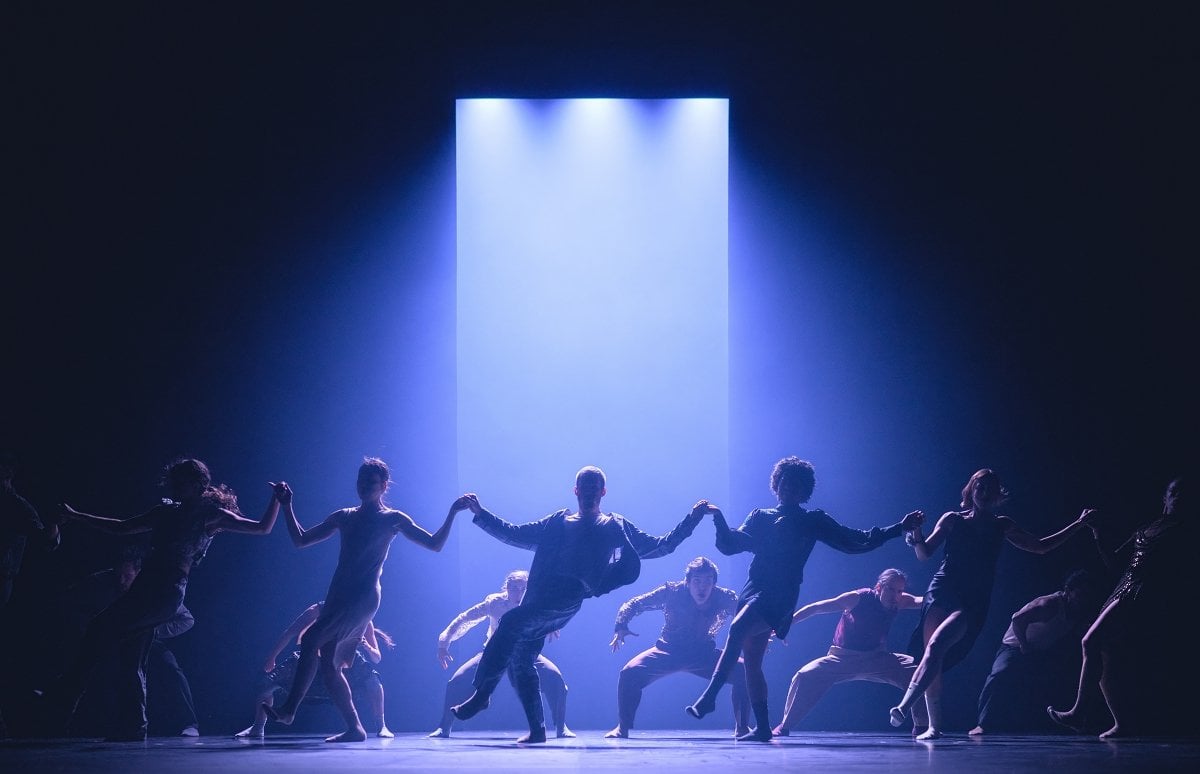
Lily Hyde sees the return of Hofesh Shechter Company’s Theatre of Dreams to Sadler’s Wells – an overwhelming sensory experience.
| Title | Theatre of Dreams |
| Company | Hofesh Shechter Company |
| Venue | Sadler’s Wells, London |
| Date | 15 October 2025 |
| Reviewer | Lily Hyde |
With the house lights still up, a solitary figure climbs onto the Sadler’s Wells stage. As the audience quietens, we hear a soft bass thrumming as amber light peeks between the curtain covering the stage. A small triangular opening reveals itself, and as the dancer begins to enter it, the house lights dim and we see only darkness. And then –
Hofesh Shechter‘s Theatre of Dreams, a co-commission with Sadler’s Wells and multiple international venues, premiered in Paris last year and won much critical praise, including an Olivier nomination. Revived a year after it first appeared at Sadler’s Wells, the fervent hum of the audience suggests a real appetite for dance which, in Shechter’s words, “is one of the best mediums to explore the complicated feelings we have about who we are and how we are.”
The piece begins with a tableau of fleeting visions, the company’s movements both frenetic and intricate. I hate to use the phrase ‘blink and you miss it’, but that is the genuine case as the company moves at the speed of light between positions, their movements taut, sharp, and devastatingly precise, creating a sense of scale usually felt in a company three times their size.

Time quickly loses meaning as a carousel of moments is presented to the audience. Nothing ever lingers long enough to give you a story, but it’s an overwhelming sensory experience that demands you give yourself over, and much like in a dream, accept the futility of looking for any meaning.
In the programme notes, Shechter says, “I would love people to watch the work without trying to overly analyse it or understand it,” but it doesn’t stop one from trying. The most resonant comparisons were not to other works of dance, but films like Alfred Hitchcock’s Vertigo and David Lynch’s Mulholland Drive (there’s a moment the stage is bathed in a Klein Blue light, which felt like an homage to the latter), but these are films notable for mystifying audiences with their lack of definitive meaning.
Perhaps this is because Shechter himself eludes comparison. Pina Bausch and Martha Graham are worthy names to mention, but the comparisons feel somewhat lacking; there is an intelligence to Shechter and his company, two steps ahead and quick to dissuade you of any notions about what Theatre of Dreams is.
Aided by the production design – Osnat Kelner’s disparate costume design, Tom Visser’s aggressive lighting, and Set Collaborator Niall Black’s design of thick black curtains and tabs, which charge about the stage as actively as the dancers – Shechter’s world is fragmented, closer to a hall of mirrors than any kind of fixed reality. The most significant part of this, however, is the score created by Shechter with collaborator Yaron Engler. In parts ethereal and gentle, in others, an aural assault, it is mercurial and complex. Soft jazz gives way to thrumming techno and strains of Molly Drake’s I Remember make a recurring appearance – a taint of nostalgia perhaps, but for what, we shall never know.


The company works with all of the above to its advantage. Their dancing, both vivacious and spirited, enables them to demonstrate a complete mastery of their craft. Even the moments of stillness, such as watching their synchronised chests rise and fall, are compelling to watch.
There seems to be a recurring theme of exclusion – sometimes a dancer will sit and watch, or crawl as the rest of the company charge across the stage, but they always reintegrate back into the company’s thronging mass. When the dancer we saw enter the world at the beginning of the piece re-emerges from the curtain, he is swiftly dragged back inside it.
It’s a piece which, at just over ninety minutes, demands a lot from its audience, including a call to dance with the company, but nearly every audience member rose to their feet. There seemed to be a sadness present amongst the scattered laughs as one of the dancers announced, “You can go back to your seats.”
There is no arc to the piece, but it builds towards the end, swapping brief glimpses of smaller worlds into a frenzied group number, but all too quickly, it melts away. The dancers stand and look to the back of the stage. We do not know what they see, and as we are pulled away from the world, knowing that we will not get an answer, it’s hard not to feel a sense of loss, as one does with any brilliant dream coming to an end.
Shechter has created something magical and compelling that is open to endless interpretation. Considering its revival a mere year after its much-lauded premiere, I am certain this is a piece that will return to mystify and delight audiences again and again.

Lily Hyde is a cultural and dance writer based in London. Her writing has appeared in The Fence and The Creative Independent, and she runs the cultural newsletter, Falling Upwards. She is currently writing her first novel.



I’m afraid I’ve been the victim of too many ‘aural assaults’ from Mr Shechter in the past to risk ever seeing his work again. I didn’t think it was healthy for my ribcage to be bouncing off my internal organs, nor indeed to risk becoming deaf in my old age.