Review: ASTITVA with Jaivant Patel Company – a choreography of power and beauty
Graham Watts sees the Jaivant Patel Company, which has stamped an indelible – and unique – mark on the British contemporary dance scene.
| Title | ASTITVA |
| Company | Jaivant Patel Company |
| Venue | The Place, London |
| Date | 4 March 2026 |
| Reviewer | Graham Watts |
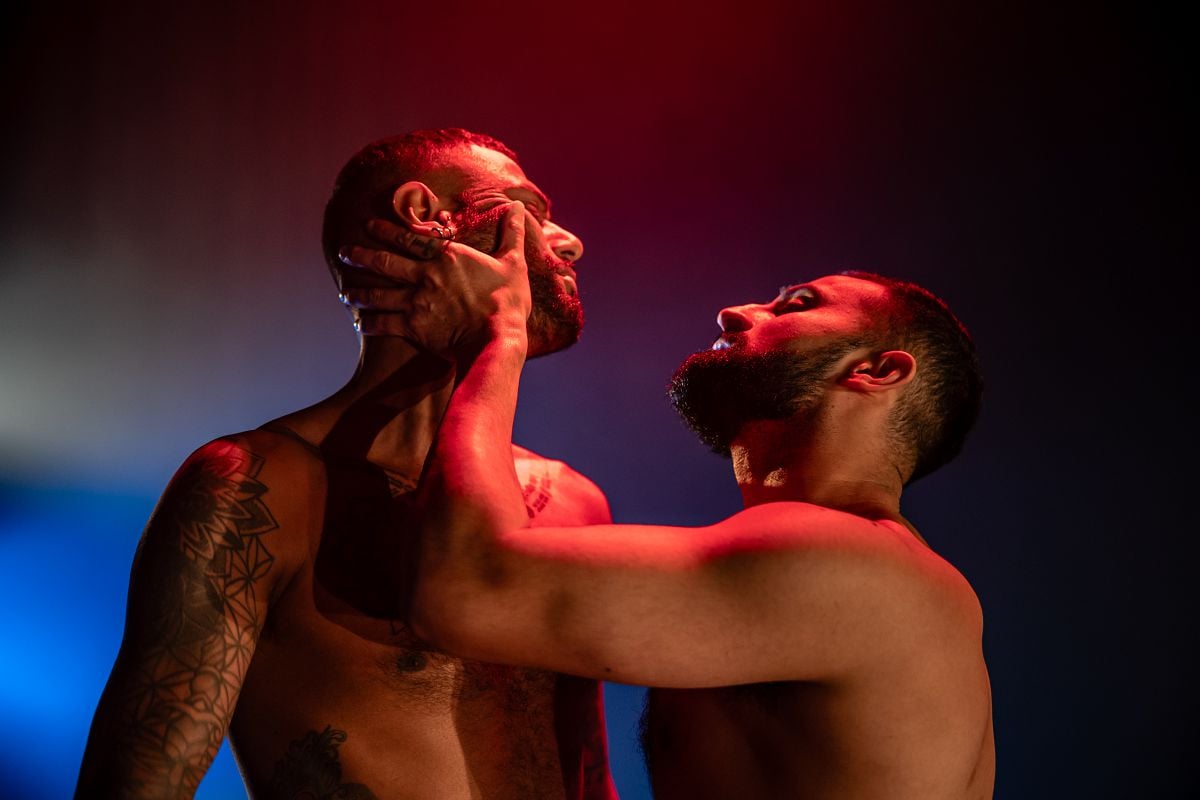
I think that Jaivant Patel has managed some kind of alchemy by encapsulating his life story, or perhaps, more appropriately, his lived experience, into an hour of dance. This autobiographical work explores the complexities of balancing cultural traditions and personal identities and sexuality, specifically drawn from his own experience of being a gay man rooted in Indian and South Asian culture. His lived experiential mix has led to the creation of work that merges LGBTQ+ essentials with contemporary dance and Kathak, and ASTITVA is the pinnacle of that rare, if not unique, achievement to date.
The title is a Sanskrit/Hindi term that signifies existence, the state of being alive or the essence of something real. Patel has used it as an envelope for his moving portrayal of what it is to be a gay man in British Indian communities, expounding on this through a journey that navigates sexuality under the pressure of familial and cultural expectations that takes place in four distinct sections: Seeking, Desire, Acceptance and Love.
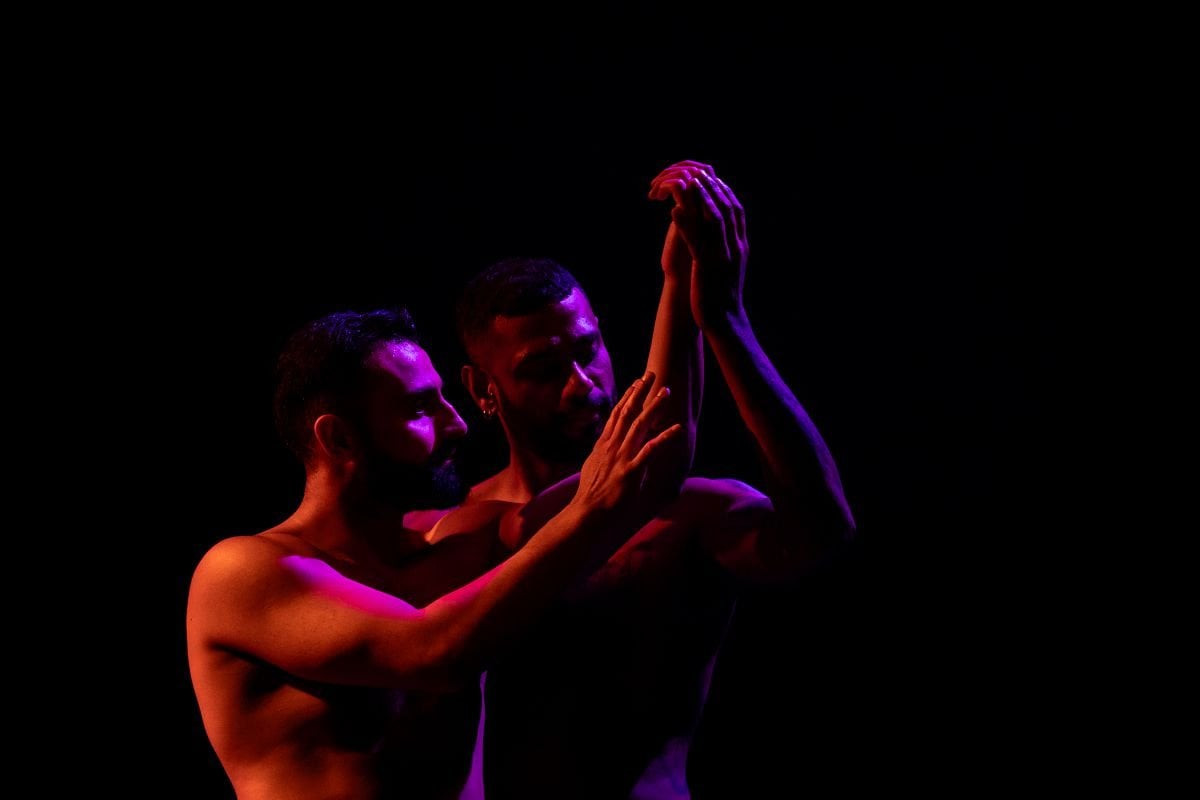
The starkness of the work is emphasised through the bareness of the black box stage with KJ’s lighting being the key that unlocks the various stages of the journey. The audience took their seats to a soundtrack of the 80s and 90s – looking back, I recall an extract from Madonna’s La Isla Bonita and perhaps snippets of Beyoncé and Freddie Mercury, but I may be mistaken since there was a lot of background chatter!
There are just three performers – Amar Bains, Dom Coffey and Mithum Gill – and it isn’t clear whether their characterisations are distinct, or different versions of the same man, or perhaps, more likely, a mixture of both. What was abundantly clear were the tremendous fluid and meaningful interactions between these three outstanding performers in this slowly simmering work.
The original score, by Alap Desai, was a pleasing mix of classical Hindustani music, in a style known as Raag Darbari, characterised by a melancholic mood, that was first created for a Mughal emperor in the sixteenth century, and which had a strong bass-driven rhythmic quality. The freesheet that accompanied the performance had a particular insight into the relevance of Raag Darbari to ASTITVA, which is worth repeating here: ‘In this reimagined (royal) court, Patel’s message is clear: this is his space now, where queer South Asian stories are visible, empowered, celebrated!’


Each performer has a solo, accompanied by their own spoken text, beginning with a kind of aggressively delivered “not me bruv” refusal to accept the character’s true sexuality and gradually moving through the phases of desire and acceptance through casual sexual encounters, concluding with a powerful and beautifully intense duet that broadcasts the arrival at Love. The choreographic exposition of these interspersed physical relationships was achieved with great sensitivity and tenderness, which could only have been possible through the attention to detail in creation by a gay man who has lived through the intersection of his sexuality with such matters of race, gender, spirituality and faith.
This performance was very far from my own lived experience, in terms of sexuality, race, culture and faith, but at the end I was moved by the power and beauty of the choreography, aligned with excellent performances and merged with the other original creative elements of music and lighting.
Jaivant Patel’s Company was founded in his home city of Wolverhampton in 2006, and his reputation has been quietly simmering for the past 20 years. It’s interesting to note that the many accolades won by the company and its founder have come in recent years. His fusion of contemporary and South Asian dance forms is aimed to be consumed by diverse audiences, and, with ASTITVA, it seems clear that Patel has stamped his indelible – and unique – mark on the British contemporary dance scene. We look forward to the next chapter.


Graham Watts is a freelance writer and dance critic. He writes for The Spectator, Tanz, Shinshokan Dance Magazine (Japan), Ballet Magazine (Romania), BachTrack and the Hong Kong International Arts Festival and has previously written for the Sunday Express, Dancing Times, Dance Europe, DanceTabs, London Dance, the Edinburgh International Festival and Pointe magazine (USA). He has also written the biography of Daria Klimentová (The Agony and the Ecstasy) and contributed chapters about the work of Akram Khan to the Oxford Handbook of Contemporary Ballet and on Shobana Jeyasingh for the third edition of Routledge’s Fifty Contemporary Choreographers.
He is Chairman of the Dance Section of The Critics’ Circle and of the UK National Dance Awards and regularly lectures on dance writing and criticism at The Royal Academy of Dance, The Place and (until the war) for Balletristic in Kyiv. He was a nominee for the Dance Writing Award in the 2018 One Dance UK Awards and was appointed OBE in 2008.