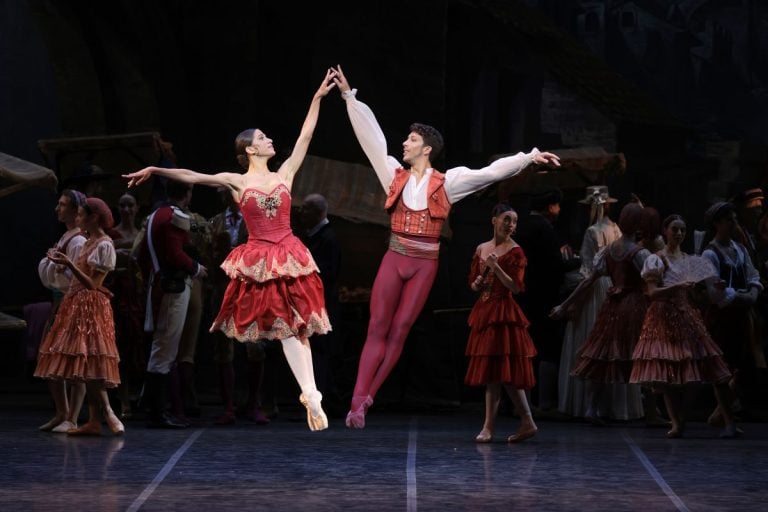
Review: Winning Works – The Joffrey Ballet and The Grainger Academy present 5 world premieres
Scott C Morgan sees Winning Works in Chicago – invaluable for all the featured choreographers and their young dancers.
| Title | The 16th Annual Winning Works |
| Company | The Grainger Academy of The Joffrey Ballet Conservatory, Trainees and Joffrey Studio Company |
| Venue | Museum of Contemporary Art, Chicago |
| Date | 12 March 2026 |
| Reviewer | Scott C Morgan |
It’s always heartening to see world-premiere dance works set on young artists on the cusp of professional careers. That’s exactly what is served up in the 16th Annual Winning Works repertory program featuring dancers from the Grainger Academy of The Joffrey Ballet Conservatory, Trainees and Joffrey Studio Company.
The Joffrey Ballet’s annual choreography contest is an international call for minority artists of African, Latinx, Asian, Arab, and Native American backgrounds. It’s the Joffrey Ballet’s way of seeking out the next wave of dance makers who can help refresh or offer new directions for young ballet artists. In some instances, pieces that debuted via Winning Works have entered the professional repertoire of the Joffrey Ballet.
Winning Works for 2026 fielded five choreographers, many of whom are or have made the transition away from being professional dancers themselves. The eclectic program featured opening video clips of rehearsals for each piece, with the choreographers explaining their approaches along with interviews from some of the young dancers.


The opening piece was To Carry Our Own Names by South Korean native and former Oklahoma City Ballet principal dancer DaYoung Jung. Jung prefaced that her piece was deliberately abstract; one could easily make symbolic meanings from much of the movement.
Jung devised a murky and low-light world for her black-clad ensemble of dancers, each often interconnected with each other. Now and then, a spotlighted individual would break free, only to have the mass of other dancers constantly pulling the brief soloist back into the fold.
Could this be a commentary on individuals unable to break free from the scrum of society around them? Or is there safety in conformity?
Jung worked very closely with lighting designer David Goodman-Edberg to dimly illuminate this grasping world set to music by Alfonso Peduto and Philip Daniel. Thanks to angled onstage lighting fixtures, a frantic mass of dancers’ silhouettes also spilled out beyond the theater’s proscenium to only add to the sense of dread and ominous movement that Jung conjured up for To Carry Our Own Names.


Choreographer Alexandra Schooling also emphasized that her piece Hushed Power was also an exploration of abstraction, though her use of the term “granular” gave an almost evolutionary or developmental theme to the piece.
Hushed Power featured an all-women ensemble in shimmery earth-toned shift dresses (The Joffrey Ballet Costume Shop was credited for designing or sourcing all of the outfits for Winning Works). Schooling started all of her dancers low to the ground, as they mostly rolled across the stage in various configurations.
As the piece progressed through its score featuring music by Debussy, Gregor Quindel, Christin Sinding, and Anonymous Choir, the dancers eventually worked their way to dancing on pointe. This included runs and heightened slides across the stage, while still on pointe.
Could the choreography of Schooling, a dancer who joined Oklahoma City Ballet in 2016, be a symbolic examination of a geological evolutionary process? Or maybe Hushed Power reflects the developmental growth of dancers finding their footing as they age from children to teens to young adults?


Closing the first act of Winning Works was a more comic-turned-tragic work by New York City-based dancer-turned-choreographer Daniel Ojeda. Visitors focused on a red-shoed man (Jake Lapham) who exudes awkwardness and reticence.
Though dressed in gray like everyone else, this man comes across as the perpetual outsider as he observes other dancers who have better Latin rhythm. So many of the man’s mawkish attempts to join in and to get close to a distant girl in green (Elsa Herr) are thwarted by the more with-it ensemble who shake their hips to Gideon Broshy’s score featuring selections by Cuba Quartet, Jeremy Stewart, and The BOMB Pulse.
There’s also an element of time running out. The sound of a hospital heart monitor starts to dominate the final third of Visitors as the girl in green starts to check out more and more. Perhaps Ojeda is making a statement that we should be brave enough to follow through and seize the day, since who knows when our time will be up.

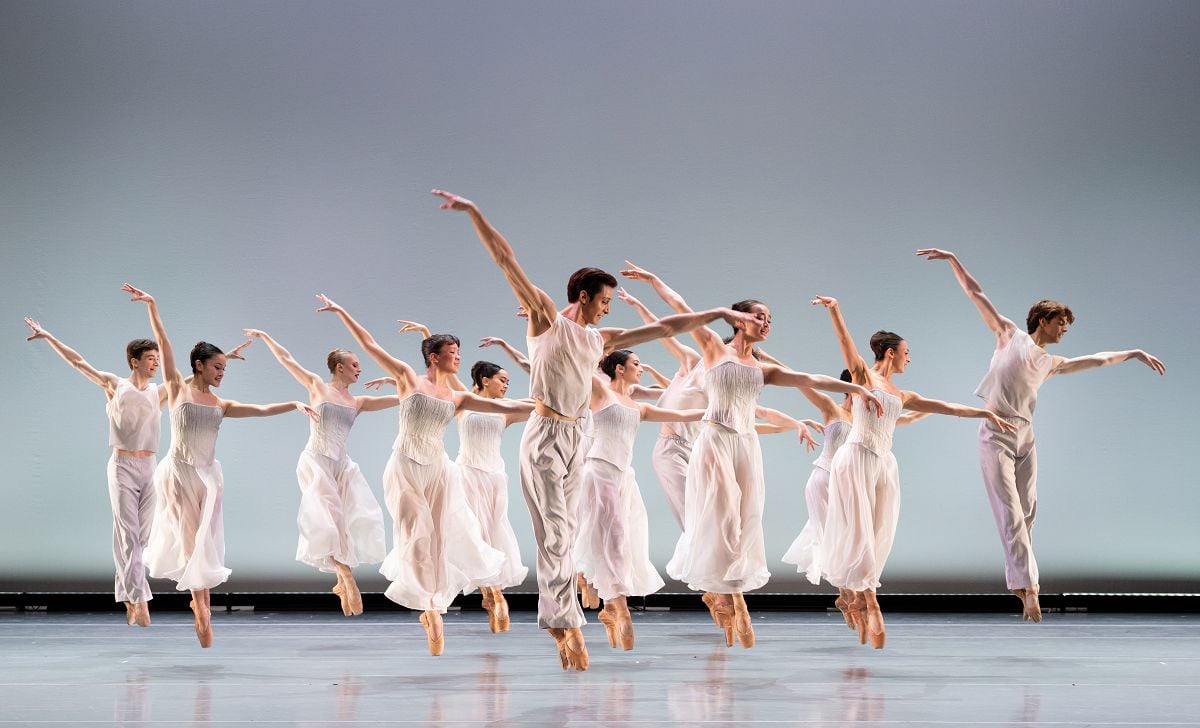
Sacramento Ballet Company Artist Julia Feldman is next on tap with Éclat. Feldman’s abstract ballet work features a large ensemble swirling to the propulsive The Chairman Dances by composer John Adams.
Though this music piece is an orchestral synthesis of themes featured in Act III of the Adams/Alice Goodman opera Nixon in China, don’t expect to see any communist farm laborers waving their little red books in the faces of exploitative landowners. Feldman defiantly divorces Éclat from the music’s earlier context for a heavy dose of swirling and geometrical classical ballet dancing.
With flowing white skirts among the all-white outfits, Éclat certainly has a breezy, summery feel, as the grinning dancers take great joy in showing off their strong technique and skills. But as someone who has seen the 2011 Metropolitan Opera production of Nixon in China by director Peter Sellars and choreographer Mark Morris, Éclat perhaps only felt like a tonal mismatch to me compared to other audience members unfamiliar with the origins of The Chairman Dances.
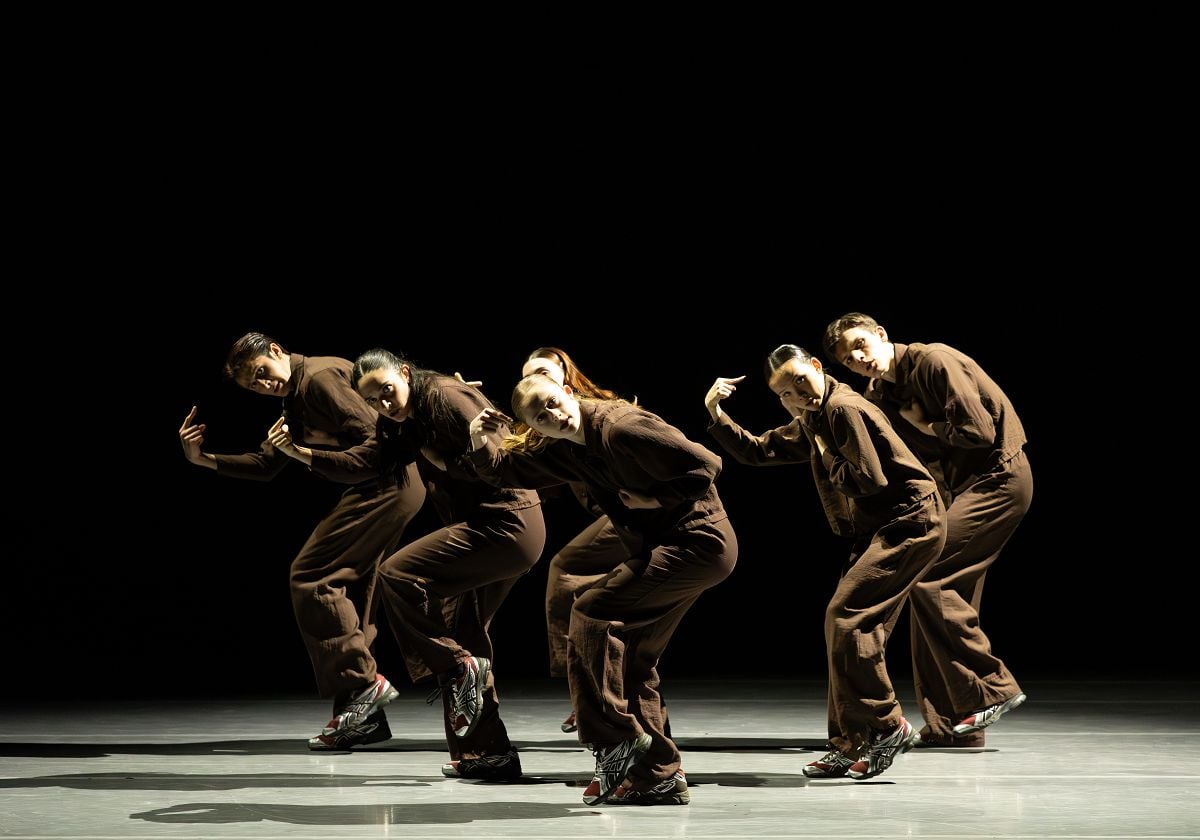

Concluding the program was Berlin-based Spanish choreographer Fran Diaz with A Strange House We Must Keep and Fill.
Set to music by Yantó, A Strange House We Must Keep and Fill features a smaller ensemble of dancers, all dressed in similar brown jumpsuits, with tightly wound, jabbing choreography. Uniformity in movement to the beat seemed to dominate throughout, and the dancers even chanted aggressively toward the end with the repeated expression “Our House!”
Rather than a classical ballet approach to the choreography, Diaz’s piece felt almost like a response to the surge of TikTok-style hip-hop choreography that has dominated so many of small screens in the pockets of today’s youth. Though not the typical dance piece you would expect to be set on a ballet company, A Strange House We Must Keep and Fill certainly showcased how classically trained dancers have the strong foundations to adapt their bodies and keep with the times with a mastery of their movement.
I can’t say if any of the 16th Annual Winning Works will be entering into the current rep of the Joffrey Ballet any time soon. Yet, this production is certainly invaluable for all the featured choreographers and their young dancers, as it challenges them together to expand movement horizons through world-premiere pieces that may point to the art form’s future.

Chicago-based Scott C. Morgan is an avid opera and theatergoer. He is a frequent freelance contributor to the Windy City Times, and previously served as that publication’s freelance theater editor from 2008 to 2018. He also worked primarily as an arts writer for the Daily Herald in suburban Chicago from 2004 to 2022.
He has raised donations as an endurance race runner for AIDS Foundation Chicago via its charity training program Team to End AIDS from 2011 to 2023, and also co-hosted two Opera Tunes fundraisers at Chicago’s famed Sidetrack Video Bar in 2019.