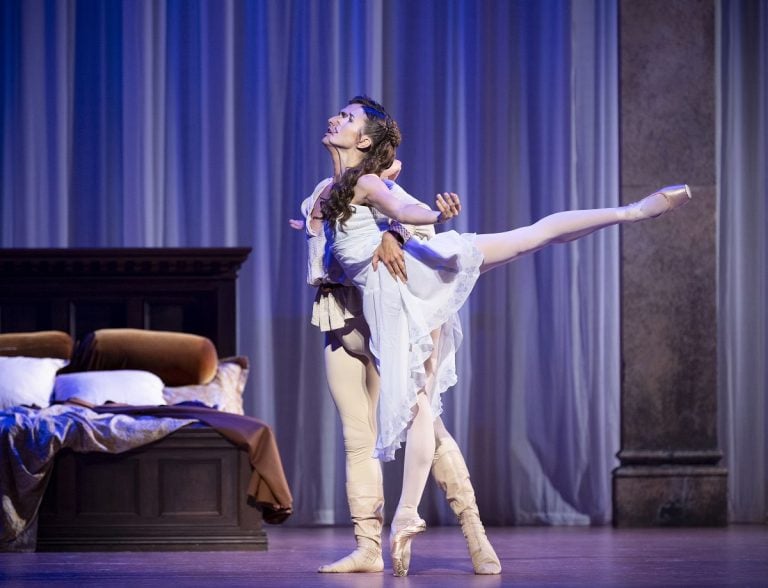
Martina Arduino and Claudio Coviello as the star-crossed lovers at La Scala

The roles of Romeo and Juliet are unexpectedly hard to bring off in ballet. In the play, the timbre of the voice and meaning of the text explain what the two are thinking and feeling, whereas, using just body movements, it is difficult to hit the right tone, and during Kenneth MacMillan‘s masterpiece at La Scala, it was sometimes a little off-pitch.
Romeo is the easier role of the two: he is knowing, he flirts with the women around him, physically he is bold. The problem in playing Juliet is that she is only 13 years-old, sheltered and with her nurse a constant presence; just observing Paris from the other side of the room makes her breathless. It is difficult to play young if you are sixteen or sixty, and sometimes – as in the first act of Giselle – she can come over as being mentally deficient. Martina Arduino didn’t always strike the right note in the earlier scenes when she improbably passes from a little girl semi-frozen by the frisson of a light touch to a surprisingly sensuous and passionate young woman in the balcony pas de deux. It is fiendish to judge. Manon is somewhat similar, but her character starts out much further down the line of experience and her generosity with her affections shows that she is no Juliet.


It was a role debut for Arduino so, whatever, an impressive one. She came into her own, however, in the later scenes when she could forget about playing ‘young’ and concentrate on her character’s infatuation and impulsiveness. Her third-act dilemma when she sits almost motionlessly on her bed and passes from confusion to decision was beautifully portrayed; a glorious theatrical moment which can suck energy out of the scene like a black hole if badly played. Arduino’s interpretation of the final scene was achingly true, as was that of Claudio Coviello, and both ‘played dead’ in a frighteningly convincing manner. Unfortunately, Arduino is too tall for Coviello who gamely coped with all the lifts, but it looked uneasy. She seemed more at home with Gabriele Corrado (Paris) who memorably stepped in at the last minute as Romeo in 2014 to partner Marianela Núñez.
Coviello’s acting skills have matured over the last couple of seasons and he communicates amply and effectively to La Scala’s large auditorium. He is a dancer’s dancer, a textbook of precision and dazzlingly assured steps. Arduino’s strong technique and aplomb – she was excellent in her principal debut in Ratmansky’s Swan Lake last year – makes her a perfect choice for a Kitri or Aurora. Here’s hoping!


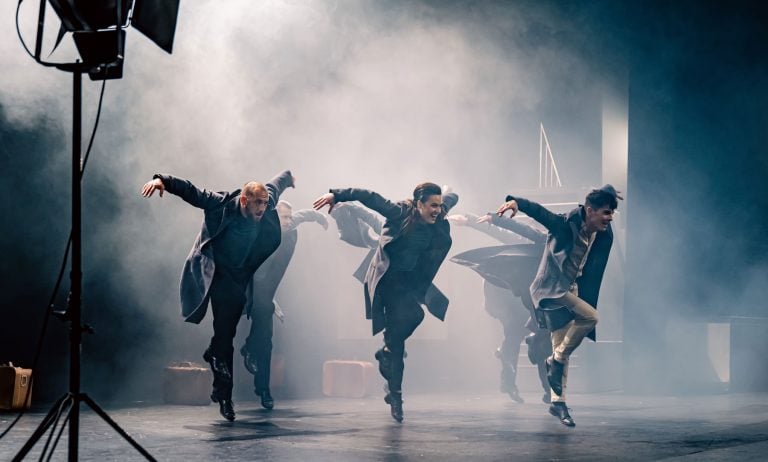
Christian Fagetti, making his debut as Mercutio, has found an ideal role. He is a dancer who fills the stage and is theatrically bold in his intentions. The choreography gives him no problems so, together with Marco Agostino as Benvolio and Coviello, he was part of an effortlessly synchronised pas de trois before the three friends join the Capulet’s ball.
Maria Francesca Garritano sparkled her way across the stage as one of the harlots, all flashing eyes and smiles. Alessandro Grillo was authoritative as Tybalt and moving during his death throes, and Mattia Semperboni was spectacular as the lead mandolin player. Adeline Souletie as the Nurse was suitably bustley, and the scene between her and the three young bloods – Coviello, Fagetti and Agostino – with Juliet’s letter, was playful and tender as Souletie wobbled around the stage like a jelly on a plate.