
Review: Robyn Orlin’s ‘We wear our wheels’ – eloquently paced, irreverent, and poignant
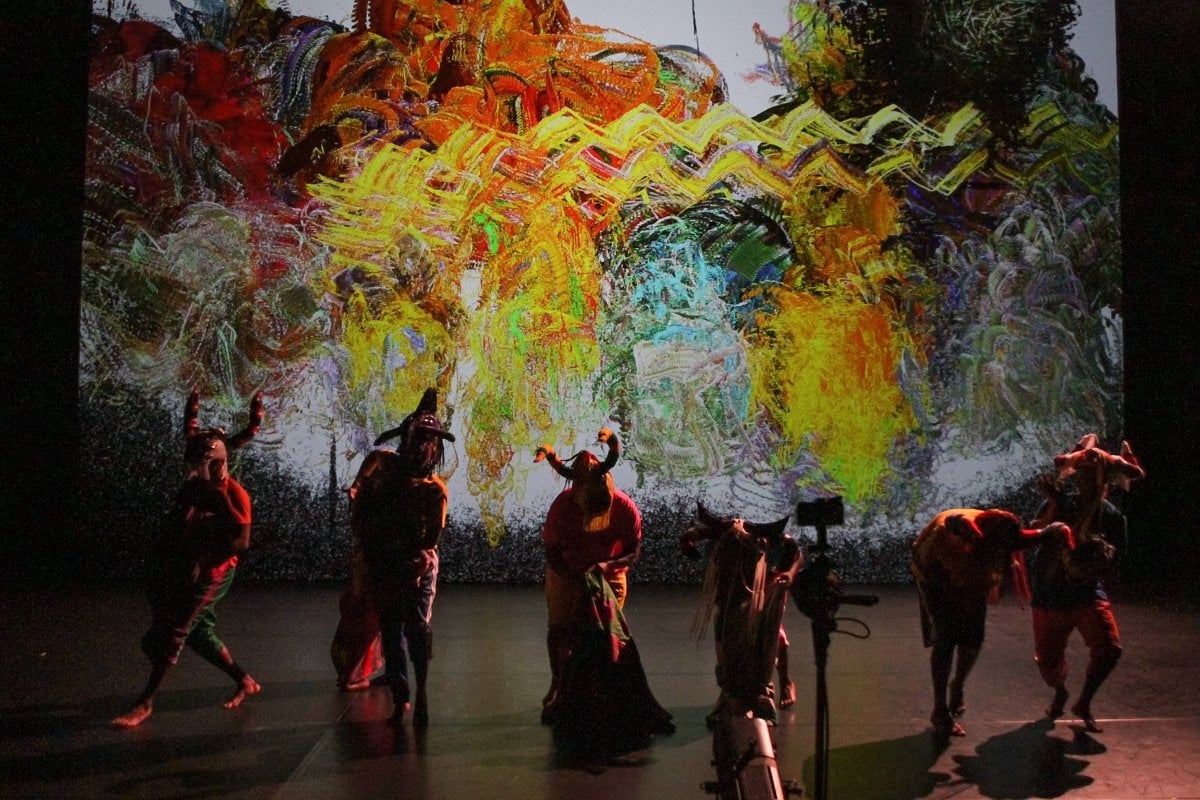
Kathrina Farrugia-Kriel sees Robyn Orlin’s “colourful, engaging, thought-provoking” ‘We wear our wheels’ in London, remembering the Rickshaws of KwaZulu-Natal.
| Title | We wear our wheels with pride and slap your streets with color… We said ‘bonjour’ to satan in 1820 |
| Company | Robyn Orlin/Moving into Dance Mophatong |
| Venue | Queen Elizabeth Hall, Southbank Cenre, London |
| Date | 21 March 2025 |
| Reviewer | Kathrina Farrugia-Kriel |
Part of the 2025 Van Cleef and Arpel’s Dance Reflections festival, We wear our wheels with pride and slap your streets with color… We said ‘bonjour’ to satan in 1820 by the eclectic, Johannesburg-born choreographer Robyn Orlin was recently staged at the Queen Elizabeth Hall at South Bank (21-22 March).
In typical ‘Orlin’ style, the audience is challenged, ancestors are remembered, and the spirit of the Rainbow Nation (both in its political, racial and historical dimensions) is vividly captured. We wear our wheels delivered what most ‘dance’ performance don’t. It is performance art. It is live art. It is dance. It is music. It is a reminder of the past that delivered so many wrongs. Like in many of her previous works, Orlin returns to her childhood memories of being a white girl of Jewish descent, living and holidaying in South Africa. Orlin recollects Zulu men pulling rickshaws dressed in ornate costumes, driving white tourists around Durban and other cities in KwaZulu-Natal. What ensues in We wear our wheels is a colourful, engaging, thought-provoking reminder of the horrors and cruelty of colonialism.
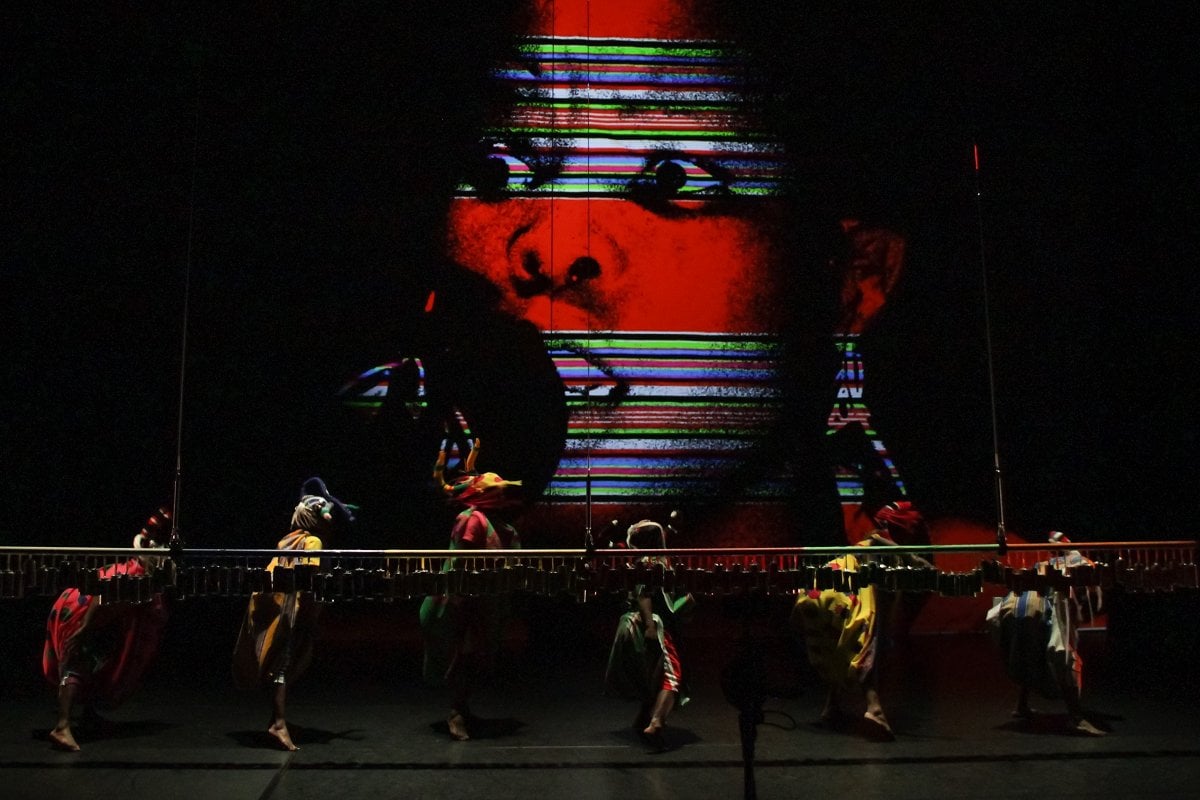
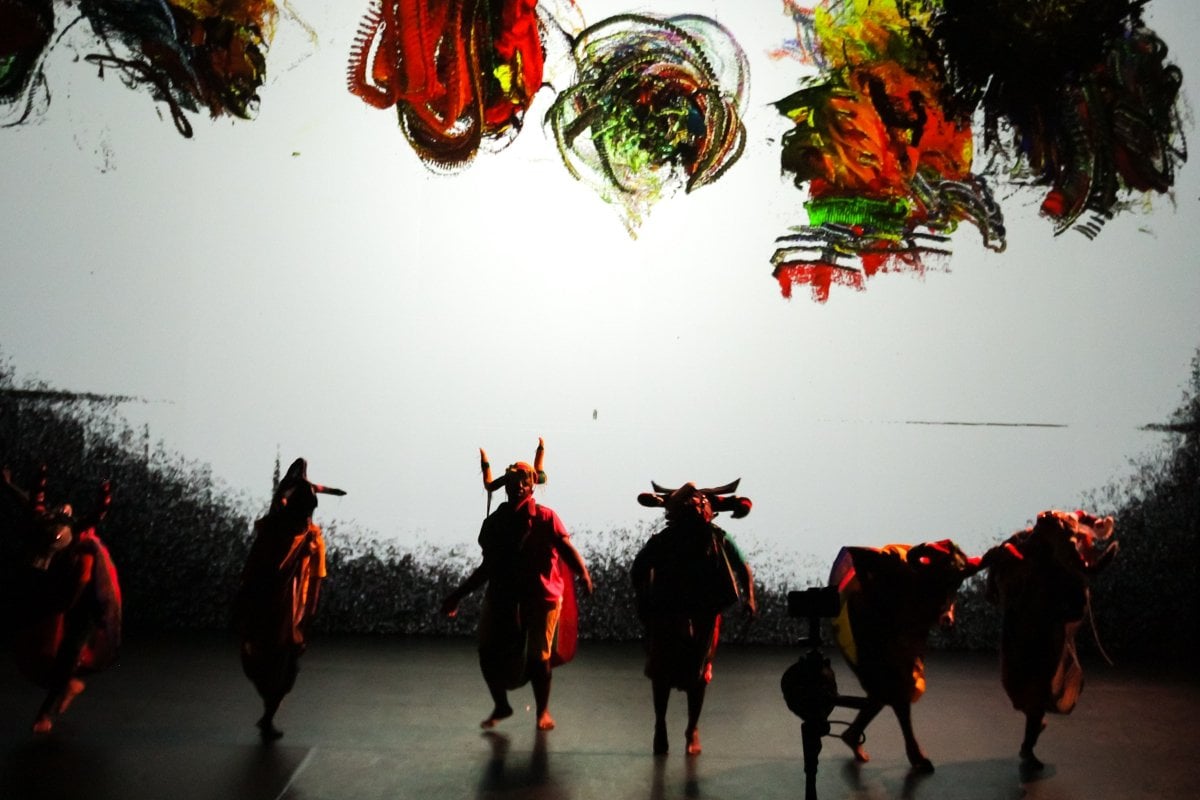
The stage is set up with technical kit on both sides of the stage (the audience only realises the extent of the hidden and emerging technologies as the performance unfolds). What ensues is a sensory feast – Orlin’s seventy-minute performance is both eloquently paced as well as colourful, irreverent, and poignant across the live and digital elements. We wear our wheels opens with a procession of eight artists. As they enter the performance space, we experience the last moments of conventional silence in theatre. There is playful banter with the transition of lighting – a feature taken for granted in most conventional performances. Romain de Lagarde on lights is brought into the ‘conversation’ – “make this a memorable transition, Romain”; “that’s too quick Romain, let’s do a fifteen second transition, Romain”. Orlin stops us in our audience tracks. The dancers neigh like horses, perform what I would readily call ‘pas de cheval’ (an old ballet step which sees the foot glide, retract and return to the floor, like a horse would in preparation for its departure). Nothing from these moments onward will reflect any further conventions – but if they do, she clearly is telling us to stop, and think ‘why did this happen?’
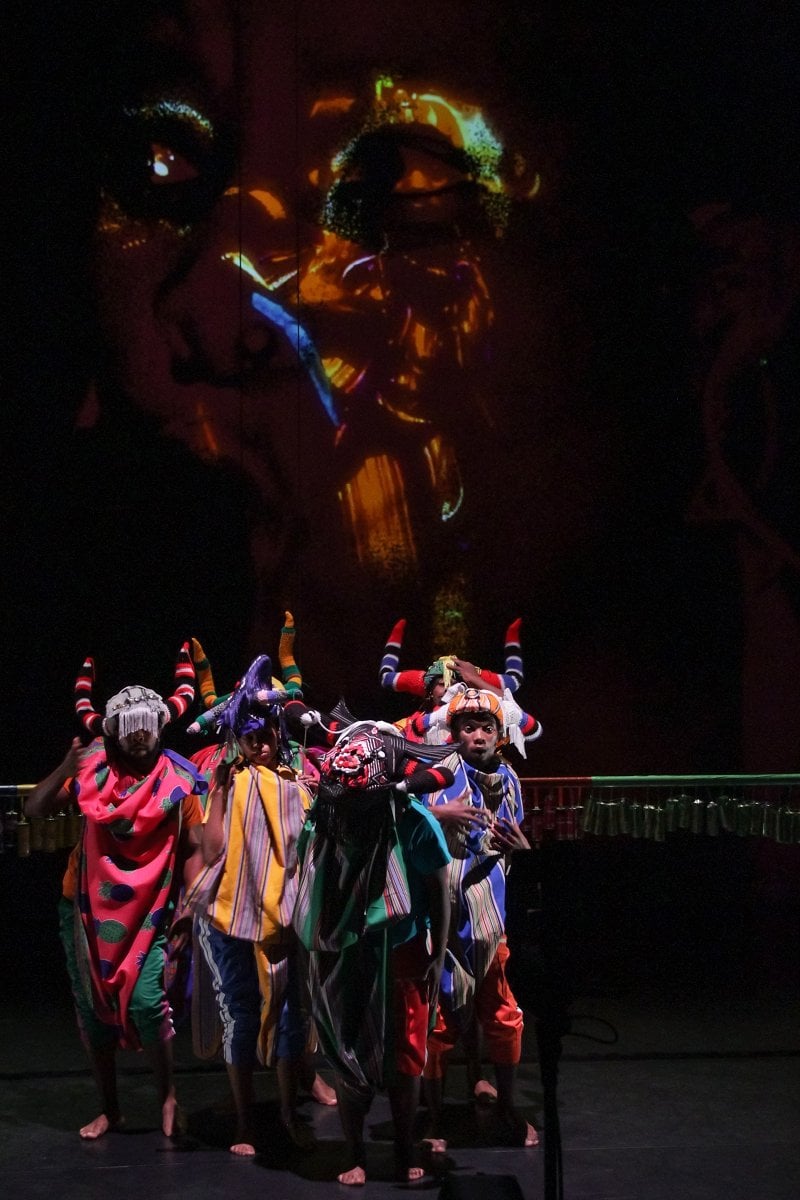
We wear our wheels was performed by Moving into Dance Mophatong dancers: Sunnyboy Motau, Oscar Buthelezi, Eugene Mashiane, Lesego Dihemo, Sbusiso Gumede and Teboho Letele. The music compositions are by UkhoiKhoi, an Eastern Cape (Khosian) black tradition, featuring Yogin Sullaphen and Anelisa Stuurman; both carry their presence as live artists alongside the dancers. Stuurman is a powerhouse on stage. She reminded me of a cross between Anna Masina (a phenomenal voice) but also the diminutive but ever-so-powerful presence of the late Dada Masilo. The eight artists take on a ritual invoking the ancestors of this land – the late Queen Elizabeth II, given her namesake for the theatre, and of course the matriarchy in her reign. The various cameras located on and above the stage give the performance a depth in presence, and the artists play with live and digital images. The dancers speak to the cameras, look up to the cameras, stamping their feet in recognition of their Zulu ancestors. Eric Perroys’ mixed live capture images of the dancers and their unique costume fabrics, many of which featured pineapples (as symbols of wealth, hospitality and the many pineapple farms in the Eastern side of South Africa).
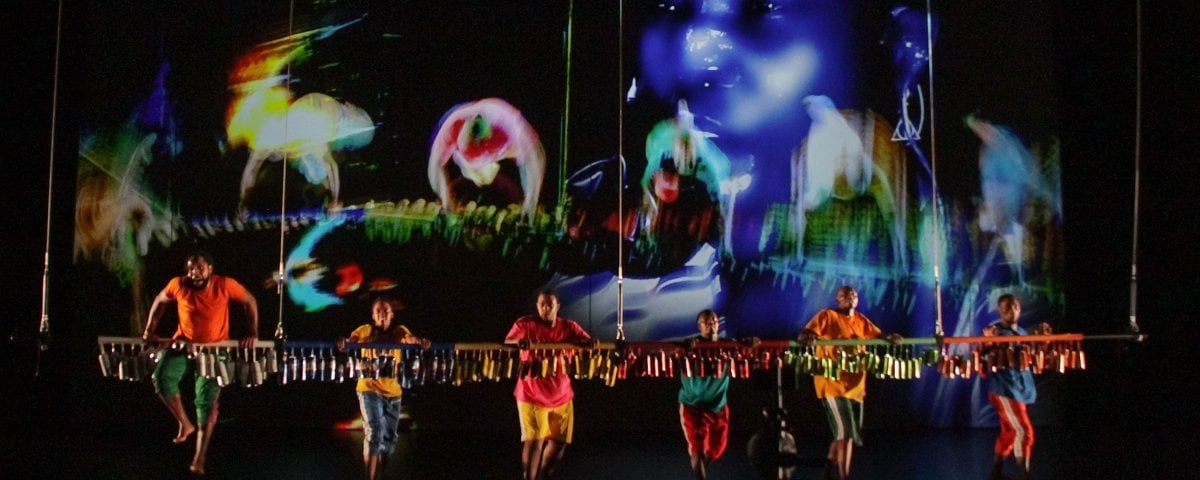
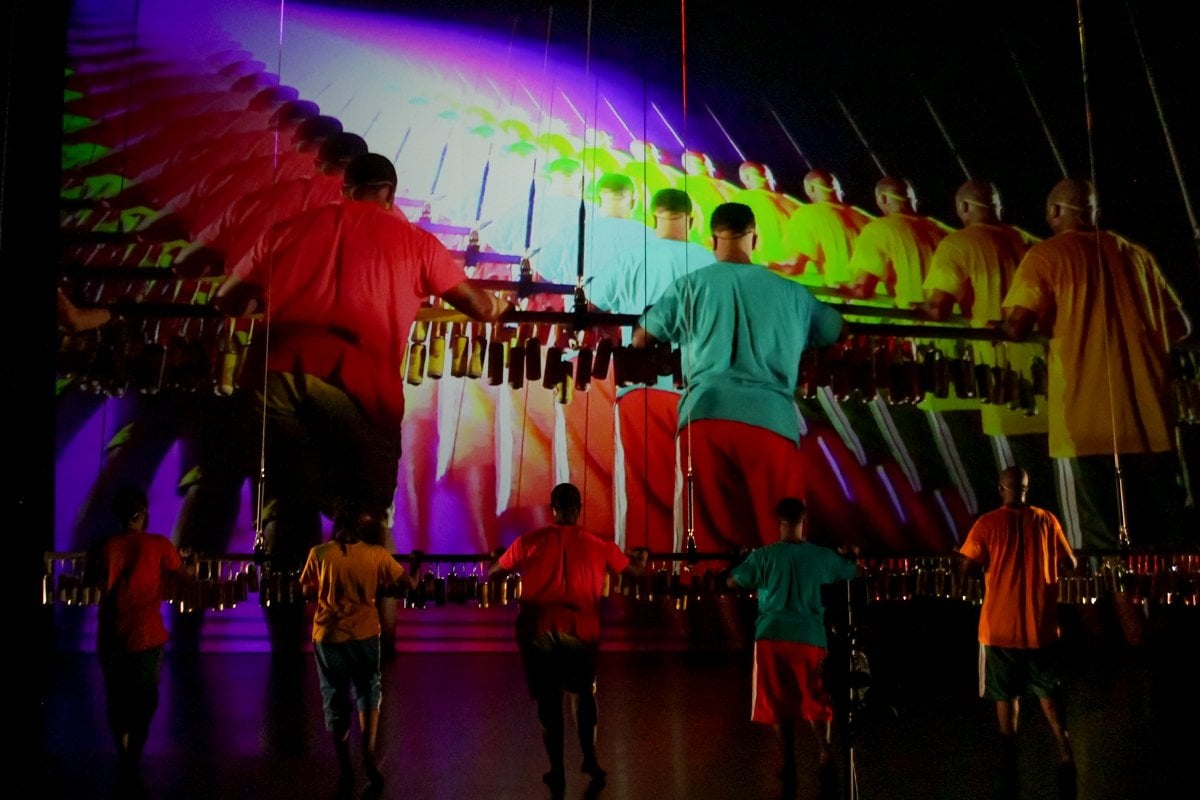
Orlin’s design (she is credited for the ‘design’, rather than the direction) reflects her belief in the power of performance as an opportunity to reflect on South Africa’s past. Birgit Neppl’s headdresses, which are cycle ‘safety helmets’ decorated as the Zulu rickshaws’ ornate headwear. These headdresses descend on stage via a truss decorated with six block colours, one for each of the dancers and where each section is a curtain of cans. Orlin draws upon familiar and nostalgic symbols of the various stall sellers in South African cities and touristy sights. But when we think we’re getting settled into the complexity of the performance, Orlin catches us off guard, yet again. While we’re taking in the visual spectacle, we’re also asked to participate: chant ‘Forwards and Back’ (phonetically, ‘a’ is ‘e’), rock forwards and back in your seat, and then also wave your arms sideways above your head (while still rocking), and finally, shake your hands, while doing all of the above. And take the spectacle in… Orlin was sat two rows ahead of me, and I couldn’t help thinking how she too was just having a great time. But beyond the endorphin-induced haze, there is much sobriety in the work.
The entertainment is just a way into the narrative Orlin creates in collaboration with the various artists, both onstage and backstage. At the end of the performance, we learned that Zulu rickshaw men lived no longer than 35 years. In an interview, Orlin reminds us that these men were also slaves, and that the colonial years, complicit to the brutality on these bodies, generated wealth, tourism, and exploitation. But it is also the ‘Africa’ in which Orlin grew up. As a child, she was fascinated with the athleticism of these Zulu men. After all, this was part of her introduction to dance. In We wear our wheels with pride, all this is packaged in a bright, vibrant and eclectic performance with reminders of the problems of the past. Orlin brings her signature style in merging past and present, technologies and colours, as she critiques her South African culture. The work brings humour, curiosity and a candid view on slavery, told by Black and Zulu South Africans. As I glanced around the audience, there was a clear ‘older’ generation in attendance – a pity that this event did not capture young people’s interest. Dance Reflections made a great choice is showcasing Robyn Orlin’s much respected and intellectual craft, qualities, alas, which are becoming less prevalent in dance these days.

Dr Kathrina Farrugia-Kriel is a dance scholar, educator and published author. She is a graduate of the Royal Academy of Dance (2003), the Universities of Durham and Surrey, and London Metropolitan University (2013). Her doctoral research focussed on Bronislava Nijinska’s Les Noces (1923), and the re-imaginings by contemporary choreographers Angelin Preljocaj and Mauro Bigonzetti. Kathrina is a former director of the Society of Dance History Scholars (now Dance Studies Association). Her scholarship on ballet histories has been published in peer-reviewed anthologies and journals, as well as newspapers, high-end magazines, and online blogs. She has authored a book on the legacy of Nathalie Poutiatine and ballet in Malta (Fondazzjoni Patrimonju Malti, 2020) and co-edited an extensive and pioneering anthology titled The Oxford Handbook of Contemporary Ballet (Oxford University Press, 2021).