New York City Ballet’s Ashley Bouder: Body shaming? Ageism? WTF?!?!!

Ashley Bouder has been a Principal dancer at New York City Ballet for 17 years. During the Covid-enforced closure of theatres she developed, what she called on Instagram, her “Covid body”, gaining 4.5 kilos (10 pounds). She said, “It’s hard when you close fifth position and your legs just don’t fit the same way. That’s really mentally taxing and physically taxing to know that I’ve gone through this transformation to more of a ‘normal’ body.” She returned in September 2022 for the NYCB fall season after recovering from a serious injury and several critics noticed she was dancing below par – at least for Bouder, who has lit up the company with her dazzling technique for almost two decades. She wrote, “This injury, after the long covid break, sent me for a loop, both physically and mentally. It’s been a difficult year for me in terms of my career choice, but I’m finally coming out on the other side. My body feels different. My mind is different. But I’m me. And I’m here. And I’ll be back on the stage that I love.”
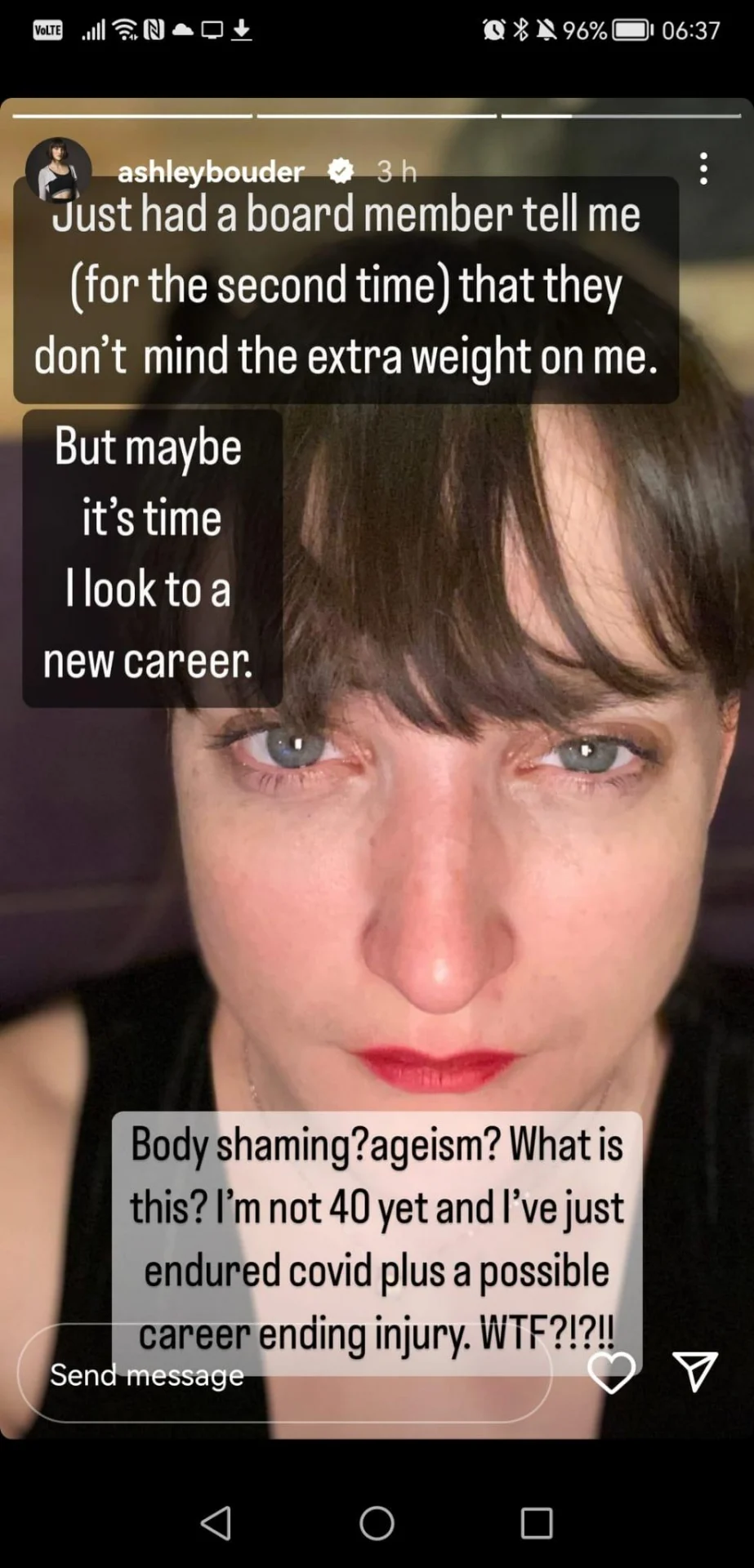
However, this is an image from her Instagram stories posted last night (New York time), 13 November, and as it is still online it was no momentary rage at a situation that looked different after a good night’s sleep. She’s angry and hurt.
Bouder wrote (over a photo of her obviously upset):
Just had a board member tell me (for the second time) that they don’t mind the extra weight on me. But maybe it’s time I look to a new career.
Body shaming? Ageism? What is this? I’m not 40 yet and I’ve just endured covid plus a possible career ending injury. WTF?!?!!
Gramilano guest author, Matthew Paluch, writes:
No one has the right to speak to a person like that – even if you are on the Board of New York City Ballet. Talking about an individual’s body and the need for them to start contemplating a career change. What planet are they on?
As many workplaces are learning, new procedures are now being proposed, accepted and welcomed to confront sensitive areas (with the new role of the intimacy director in theatre and film, for example) and they are found to be valid and helpful, and above all are being put in place to protect the workers. No one throws bricks around randomly on a building site saying, “Well, if someone gets hurt, it’s just part of the job.” There are rules about handling potentially dangerous objects and hard-hats to protect a construction worker if something does go awry.
Matt says:
If difficult conversations need to be had – from either side – they should be done in a safe, professional environment. With the dancer, Artistic Director, and a representative of the HR Dept present. This is 2022.
It’s totally inexcusable and, surprise surprise, it’s happening in the context of a ballet company. Another abuse of the (already very questionable) pyramid scheme in action. That Board member should be hauled in front of the Executive Management and demanded to explain themselves, and if they can’t give sound reasoning in relation to this ‘conversation’ they should be out. ASAP.
In an interview during lockdown last March, Bouder (37 at the time) told The New York Times: “I definitely feel like I lost a year and I want that back.” Adding, “I’m definitely going to dance past 40, I don’t want to just like come back and retire.”
Willpower can easily be undermined if those who are supposedly on your side – like the NYCB board member – destabilise your resolve with casual (or maybe not) comments.
Matt concludes:
Newsflash: there is no ‘sound reasoning’ to this type of discrimination and shaming, and we all eagerly await NYCB’s official statement about acceptable conduct in the workplace. Shocking and unsurprising but make individuals accountable.
Stop the patterns of learned behaviour.
Obliterate the systemic rot.