Review: Tanz Luzern in Beyond – The Human Attributes | SEREMOS
Graham Watts sees Tanz Luzern in Beyond, a double bill with The Human Attributes and SEREMOS – a small company punching well above its weight
| Title | Beyond – The Human Attributes | SEREMOS |
| Company | Tanz Luzern |
| Venue | Luzerner Theater, Switzerland |
| Date | 7 December 2024 |
| Reviewer | Graham Watts |
I travelled to the picturesque city of Luzern for a whistle-stop overnight visit to catch perhaps the most outstanding double bill of contemporary dance I will see in 2024. Not only equally excellent in choreography, performance, and design but also a programme of great contrasts. It was fascinating how two such different works could fit together so well. Swee Boon Kuik’s The Human Attributes and Andrea Miller’s SEREMOS were half an hour each in duration and both pieces left me wanting more with that feeling of surprise that 30 minutes could fly by so quickly!
The overall theme that conjoined the two productions was essentially about identity, exploring issues of what individuals are capable of achieving, going ‘Beyond’ the norm, hence the generic title for this double bill. Swee Boon Kuik’s work was a world premiere and Miller’s choreography, while also in a new form, has built on pre-existing material that she made in Sama for Rambert 2, in 2019 (and I believe other works with which I am unfamiliar).
Although Miller is better known in the US, where she founded the New York based multidisciplinary company, Gallim, she has previous form in the UK, choreographing an imaginative version of Stravinsky’s Les Noces for English National Ballet, in 2023, in addition to that earlier iteration of this work for Rambert’s junior company.
The contrast between the two works was something akin to Cloud Gate Theater of Taiwan meeting Hofesh Shechter (and both at their best). Swee Boon Kuik is a Malaysian-born choreographer who is new to me but one that I will be eager to follow in future. Now aged 51, he developed his dance career in Singapore where he was a member of the Singapore Dance Theatre for ten years; and then Spain, as a member of Compañia Nacional de Danza, where he was significantly influenced in his choreographic practice by the CND leader, Nacho Duato.

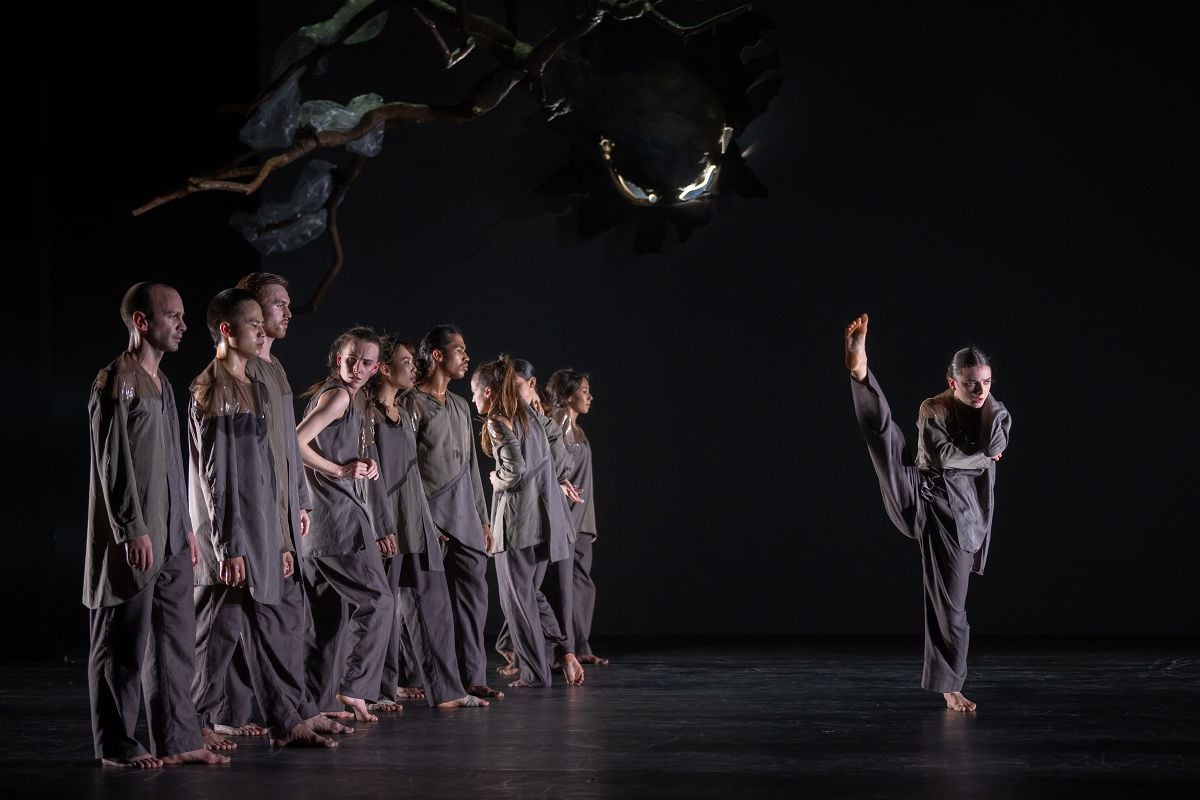
The Human Attributes is a soft and gentle work that appears heavily influenced by the spirit of the ancient art of Tai chi, with flowing and deep meditative movement at the heart of the choreography, accentuated by Ivo Schnider’s atmospheric lighting. There is also clearly a climate change message underlying the non-narrative intent as the set design is focused upon a dead tree with plastic bags tangled in the branches. We appear to be witnesses to the aftermath of a dystopian event (a regular theme of recent years, as evidenced just weeks’ ago by Wayne McGregor’s MaddAddam for The Royal Ballet) but, in this instance, the message is clearly one of hope and regeneration.
The choreography appears largely controlled and strongly disciplined with a frequent use of slow motion and floor-based movement, but it is also, occasionally, riotous. At the centre of the piece was an impressive duet for guest dancer, Marioenrico d’Angelo, and Mia Bardot who continued from the duet into a long sinuous and outstanding solo. Tanz Luzern is a small company with just a dozen dancers, two of whom are interns for a season, and I was surprised to discover that Bardot (a French dancer, of course, with that evocative name) is one of the latter. Whether her future lies in Luzern, or elsewhere, I’m quite certain that on this evidence she should have a strong career. D’Angelo is a charismatic and strong dancer and his partnering in a plethora of challenging and often innovative lifts was never less than secure.

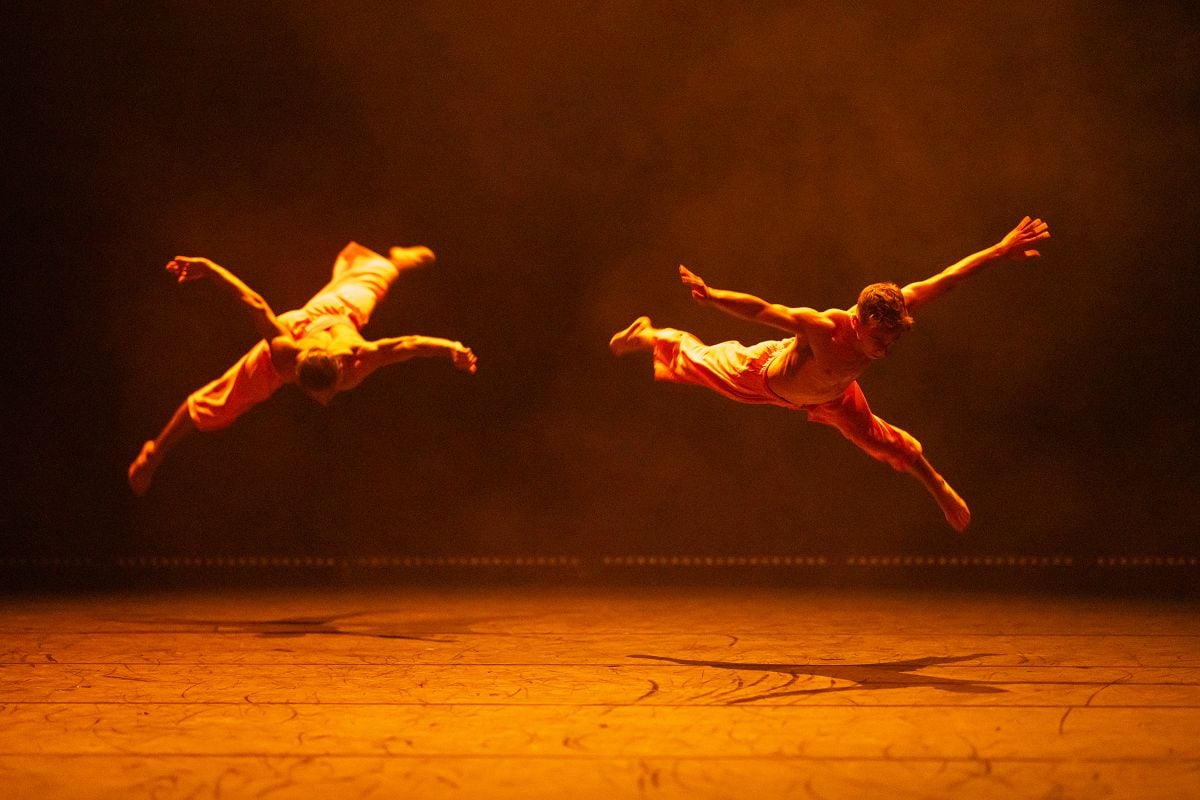
SEREMOS is an explosion of absorbing dance performed to a pulsating score, but the hi-energy façade also contains many subtleties alongside the powerful, virtuosic dance. A link to the preceding piece lies in an undercurrent of spirituality that is carried by both choreography and design. The memorable costumes for both works were designed by Caroline Stark; and Petri Tuhkanen created the impactful lighting for SEREMOS, which included both a line of bulbs at stage level and a circle on the backdrop staring out into audience. Having lighting shining at the audience is one of my pet hates but to Tuhkanen’s credit it worked well here, contributing to the effect of the dance and the dancers being bathed in a comforting, warm red glow.
It’s always great when the disparate choreography of two pieces works so well together but the significant bonus came with an excellent and incredibly hard-working ensemble (they surely needed a half-hour interval to recover and prepare). In SEREMOS, although the whole cast of ten dancers was outstanding, I was particularly impressed by the presence and strength of Matthew Prichard and the exhilarating climax of Phoebe Jewitt’s final solo.
Tanz Luzern is clearly a small company punching well above its weight with an impressive international ensemble and, in Wanda Puvogel, it has the added advantage of being led by an artistic director with an inquiring vision to find and showcase excellent new choreography from around the globe.


Note: The author’s travel and accommodation expenses were met by Tanz Luzern

Graham Watts is a freelance writer and dance critic. He writes for The Spectator, Tanz, Shinshokan Dance Magazine (Japan), Ballet Magazine (Romania), BachTrack and the Hong Kong International Arts Festival and has previously written for the Sunday Express, Dancing Times, Dance Europe, DanceTabs, London Dance, the Edinburgh International Festival and Pointe magazine (USA). He has also written the biography of Daria Klimentová (The Agony and the Ecstasy) and contributed chapters about the work of Akram Khan to the Oxford Handbook of Contemporary Ballet and on Shobana Jeyasingh for the third edition of Routledge’s Fifty Contemporary Choreographers.
He is Chairman of the Dance Section of The Critics’ Circle and of the UK National Dance Awards and regularly lectures on dance writing and criticism at The Royal Academy of Dance, The Place and (until the war) for Balletristic in Kyiv. He was a nominee for the Dance Writing Award in the 2018 One Dance UK Awards and was appointed OBE in 2008.