Review: 17th World Ballet Festival in Tokyo, Programme B

Matthew Paluch sees Programme B at the 17th World Ballet Festival in Tokyo: “The festival has a 48-year legacy behind it, but this shouldn’t be taken for granted.”
| Title | World Ballet Festival, Programme B |
| Company | Japan Performing Arts Foundation (NBS) |
| Venue | Bunka Kaikan (Tokyo Metropolitan Festival Hall) |
| Date | 8 August 2024 |
| Reviewer | Matthew Paluch |
Programme B of the World Ballet Festival is only 3.55 hrs long… and I feel ripped off! Where’s the other 20 mins gone since Programme A? Joke.
I attended the second performance of four on 8 August and the opening piece – Raymonda performed by the Bolshoi’s Maria Alexandrova and Vladislav Lantratov – was a lukewarm start to a largely lacklustre Part 1. The pas de deux is less bombastic than others but what starts as understated soon feels underdone. It all seemed to lack effort. Alexandrova offers command but it verges on indifference, and the comedy révérences continue.
The above lacklustre comment also concerns the three modern inclusions. Where’s the actual good contemporary dance?
A Dialog by Roman Novitzky (Artist in Residence at Stuttgart Ballet), danced by company principals Mackenzie Brown and Gabriel Figueredo, is predictable European fare. Convulsions and hyperactive gesture, and what’s communicated seemingly has zero to do with Nina Simone’s Sinnerman. Blasphemy.


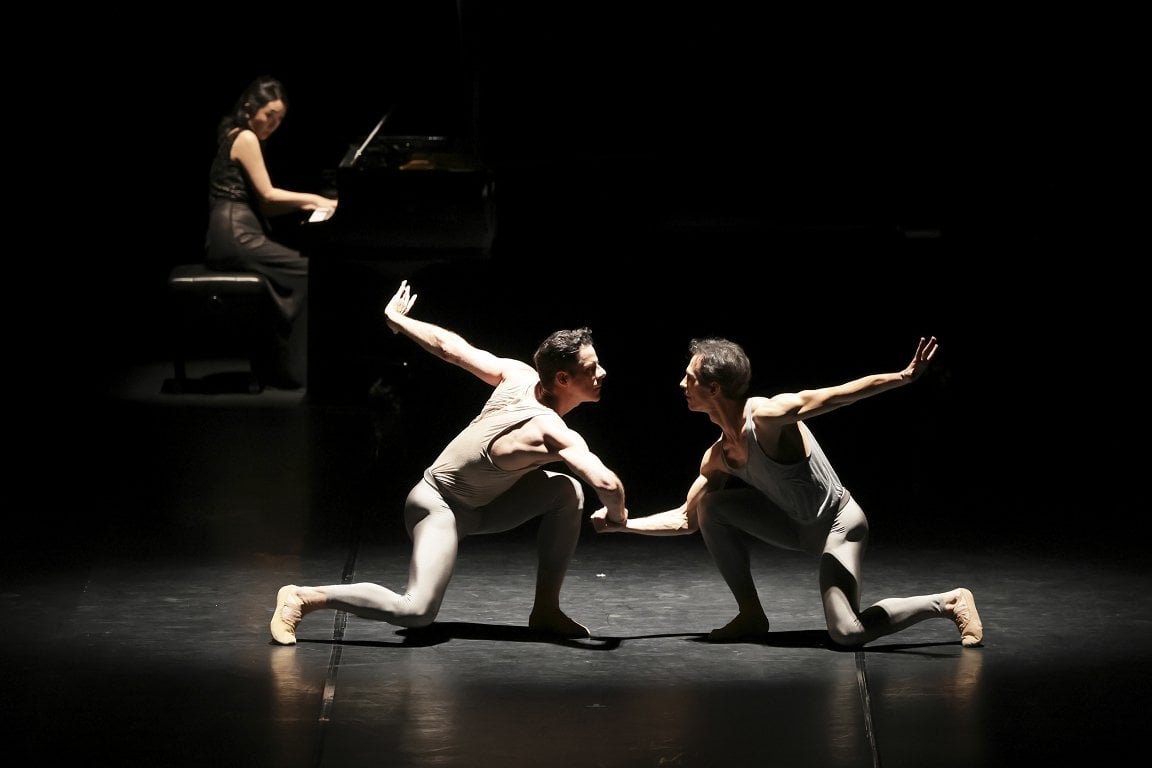
Ami by Marcelo Gomes, performed by Gomes and Alexandre Riabko is more successful but still verges on style over substance. And what is going on? Their friendship seems strained, yet the work doesn’t get close to solving the conundrum for the observer.
And the pièce de résistance? Maurice Béjart’s Bhakti III. I’m sure at the 1968 premiere it was a revelation, however this isn’t the case 56 years later. Two words spring to mind – cultural appropriation. Mari Ohashi of Béjart Ballet werked the en pointe twerk but yeah, no.
Things improved with Balanchine’s Diamonds danced by May Nagahisa and Kimin Kim but not by a lot. The standard of dancing was of course very high, yet the overall experience lacked drama and dynamic. Specific roles cannot, and should not, be frozen in time, but anything created on Suzanne Farrell is its own kind of beast. I hope Nagahisa’s ongoing agenda is to take the role where it can, and must go.
Closing Part 1 was Petipa’s Le Corsaire with Marianela Nuñez and Vadim Muntagirov. Nuñez wore a three-quarter length costume to shake things up, though I must admit I prefer the tutu look. Largely speaking they don’t even seem challenged by the choreography, but this confidence allows for Muntagirov’s big dancing to be unleashed and Nuñez’s generous use of the head and upper body to have full reign. Nuñez’s festival repertoire dictates she’s required to execute 32 fouettés each time she takes to the stage. Groundhog day?
Part 2 opens with Balanchine’s Sonatine and things are looking up. Take Ravel, Mr B’s genius and Hannah O’Neill and Germain Louvet of the Paris Opera and things are likely to work. It was my first viewing of the piece. It is 12 minutes of rich, unpredictable choreography where Balanchine continues to defy classical conventions, through both the content he creates and the way it’s structured. One can’t help aligning the folk inflection in relation to Robbins’ Dances at a Gathering (1969) and imagining Violette Verdy at the 1975 premiere – chicness personified one assumes. Unlike O’Neill’s costume choice… another balletic nightie.
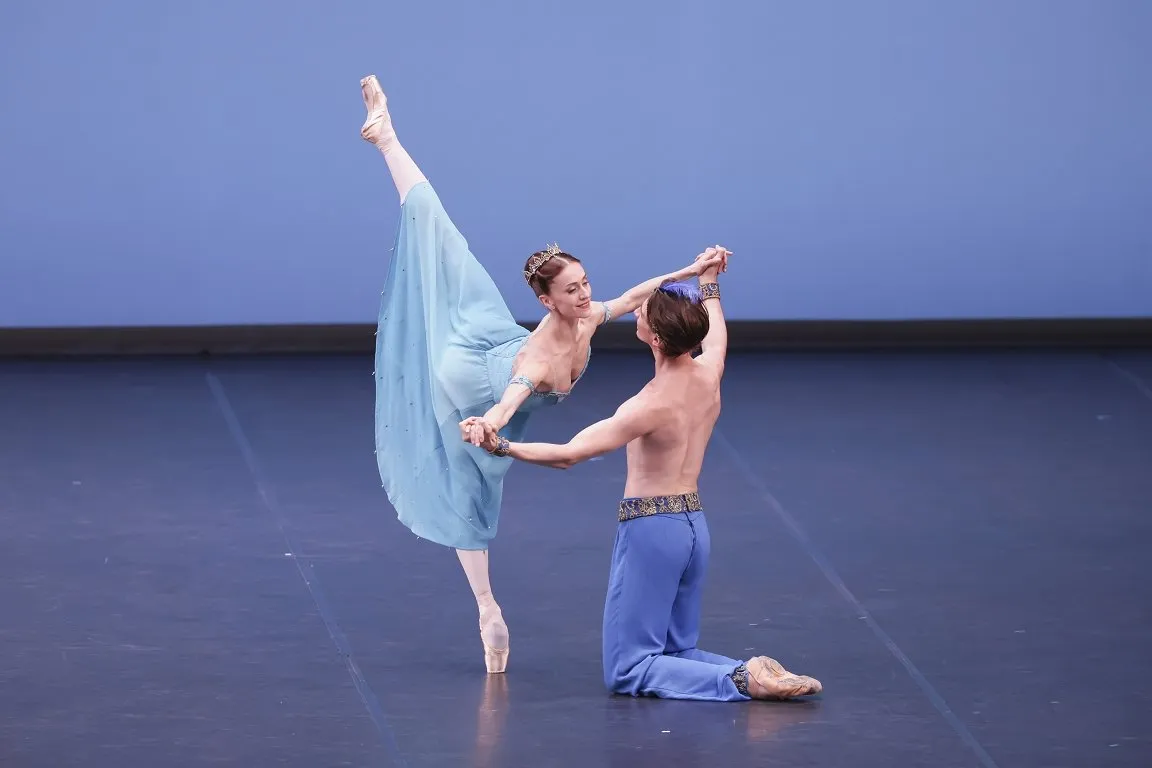


The Balcony pas de deux from Kenneth MacMillan‘s Romeo and Juliet, danced by the Royal Ballet’s Sarah Lamb and William Bracewell, was more than adequate but also has room for interpretational development. The majority of the rendition was too safe, feeling over-rehearsed to the detriment of the characterisation believability. I understand it’s a balancing act, but narrative ballet intention has to be about communication initially, not exacting execution. The last few moments were wonderful though – a powerful parting kiss and balcony yearning. Bracewell does Romeo hair and renversé with gusto, though I think Lamb should reassess the grand jeté inclusion after Juliet descends the stairs. Is this in the original choreography? It feels out of place to say the least.
Third Symphony of Gustav Mahler by John Neumeier confirms numerous points we already know – the epic-ness of Mahler, the fact dance can handle this kind of score, and the space that Neumeier utilises to allow for such contemplation. The two dancers – Hamburg’s Madoka Sugai and Alexandr Trusch – use the vast, empty stage to give Neumeier’s language both internal power and bewildering projection, and watching this piece one can understand why artists would be desperate to perform Neumeier’s canon. He gives them the opportunity to embody monumental movement; this is art in motion.
The second MacMillan interlude is the Manon, Act 1 Bedroom pas de deux danced by Yasmine Naghdi and Reece Clarke. Naghdi’s speed and agility is infectious and perfectly suited for the role, and Clarke as Des Grieux makes a very dashing amour. They look stunning together – he is verging on 7ft, she an insatiable whisp. But most importantly, Naghdi lets the choreography do the talking, where others all too often get carried away with affectation… though moments of Manon-itis (unnecessary, fumbling hands around the neck) did still present themselves.
Closing the section is Béjart’s Ring um den Ring with Diana Vishneva and Gil Roman. The full work is 4 hours 45 minutes (!), so of course we only experience a very small taster. With Vishneva barefoot in white chiffon, and Roman reminiscent of a punk clown in tails, it’s all a bit random and add into the mix the Wagnerian Wagnerism of the whole thing, and well, you can probably imagine. We went to hell in the end. Pun intended.


Part 3 opened with Le Parc (again) by Angelin Preljocaj. The alternate cast of Alessandra Ferri and Roberto Bolle brought more humanity to the piece, and Ferri reconfirmed her reputation as a dancer actress. Everything she does feels so method, made even more poignant by the Mozart.
Mayerling by Kenneth MacMillan is a richly, layered ballet, so considering the lack of context, Elisa Badenes and Friedemann Vogel of Stuttgart Ballet did great work with the Act 2 pas de deux. Badenes brought the requisite bendiness and fervour to Mary Vetsera, and Vogel’s Rudolf has the appropriate mix of self-destruction and fear. And the Liszt… when those strings start to swoon, we’re all DOOMED I say!
Désir by John Neumeier is another journey into his world, and one consummately executed by longtime Hamburg collaborators Silvia Azzoni and Alexandre Riabko. Neumeier choreography doesn’t allow dancers to play safe, and this I’m thankful for. No matter what they may want to ‘show’, they’re also kept extremely busy trying to make it a (successful) reality in the moment. This challenge creates a distinct atmosphere where the dancers and consequently the movement feels now.
Onegin is a similar situation to that of Mayerling, but Dorothée Gilbert and Hugo Marchand took us directly to the high drama of the final pas de deux from Act 3. I’ve heard people describe Onegin as a weak ballet, however I find this scene in particular anything but. Cranko creates moments like no other – when Onegin supports Tatiana as she’s too emotionally weak to walk, and as the roles reverse she drags him in defiance. I’m a wreck by this point, and largely hold Tchaikovsky responsible, whose sweeping melodies are the stuff of total, emotional instability. Gilbert as Tatiana is complete Jekyll and Hyde, and how could she refuse Marchand’s desperate Onegin. I absolutely loved it, and you can call me a melodramatic Kween if you must.


Don Quixote closing again?! That’s what I thought… but then you get a cast like Madoka Sugai and Daniil Simkin. Simkin, at his most supercharged, executes unparalleled virtuosity with undeniable clarity. Does it all come under the danse d’école umbrella? No. But I don’t think the majority of the audience give a damn. Sugai has major range as a ballerina, and her Kitri is all tasteful sass with the goods to back it up. Her internal fouetté dialogue was so interesting to watch in performance. The first 16 were all doubles, and she didn’t take no for an answer. Her plié execution slows down time, but even when it wasn’t the ideal preparation she went for the double regardless. A perfect example of what dancers have to process and accomplish in milliseconds in front of thousands of people – get your head around that.
The orchestra, pianist Shino Takizawa and technical team are all in fine form as was the case for Programme A, though some of the tempi felt a little indulgent this time, specifically in the MacMillan repertoire. His language (generally) needs pace even during phrases of languish, and I believe the dancers would benefit from it also.
So what to take away from the World Ballet Festival 2024? The two performances I attended were very busy, so there’s clearly a demand for the product. The calibre of dancing means that ballet is very much alive, but the content reaffirms less admirable qualities, most keenly – it’s detachment from reality and the continued denial of anything that lives outside heteronormative ideals.
As for the modern aspect, contemporary dance can actually do what classical ballet struggles with, but the work needs to be good, and this wasn’t the case across the board. More rigorous thought needs to take place in relation to finalising the 2027 festival repertoire. For example, how diverse can the classical offering be, and the contemporary programming must include both (relevant) historical works and zeitgeist creators. The festival has a 48-year legacy behind it, but this shouldn’t be taken for granted and the lowest common denominator allowed to suffice. The existing infrastructure must be used as a springboard for speculation. The art form needs it.

Matthew Paluch was awarded a place at The Royal Ballet School in 1990 where he graduated in 1997. His first four years as a professional dancer were spent working with London City Ballet, Scottish Ballet, K-Ballet and English National Ballet, becoming a full-time member of ENB until leaving in 2006.
Matthew graduated from the Royal Academy of Dance, Professional Dancers’ Teaching Diploma in 2007, and was formerly on faculty at The Royal Ballet School. He completed his Masters in Ballet Studies at Roehampton University in 2011, has been a freelance writer since 2010 and currently works in the Law Sector.
He is a member of the Dance Section of The Critics’ Circle.