Review: Phoenix Dance Theatre’s Inside Giovanni’s Room – a brave and daring proposition

Jonathan Gray sees Phoenix Dance Theatre in Marcus Jarrell Willis’s ‘Inside Giovanni’s Room’ with the Leeds-based company in top form.
| Title | Inside Giovanni’s Room |
| Company | Phoenix Dance Theatre |
| Venue | Sadler’s Wells East, London |
| Date | 11 June 2025 |
| Reviewer | Jonathan Gray |
After enduring several turbulent years, which included the sudden loss of its artistic director, Dane Hurst, as well as a ‘creative pause’ in 2022, the Leeds-based Phoenix Dance Theatre appears to be back on top form with the staging of its latest production, Inside Giovanni’s Room, a two-act work choreographed by its new artistic director Marcus Jarrell Willis. Following the premiere in Leeds and a Spring tour that took it across the UK, the production finally arrived in London for a week of performances at the new Sadler’s Wells East on 11th June.
Based on James Baldwin’s novel Giovanni’s Room, a milestone in the history of queer literature, Willis’ production – with a ‘soundscape’ score (mainly percussion and synthesizer) by Marc Strobel, sets and costumes by Jacob Hughes and Melissa Parry, and lighting by Luke Haywood – not only marks the 100th anniversary of the author’s birth but celebrates a new generation of Phoenix dancers, most of whom joined the company after 2023. This new cohort is not only committed, highly talented and exciting to watch but, in Inside Giovanni’s Room, they prove themselves fine interpretative artists.
First published in 1956, Giovanni’s Room tells of David, an American living in Paris, who is divided between his duty towards Hella, his fiancée, and his sexual attraction to Giovanni, an immigrant Italian who works in a gay bar. Baldwin’s story is complex, multi-layered and often bitter, and explores themes of gay desire, internalised homophobia, bisexuality, masculinity, poverty and social alienation.

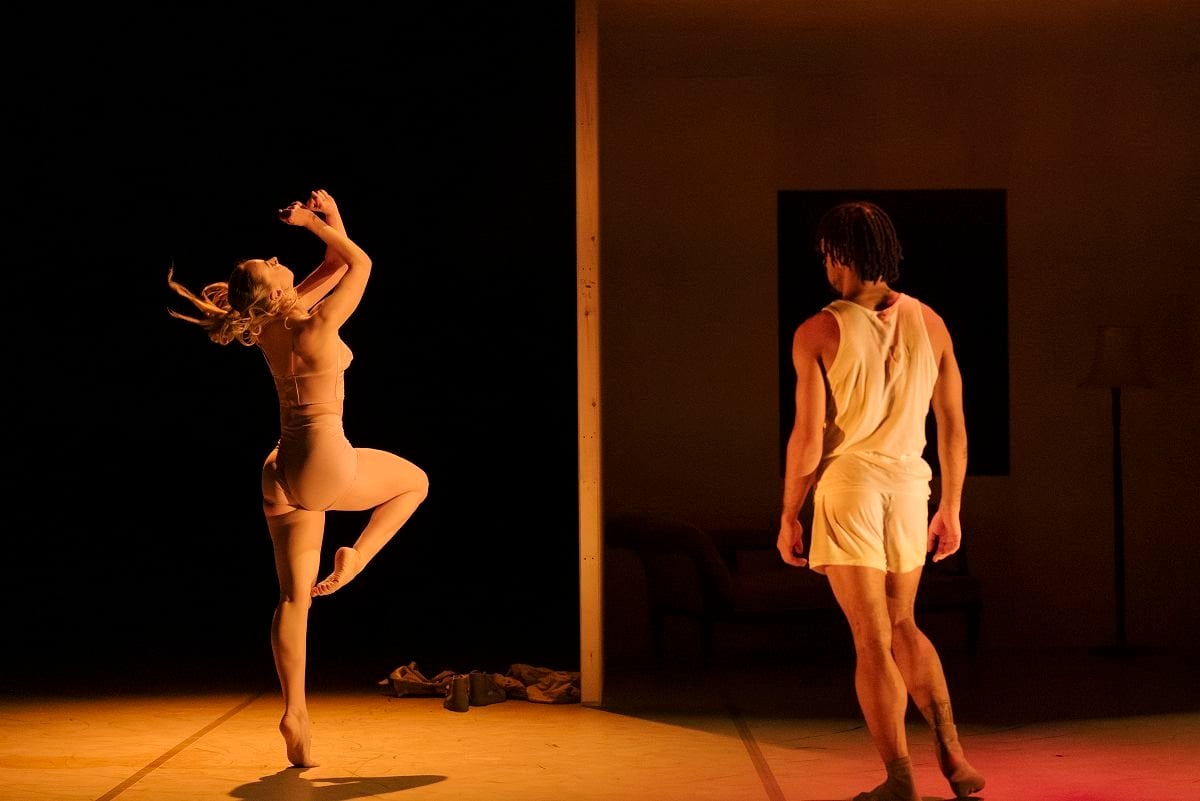

The novel was considered controversial in the 1950s (and is still condemned in conservative countries, such as Belarus) and I did wonder in advance how it could be expressed clearly in dance. By way of an answer, Willis has choreographed the work in a tight vocabulary of theatrical, jittery, fragmented movements that suggest suppressed tensions and unspoken desires, especially in the duets between David and Giovanni. Both men, rightly, never appear comfortable in their own skins, their desires constricted, fearful and failing to take flight, all brilliantly conveyed through the superlative performances of Teige Bisnought as David and Dylan Springer as Giovanni. Likewise, Willis has given Hella, danced by Dorna Ashary, beguilingly curling dances that speak convincingly of joy, confusion and rejection. The performances of all three are utterly sincere and compelling and make a substantial contribution towards the success of the production.
Where Willis is less effective is in his handling of some of the minor characters, such as David’s friend Jacques (Aaron Chaplin), and the bar owner, Guillaume (Tony Polo), who are defined more sketchily and are therefore less credible. There are also sections of dance within both acts that are pure choreographic ‘padding’ – the long jive ensemble in the gay bar, and the almost absurd ‘ballet of the postmen’ – that add nothing to further the story and somehow lessen the impact of the production. One solution might be to condense Inside Giovanni’s Room into one long act so that greater tension and a stronger tragic climax can be built up.
I was disappointed in the production’s music and the designs, both of which somehow failed to sufficiently evoke the Paris of the 1950s (in fact, I felt Giovanni’s box room, with its scarlet walls, lamp, sofa and shuttered windows, and on stage throughout, was pure David Lynch). Nevertheless, Inside Giovanni’s Room is a brave and daring proposition as a work of dance. Marcus Jarrell Willis so nearly gets things right that I hope he can now take stock and refine and improve upon what he has achieved so far. It would be well worth the effort.


Jonathan Gray was editor of Dancing Times from 2008 to 2022.
He studied at The Royal Ballet School, Leicester Polytechnic, and Wimbledon School of Art where he graduated with a BA Hons in Theatre Design. He was on the Curatorial Staff of the Theatre Museum, London, from 1989 to 2005, assisting on a number of dance-related exhibitions, and helping with the recreation of original designs for a number of The Royal Ballet’s productions including Danses concertantes, Daphnis and Chloë, and The Sleeping Beauty.
Jonathan Gray has also contributed to the Financial Times and The Guardian, written programme articles for The Royal Ballet and Birmingham Royal Ballet, and is co-author of the book Unleashing Britain: Theatre gets real 1955-64, published in 2005. He is a member of the Dance Section of The Critics’ Circle.