Review: Gala Mario Porcile at the Nervi Festival – international stars in a refined programme

Graham Spicer sees Gala Mario Porcile, the closing event of the Nervi Festival, with dancers from The Royal Ballet, Hamburg, Dutch and Bavarian State Ballet companies, and ABT.
| Title | Gala Mario Porcile |
| Company | Nervi International Ballet Festival |
| Venue | Nervi Park, Genoa |
| Date | 27 July 2025 |
| Reviewer | Graham Spicer |
The Nervi International Ballet Festival concluded with a gala dedicated to its founder Mario Porcile who brought about the first festival in 1955. More than a gala, it was a mixed programme of dance, as there were only three extracts – the ‘black’ pas de deux from John Neumeier’s The Lady of the Camellias, the second act pas de deux from Giselle, and the balcony pas de deux from Kenneth MacMillan’s Romeo and Juliet.
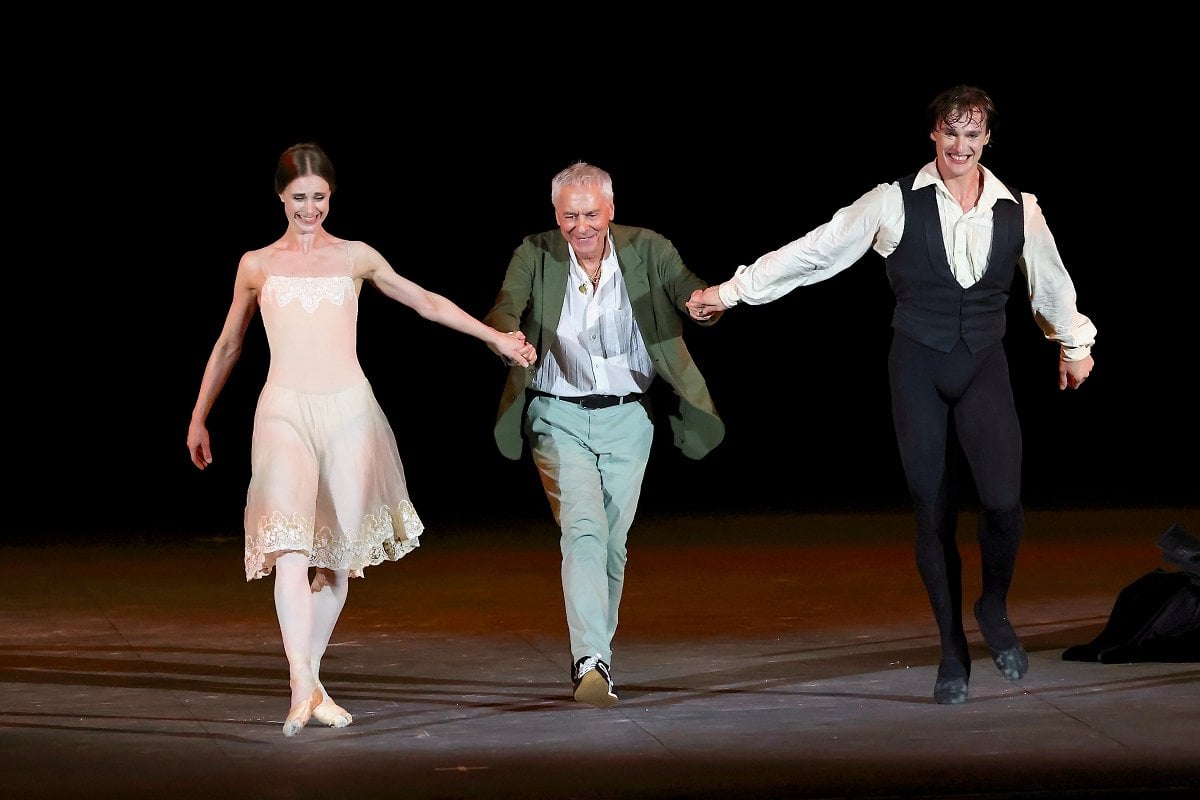
Maina Gielgud assembled the programme in her capacity as the festival’s Artistic Advisor, together with the festival’s director, Jacopo Bellussi, who also danced in two pieces. It honoured the origins of the Nervi Festival as well as celebrating the participating dancers with works they are noted for. It was an intelligent selection, though maybe a couple of upbeat numbers would have been welcomed in a celebratory evening. Although frequently included in galas, the ‘black’ pas de deux from The Lady of the Camellias is a strange choice to end an evening without a défilé, or similar concluding number. However, the arrival of its 86-year-old choreographer, John Neumeier, nimbly running up and down the stage with the dancers during the applause, gave a lift to the closing moments.
The Lady of the Camellias was splendidly interpreted by Neumeier favourites, Ida Praetorius (Principal Dancer at Hamburg Ballet, the company Neumeier led for half a century, until last year) and Bellussi, who was a principal dancer with the company until June of this year. They know the piece intimately, and that was shown in the nuanced details. Praetorius was touching in her fragility as Marguerite’s illness consumes her (with audible coughing), and the pull and tug of emotions between them was extremely moving.

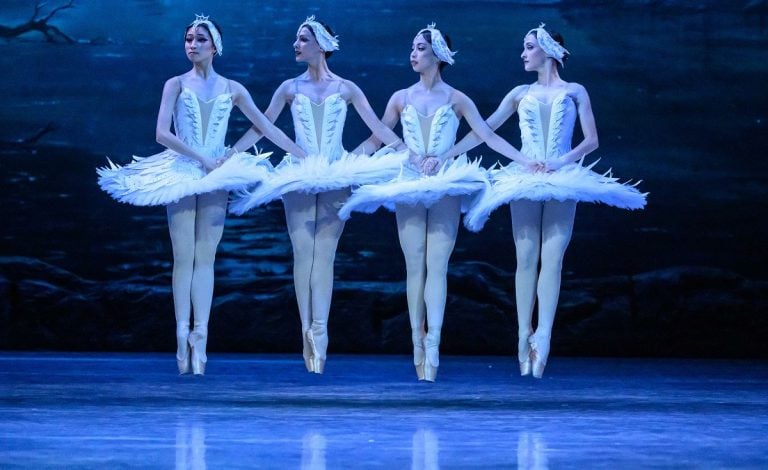
The programme opened, however, with the rarely seen Pas de Quatre, the Jules Perrot ballet from 1845, reinvented by Anton Dolin in 1941 to represent its four original dancers – Maria Taglioni, Fanny Cerrito, Carlotta Grisi, and Lucile Grahn – with wry nods to the jealousies between these dancers and with youth bowing to experience. The four dancers who took to the stage in Nervi bravely respected the gesturing between variations and held the stage, even though many of the audience didn’t know what was going on. The four dancers were Ida Praetorius, Cassandra Trenary (American Ballet Theatre), Aliya Tanikpaeva (Hungarian National Ballet), and Jessica Xuan (Dutch National Ballet). They were all so very good, though not magical, but I imagine that most (all?) of them were dancing it for the first time. This was one of many pieces in the evening remounted by Gielgud, and the style of the 1940s imitating that of the 1840s was well assimilated by her ‘students’.
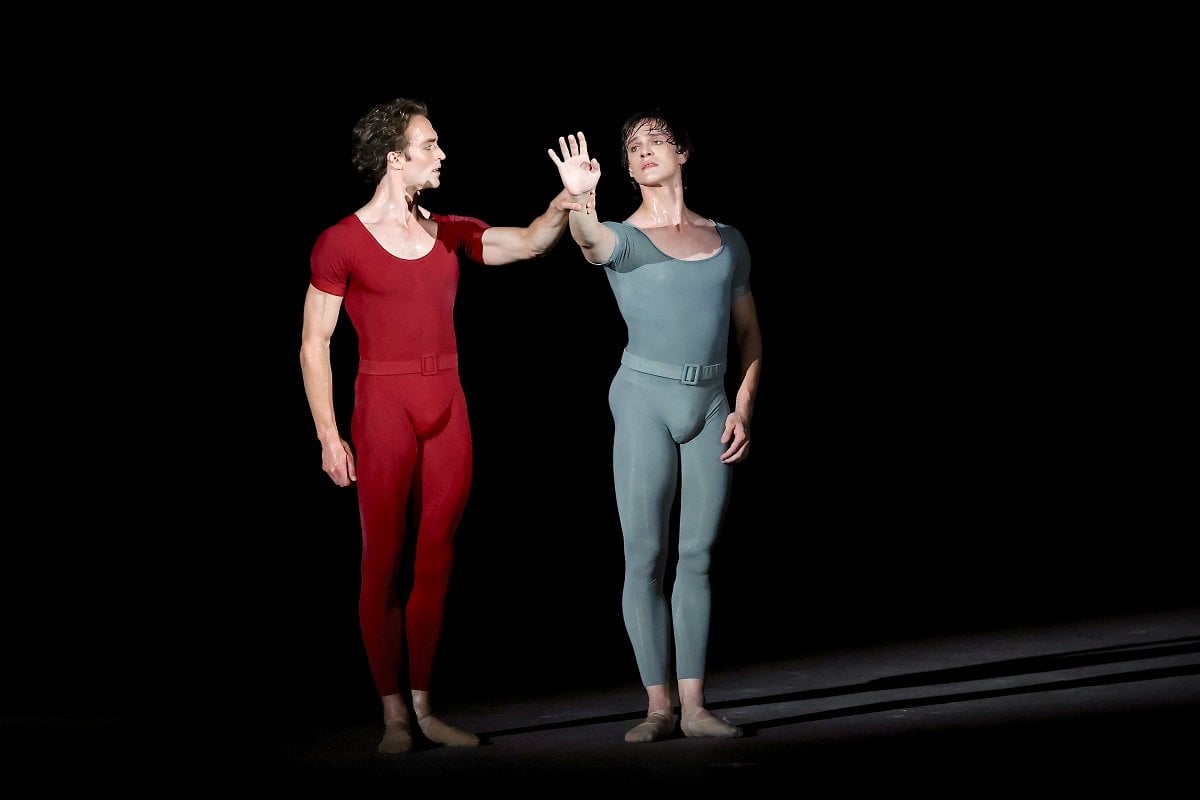
Another piece overseen by Gielgud was Maurice Béjart’s Le chant du compagnon errant (Song of the Wayfarer), created for Rudolf Nureyev and the Genovese dancer, (once a student of Mario Porcile), Paolo Bortoluzzi. Béjart was playing to each dancer’s strengths, and so the role of the ‘Wandering Companion’ with fleet footwork, ronds de jambes, and perfect 5th positions was for Nureyev, and Bellussi danced it capably with his customary intensity. More lyrical was Bortoluzzi’s role as his alter ego, his shadow of destiny, danced here by Matthew Ball (The Royal Ballet) with grace and containment, even in the most explosive parts of the choreography. There was a huge emotional connection between the two men, though without the homoerotic undercurrents that are sometimes felt. It was the most satisfying work of the evening.
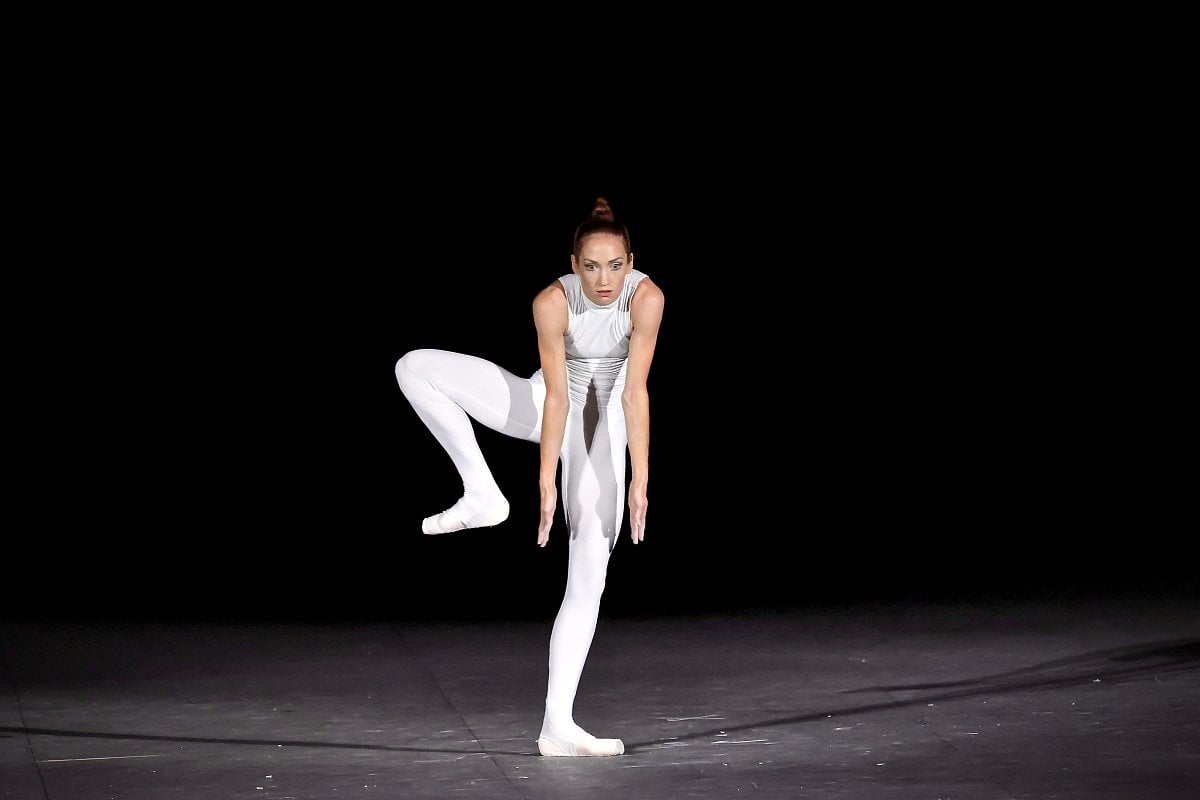
Also by Béjart was Forme et Ligne (Shape and Line), which was almost immediately rechristened Squeaky Door after it’s creation in the 70s, due to its percussive soundscape. It was choreographed for Gielgud and made the most of her incredible balances. She once danced the piece at Nervi, and now oversaw its performance with Berlin State Ballet principal dancer Ksenia Ovsyanick. Maybe Ovsyanick doesn’t have the daring off-balances that Gielgud shows in the videos of the piece, but it was a beautiful performance of robotic angular movements, rag-doll floppiness, and quirky poses… and Ovsyanick looks great in a white unitard! And to contradict what I stated before about the gala’s lack of upbeat moments, the six little girls in the row in front of me squealed with delight at every ‘squeak’.
The last complete piece was Hans van Manen’s Trois Gnossiennes, and before you rush for a French dictionary, ‘Gnossiennes’ is a word composer Erik Satie made up (but Google it for various interpretations). It is a small jewel of a piece, and principal dancers Jessica Xuan (Dutch National Ballet) and Jakob Feyferlik (Bavarian State Ballet) gave a jewel of a performance. Van Manen had the two dancers hardly looking at each other, and their remoteness mirrors the cool blue lighting, yet there is passion in the distance between them. The familiarity between Xuan and Feyferlik’s is palpable – their partnership dates back to when they both danced in Amsterdam – and their casual synchrony matched Satie’s hypnotic score.
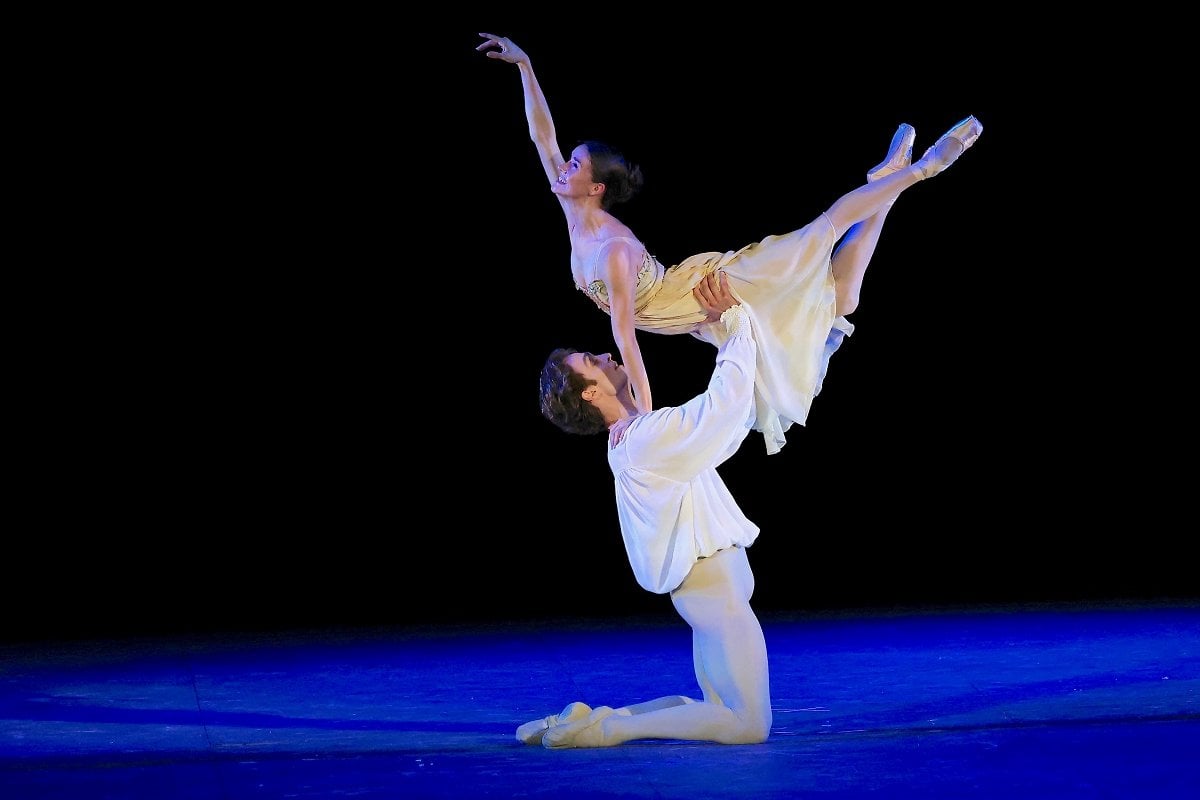
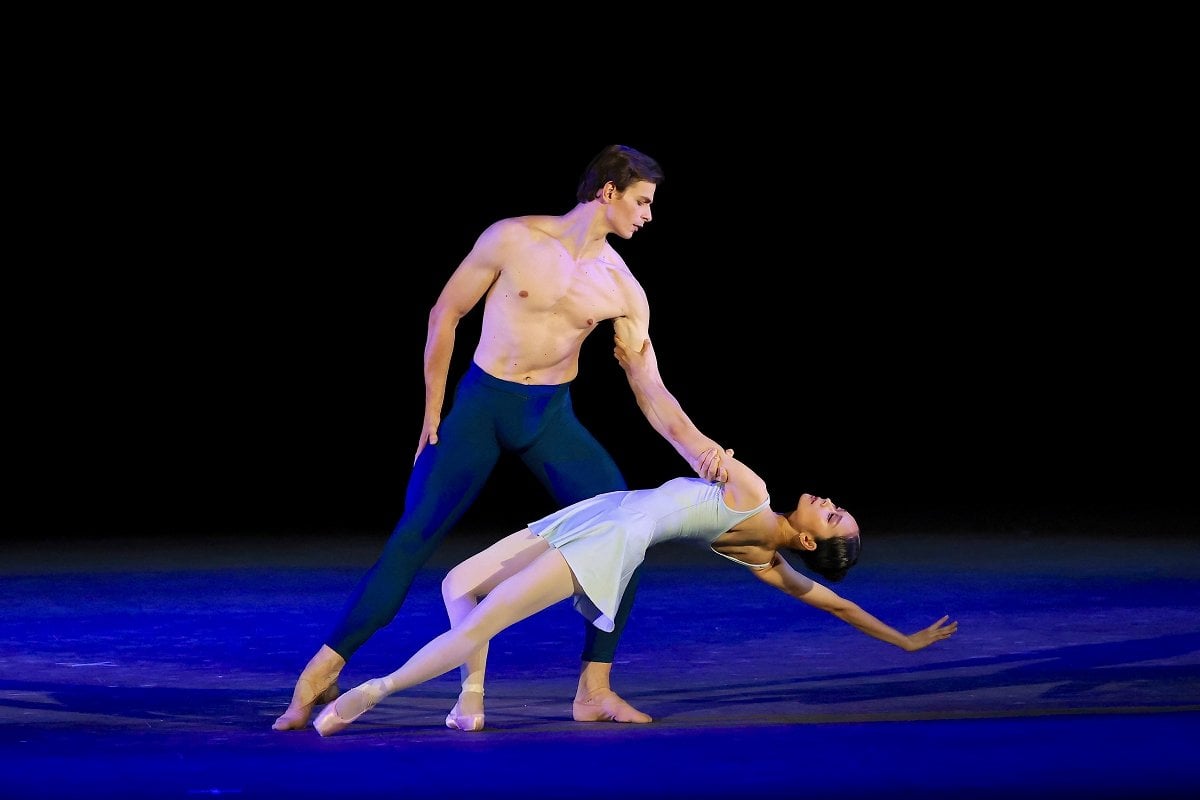
The Giselle and Romeo and Juliet pas de deux in the programme are both set in the open air and should have been highlights of the evening in Nervi’s beautiful park. Giselle just didn’t land, and technically and occasionally stylistically, it was lacking. Aliya Tanikpaeva and Dmitry Timofev (Hungarian National Ballet) were the dancers. The Romeo and Juliet balcony scene was danced by Cassandra Trenary and Matthew Ball, who separately were passionate under the starry sky, but there was little connection between them. However, what dancers! Trenary was fresh, without coyness, her feelings bursting to escape from her well-educated exterior. Ball was lost in his infatuation, slightly puppyish, and unafraid to express his emotions. They danced the steps to loving perfection. Trenary has left New York for Vienna (another of the dancers cleverly ‘poached’ by Alessandra Ferri for her first season as director), so here’s hoping to see more of her.
The Gala Mario Porcile was a fitting conclusion to the Nervi International Ballet Festival, which has returned to being a dance festival, removing (pop) ‘Music’ from its title. Jacopo Bellussi only has a contract for this season, which does not seem enough time to re-habituate the ballet-going public. Most festivals – Spoleto, Pesaro – last for two weeks, so it’s possible to see several shows in a stay of a few days. Nervi rambles over a month, with gaps between events, so it is not feasible to go ‘for the festival’. It’s tricky to get to by car (hairpin bends, traffic, motorway closures) and train (Turin to Nervi, changing at Genoa, is a three-hour journey to cover less than 200km, and from Milan up to four hours), and so a hotel is needed. Yes, there will be dance fans in the local area, but enough? Forgetting about budgeting and judging by the programme alone, Bellussi and Gielgud deserve a multi-season contract to give them time to elaborate their ideas and cultivate a new public.