
Review: The Royal Ballet’s Perspectives with Against the Tide, a world premiere from Cathy Marston

Perspectives Photo Album below
Jonathan Gray sees The Royal Ballet in Perspectives, a triple bill with works by George Balanchine, Justin Peck, and a world premiere from Cathy Marston.
| Title | Serenade | Against the Tide | Everywhere We Go |
| Company | The Royal Ballet |
| Venue | Royal Ballet and Opera, London |
| Date | 14 November 2025 |
| Reviewer | Jonathan Gray |
The Royal Ballet’s first triple bill this season on the main stage of the Royal Ballet and Opera (there will be only one more, next spring) offered audiences a good revival of George Balanchine‘s familiar Serenade alongside the world premiere of a new work by choreographer Cathy Marston, and the company premiere of a ballet by Justin Peck that was first performed by New York City Ballet in 2014. It’s an oddly made-up, uneven programme, but it did prove to be a stimulating one.

Against the Tide, danced to Benjamin Britten’s Violin Concerto (superbly played by soloist Vasko Vassilev) finds Cathy Marston working in a more fluid and lyrical style than I have ever seen from her before. Although she offered no overt explanation for the dances she has created, Marston made clear in her programme note that it was not an abstract work and was happy for audiences to decide for themselves what the ballet was about.
Britten composed the Violin Concerto not long before the outbreak of the Second World War, and, after a first viewing, I felt that Marston had based her ballet on the anxieties of that period of time, as well as drawing on Britten’s own personal life for inspiration.
Danced before an impressive set designed by Chloe Lamford that looked like the rocky outcrop of a cliff, we see William Bracewell – that most elegant of Royal Ballet principals – enter, sweeping his feet along the floor in a short solo, before he is joined on stage by a group of young men for a sequence of playful, gambolling encounters. The young men depart before another man, danced by Matthew Ball, enters the stage. There is an obvious physical attraction between him and Bracewell, succinctly expressed through caressing lifts and gestures as the men circle around each other. The intended homoeroticism is clear, although this pas de deux appears tentative, secretive and emotionally restrained.
Then another man (Nicol Edmonds) appears in uniform, and encourages the young men, including Bracewell, into militaristic exercises, although Ball does not participate in them. Are they being enlisted to fight in a war? It seems so, as the young men later reappear at the end of the ballet, marching and wearing uniforms. They leave, and a woman (Melissa Hamilton) enters and sits on the rocks beside Bracewell. By her movements, and by her loving, tender expressions towards him, I took her to be a maternal figure of comfort, her cradling of him an attempt to protect Bracewell against what the future might hold.
After she departs, Ball reappears for a second duet with Bracewell, which deploys some extraordinary dance images, including MacMillanesque lifts that see Bracewell held upside down in the air or diagonally across Ball’s back. The duet is intimate, tender and moving. As the ballet draws to a close, Bracewell seems on the verge of joining the other men before deciding to distance himself, and as the curtain falls, he is seen climbing up and along the cliff edge, his life taking him in another direction to that of his companions.
These, of course, are only my own reflections on what I saw on stage; others may have seen something entirely different. I did, however, find Against the Tide intriguing, if emotionally muted, and I greatly appreciated the fact that Marston had, first, brought Britten’s music back to Covent Garden, and, second, the bravery to depict an openly gay male relationship on the stage – something her male counterparts at Covent Garden have yet to tackle in any great depth. Her dancers were superb, with Bracewell and Ball outstanding. The Royal Ballet is lucky to have such marvellous interpretative artists within its ranks.

Justin Peck’s Everywhere We Go, which is now performed by companies around the world, is a wonderful series of dances to music by Sufjan Stevens which is performed before a beautiful, kaleidoscopic backdrop (designed by Karl Jensen) that changes its patterns and muted colours before our very eyes. Peck’s choreography is fast paced, inventive, sometimes humorous, often virtuosic, occasionally disquieting, and very American in style. It has energy and grace, and it is joyous in its unexpected twists and turns. I loved it.
Everywhere We Go must be wonderful to perform, and the dancers of The Royal Ballet rose to the challenge of the choreography with alacrity. Sae Maeda, Daichi Ikarashi, Luca Acri and Viola Pantuso all danced with speed and brilliance, whilst Mayara Magri and Marianela Nuñez brought a greater sense of voluptuous warmth to the choreography. Best of all, I thought, was Reece Clarke, who performed gloriously, and brought such largesse and scale to his dances that he seemed a man transformed. He was thrilling. Now The Royal Ballet needs to invite Peck back to create something entirely new for the company, and soon.
Top marks also need to go to conductor Martin Georgiev, who drew some marvellous playing from the Orchestra of the Royal Ballet and Opera, especially in Britten’s Violin Concerto. If you decide Cathy Marston’s ballet is not for you, you can simply close your eyes and just listen to the wonderful music instead.

Perspectives: A Photo Album
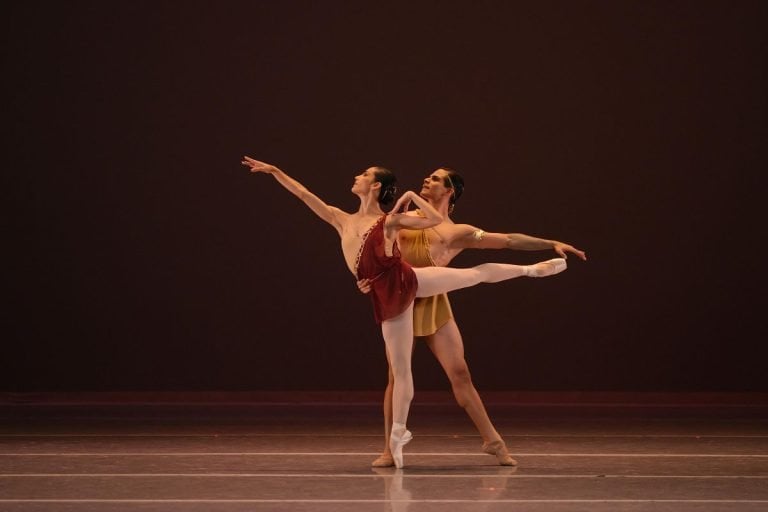
George Balanchine’s Serenade


Cathy Marston’s Against the Tide


Justin Peck’s Everywhere We Go


Jonathan Gray was editor of Dancing Times from 2008 to 2022.
He studied at The Royal Ballet School, Leicester Polytechnic, and Wimbledon School of Art where he graduated with a BA Hons in Theatre Design. He was on the Curatorial Staff of the Theatre Museum, London, from 1989 to 2005, assisting on a number of dance-related exhibitions, and helping with the recreation of original designs for a number of The Royal Ballet’s productions including Danses concertantes, Daphnis and Chloë, and The Sleeping Beauty.
Jonathan Gray has also contributed to the Financial Times and The Guardian, written programme articles for The Royal Ballet and Birmingham Royal Ballet, and is co-author of the book Unleashing Britain: Theatre gets real 1955-64, published in 2005. He is a member of the Dance Section of The Critics’ Circle.





Against the Tide … Swan Lake?
I’m surprised there’s no account of the actual quality of the dancing in the Balanchine beyond “good”. I thought it beyond remarkable, particularly the ensemble precision of the seventeen women at the start, as immaculate a display as I’ve ever seen in this piece (and incidentally, its 100th performance in the house). Vadim Muntagirov continues to define the term “elegance”; and Ryoichi Hirano, as the man torn between a crushed “Odette” and a ruthlessly controlling “Odile”, nailed the impossibly difficult manoeuvre of turning the latter slowly through two complete en pointe arabesques whilst himself recumbent and therefore only having access to her supporting leg from below to do so.
I thought the rationale behind the combined choice of works – far from “uneven” – quite cleverly calculated: the female-dominated “Serenade”, the wholly male-dominated Marston, ending with the full mixed-company Peck piece.
Incidentally, the Marston begins with a clear depiction of Bracewell’s character – Britten himself, perhaps: or possibly Lorca, given the Spanish Civil War origins of the music – not just in a “short solo” but actively running away in terror from something that has him in anguish: surely the pressure to conform (to his peers, to his mother, to society’s expectations of duty as personified by the man in uniform, who eventually claims all the others). And at the end he finally decides to go “against the tide” and strike out on a (literally) new path quite alone.
I thought the Peck piece overlong, poorly-structured, tediously hyperactive and with low-rent music; but there it is.
I quite agree about Pecks very NY City ballet, over long and repetitive and exhausting to watch! I really enjoyed Marston’s newest offering ,Against the Tide, intriguing intelligent ,thoughtful, and what the music expressed. Will and Matti were amazing in their interpretation. I want to see it again. The opening ballet ” Serenade” was danced impeccably by the company, especially by Vadim and Fumi ,they lit up the stage How lucky are we!