William Forsythe’s Ballets: Writing/Watching in a Contemporary Fashion
After seeing English National Ballet’s The Forsythe Programme, Kathrina Farrugia-Kriel reflects on William Forsythe’s career… so far.
Author’s note:
In ‘writing’ about Forsythe, I have been mindful that ‘watching’ is also part of the deal. There are several links in this article, including extracts of studio rehearsal, performances on stage, and an interview with a leading commentator on Forsythe’s ballets, which offer an interplay between writing/watching.
American choreographer William Forsythe has kept his audiences at the edge of their seats for almost five decades. Curiosity and rule-bending have been the hallmarks of his career – from his early days at Stuttgart Ballet, to coming full circle to his post-retirement, freelance career staging and creating works for ballet companies such as La Scala Milan, Boston Ballet and English National Ballet. While Forsythe’s late ‘foundation training’ with Nolan Dingman gave him a grounding in Balanchine Technique, it was his interest in theories by movement specialist Rudolf von Laban and post-structuralist thinking that enabled Forsythe’s ballets to move into new terrains. Critic for The New York Times Roslyn Sulcas describes Forsythe’s work as a ‘visual spectacle, a kinetic spectacle’.
As early as 1984, deconstructing the conventions of ballet and theatre was high on Forsythe’s agenda. Made in December in his inaugural year as director, Forsythe’s first ballet for the Frankfurt Ballet was titled Artifact. a three-act work that offered moments of rethinking ballet’s conventions, histories and practices. Like many of his ballets, Artifact underwent some evolution. Aterballetto in Reggio Emilia (Italy) performed a truncated version of the second act of Artifact, which became Artifact II, a precursor of Steptext, which The Royal Ballet first danced in 1997. I first saw the full-length Artifact at Sadler’s Wells in the autumn of 2001. I didn’t need convincing that this work radically reconsidered what ballet ‘looked like’, ‘felt like’ and ‘sounded like’. The second part of the full-length work, its core ‘ballet’, pinpointed some of the shifts at the hands of this choreographic innovator. A recording of J. S. Bach’s Chaconne in D minor solo for violin was chunked, re-ordered, repeated, and in many ways ‘deconstructed’. The drop curtain comes down, or blackouts occur, midway through the course of the performance. The audience loses sight of the dancers, but still hears the chunk of the ‘Chaconne’ as it continues to be played. When the lights suddenly come back on again, the dancers appear to have kept moving as though we ought to have known this was happening. I was struck by the qualities of movements of the female dancers as they were partnered. These women were not passively lifted; they moved with the same energy and aplomb as their male counterparts. They moved with the same kinetic energy, heightened by the attack of their pointework. There is so much happening on stage; the audience is responsible for which aspect of the ballet they watch.
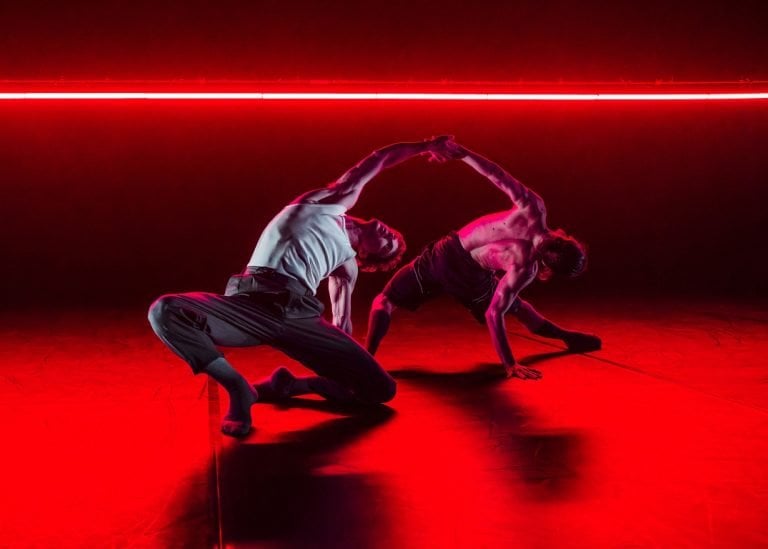
Sometime later I watched Of Any If And, which outlined the multiple points of movement within the moving bodies and where the electronic music of Thom Willems set sonoric points in space, rather than a framework for suspending the movement phrases. The fluidity in the transitions, often improvised responses to the rules of engagement set by Forsythe and his dancers (in this case Dana Caspersen and Thomas McManus), carved out a new possibility for the genre of ballet. But could we call this ‘ballet’? For two decades, I tussled with what to suggest this style of ballet could be called (it wasn’t ‘neoclassical’, nor was it post-modern, but maybe somewhere in between). Jill Nunes Jensen and I explored the notion of ‘contemporary ballet’ in a large anthology (called The Oxford Handbook of Contemporary Ballet), which dedicated a number of chapters to discussing Forsythe’s choreographic innovations and how ballet evolved through different permutations under his artistic vision. To some degree (albeit not in its totality), Forsythe’s work offered a window into the definition of ‘contemporary ballet’.

English National Ballet’s The Forsythe Programme offered a historical insight into these contemporary ballet moments. Rearray (London edition, 2025) and Herman Schmerman (Quintet) explored a concoction of the features and qualities that emerge from Artifact and Of Any If And. In Rearray, there are plays with where and when the movement starts/ends, chunks of accompaniment that sometimes get ‘cut’ or have rapid starts/stops, and the lighting cuts or fades out at unexpected times. During the interval on opening night I chatted with an old acquaintance, and we reminisced about first seeing Forsythe’s work. Did we think Forsythe’s choreography was cliché back in the day? Yes, some audience members found the theatricality somewhat perplexing, but we were certainly made to sit up in our seats and take note of what was happening, or figure out a way into these ballets. Sometimes these new works weren’t easy viewing. We were active audiences kept on the edge of our seats. Twenty years down the line, I think Forsythe’s ballet repertoire sits with both generations (those familiar, those new to these works).

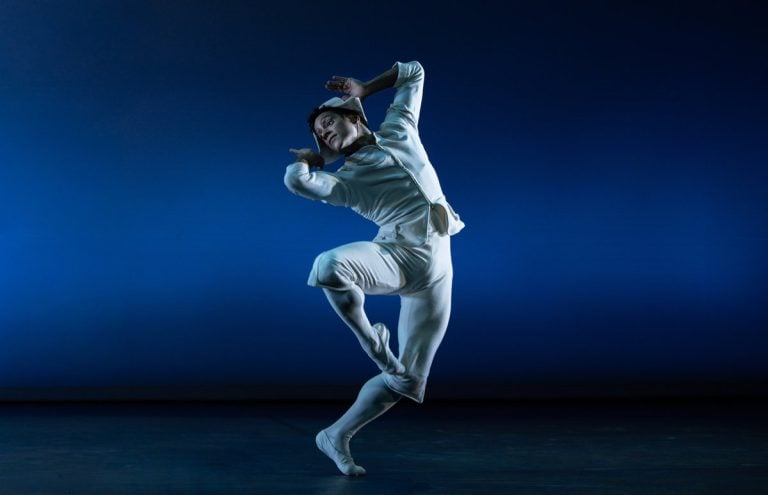
While Herman Schmerman (Quintet) (the title makes reference to a line from a Steve Martin film from the 1990s) may seem to be more ‘conventional’ in structure, there are so many threads that link back to the legacy of Forsythe’s ergonomic interest in ballet. Originally choreographed in 1992 for New York City Ballet‘s Diamond Project platform, the quintet version takes Willem’s score and presents a punchy, plucky and quirky use of ballet vocabulary and composition. Across the five dancers, there is plenty of movement material, patterns, and reorganisation of material to keep audiences seeking out the content of the ballet. It’s there in its full glory. The ballet has travelled to other companies, including a more austere version for the Bolshoi, while the duet version of Herman Schmerman has had multiple restagings from City Ballet to The Royal Ballet and the Paris Opera. In Forsythe’s world, restagings generate multiple interests in the possibilities of merging the past with the creative present. Expect variations and developments. It’s no different to the 1984/85 season.

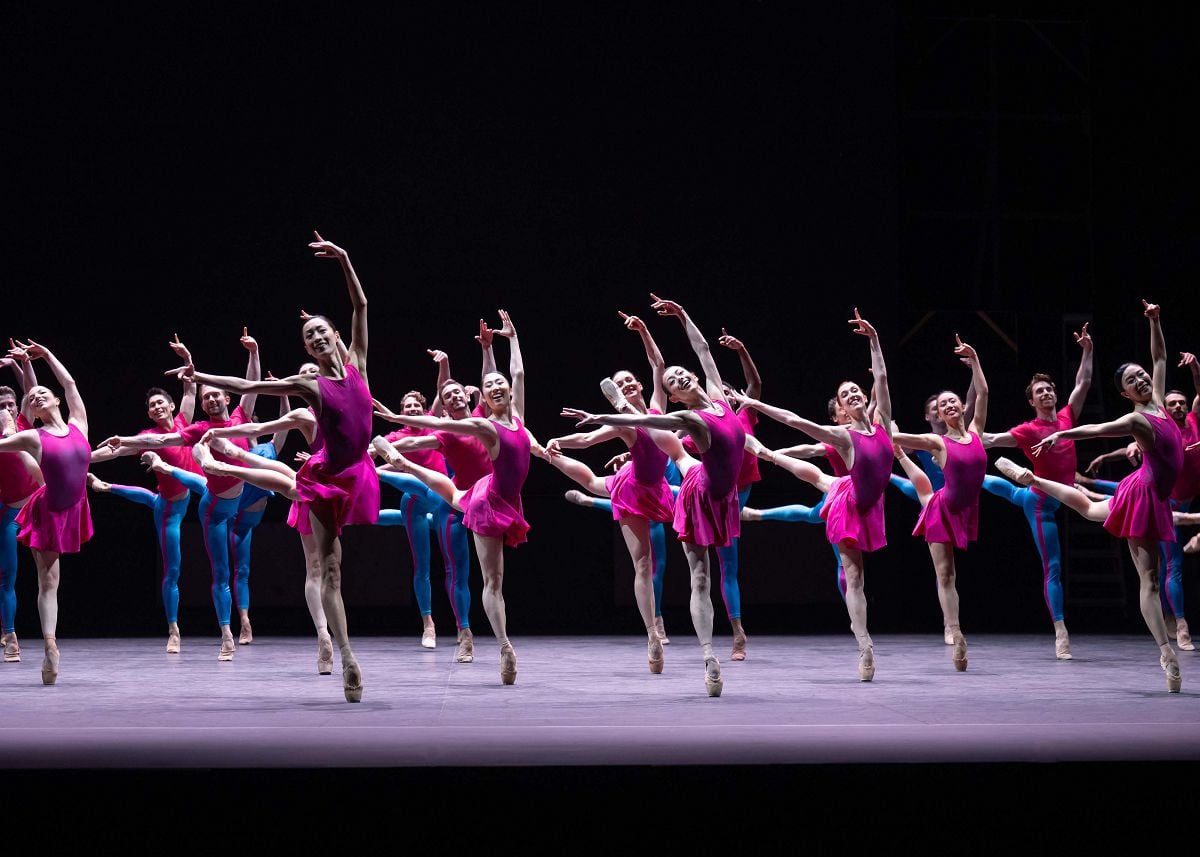
Playlist (EP) (2019) closed ENB’s The Forsythe Programme. It’s a popular ballet, to popular music (the list includes a Jax Jones remix, Barry White, and Natalie Cole). It’s almost reminiscent of Forsythe’s early ballet, Love Songs (1979), but it’s a lot more hip and ‘classical’ in many ways. Beaten elevation steps to catchy tunes, where a dozen men in blue lycra shirts and tights show off bravura but also an intensity of fun that, for me, is a rare feeling at the theatre. The exquisite detail of the formations (emerging and folding into the dozen men’s groupings) elicits a star quality in this work. I quite like the footage of Boston Ballet in rehearsal (Boston first premiered Playlist (EP) in 2019, but ENB first performed Playlist Track 1&2 in 2018); you get to see the detail up-close and personal. In all its historical forms, Playlist is not meant to be taken seriously, but it is a serious act of joy. It pushes the dancers to remind themselves ‘why’ they dance, and ‘how’ they do it.
Since ‘retiring’ from The Forsythe Company (which he directed between 2004 and 2014), Forsythe’s presence as a global phenomenon, has attracted new interest in creating ‘balletic’ works. Set to James Blake’s contemporary music from his debut album The Colour in Anything (2016), Blake Works (2016) was Forsythe’s first? creation for the Paris Opera since Rudolf Nureyev invited him to create In The Middle Somewhat Elevated in 1987. Like Blake Works, Playlist explores ballet in current times, and allows the audience to imagine a space for ballet on contemporary stages. In writing and watching the selection of works I have shared with you here, there is much to consider about Forsythe’s legacy. He is a maverick of contemporary ballet – past and present.

Dr Kathrina Farrugia-Kriel is a dance scholar, educator and published author. She is a graduate of the Royal Academy of Dance (2003), the Universities of Durham and Surrey, and London Metropolitan University (2013). Her doctoral research focussed on Bronislava Nijinska’s Les Noces (1923), and the re-imaginings by contemporary choreographers Angelin Preljocaj and Mauro Bigonzetti. Kathrina is a former director of the Society of Dance History Scholars (now Dance Studies Association). Her scholarship on ballet histories has been published in peer-reviewed anthologies and journals, as well as newspapers, high-end magazines, and online blogs. She has authored a book on the legacy of Nathalie Poutiatine and ballet in Malta (Fondazzjoni Patrimonju Malti, 2020) and co-edited an extensive and pioneering anthology titled The Oxford Handbook of Contemporary Ballet (Oxford University Press, 2021).




Thank you for your wonderful insights.