Review: Nederlands Dans Theater’s double bill, Wildsong

Matthew Paluch sees Jan Martens’ KID IN A CANDY SHOP and Marcos Morau’s Horses with Nederlands Dans Theater – dancers of unquestionable commitment and style.
| Title | Wildsong – KID IN A CANDY SHOP | Horses |
| Company | Nederlands Dans Theater |
| Venue | International Theater Amsterdam |
| Date | 18 February 2026 |
| Reviewer | Matthew Paluch |
The Nederlands may be a small country, yet its cultural landscape is anything but. Nederlands Dans Theater are currently on tour, and I was lucky enough to catch their double bill Wildsong at the International Theater Amsterdam at Leidseplein.
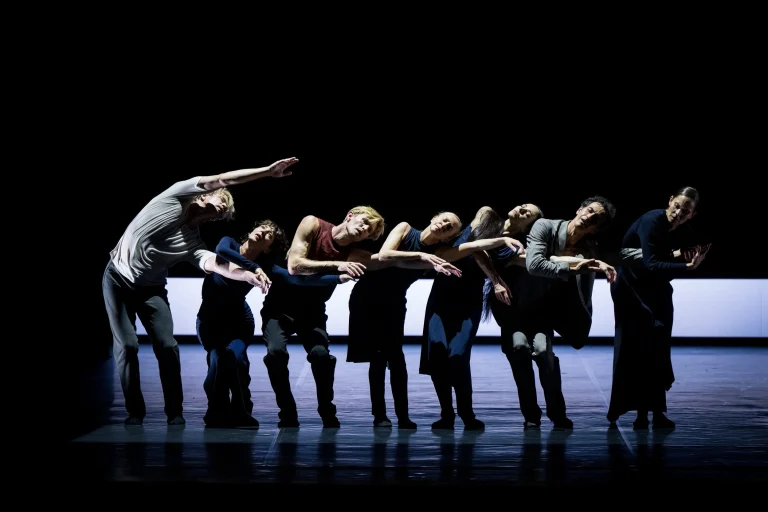
The opening work was KID IN A CANDY SHOP (2026) by Belgian choreographer Jan Martens, and it restored my faith in of the moment contemporary dance choreography. Martens is known to use music as the starting point for his creations, and it shows – in a good way. First, he has taste as both pieces; “Pretty” by Julia Wolfe and “GG Concerto” by Hanna Kulenty are original, modern and engaging. And most importantly he understands music; how to go with or against it, and the power of music visualisation via movement.
Of course, the dancers of NDT help no end. With their unquestionable commitment and movement style that’s simultaneously articulate yet free, and with physiques to die for. But that said, if they didn’t believe in what they were doing, I think we’d be able to tell, and they clearly do.
Martens is also an expert in structure. Numerous things can be happening, but one never feels bombarded. Unison starts to break so inconspicuously that you initially think a dancer has made a mistake… but then it becomes clear. His bird’s eye view of the work is captivating his audience, making them relax, waking them up to concentrate and so on. It’s truly engaging.


The movement itself harks back to the modernism of the 1960s. Martens uses simple language but repeats and develops it in order to create something that feels truly original and spontaneous.
Case in point: chasse en tournant becomes vividly paramount – who knew?! At times the experience felt like a movement kaleidoscope, undoubtedly supported by the pastel lycra (Joris van Oosterwijk), sporadic soft lighting (Jan Fedinger) and a video backdrop (van Oosterwijk and Ennya Larmit) that ranges from minimal matter to ever-multiplying flora and then Rothko-style red vibes.
Throughout one feels an urgency, and this came into fruition towards the end during a male solo. The dancer in question seemed quietly possessed by the choreography, as if the movement was a virus and it was exploring its capability through his body. Tight, frustrated gesture – pained, long reaches. It seemingly went everywhere yet absolutely made sense.
Only one moment did I contemplate groundhog… but that could equally read motif – and I found the ending a little weak – but I wonder if there was a slight production blip in the moment. All in all, Martens is a major talent with something to say and is creating movement in this work that the dancers want to realise and the audience want to experience. Exciting to put it mildly.


The second work Horses (2024) by NDT associate choreographer Marcos Morau is something I can appreciate but not necessarily buy into. Personally, it comes under the umbrella term ‘contemporary dance noir’.
To explain: a lot of contemporary dance, in the last decade or so, has a similar feel. One always seems to be in an interchangeable place – a poorly lit undisclosed basement or bunker and the atmosphere conjures feelings of incarceration and interrogation. Eccentric characters move around the space in an absurd manner – in relation to both movement and personality – yet we don’t really find out anything more. So there’s a sense of narrative – dark, doom, dread etc. But as it ultimately goes nowhere, I tend to lose interest.
Morau understands atmosphere and works with a talented team to create it. Lighting Designer Tom Visser seems to be everywhere currently and works his subtle, foreboding magic here. Though I’m unsure whether it’s Visser or Max Glaenzel (set design) who are responsible for the moveable streetlamps that very much define the piece – both in how it’s lit and subsequently seen, as well as acting as climbing apparatus to enhance the choreography, which they actually do.


Betroffenheit (2015) by Crystal Pite introduced (to me and I’d propose the larger contemporary dance scene) the notion of dance in relation to spoken text. In that moment it felt of importance, but I’ve since tired of the method as I find it relentless and a tad anxiety-inducing. Morau opens Horses like this and brings it back midway, and then later during a duet a female dancer moves as she chirps, developing to pained groans, before blood-curdling screams. We don’t know why. Not for me.
Elsewhere, ragdoll-style duos are ingeniously created but it’s not a new proposition, and this is how I feel about the entire work. Skilled yes – and I can appreciate this. But overall, it feels like Morau has taken the ‘what does a current contemporary dance work need to include in order to be taken seriously’ test and scored top marks. In reality, Martens is top of the class for me – but the subject is subjective; so who knows…


Matthew Paluch was awarded a place at The Royal Ballet School in 1990 where he graduated in 1997. His first four years as a professional dancer were spent working with London City Ballet, Scottish Ballet, K-Ballet and English National Ballet, becoming a full-time member of ENB until leaving in 2006.
Matthew graduated from the Royal Academy of Dance, Professional Dancers’ Teaching Diploma in 2007, and was formerly on faculty at The Royal Ballet School. He completed his Masters in Ballet Studies at Roehampton University in 2011, has been a freelance writer since 2010 and currently works in the Law Sector.
He is a member of the Dance Section of The Critics’ Circle.