Review: The Nutcracker with Rome Opera Ballet showing choreographer Paul Chalmer’s “wisdom, passion and finesse”

Donatella Bertozzi sees The Nutcracker in Rome and finds in Paul Chalmer “a strong narrator and an expert dance maker”.
| Title | The Nutcracker |
| Company | Rome Opera Ballet |
| Venue | Teatro dell’Opera, Rome |
| Date | 15 December 2024 |
| Reviewer | Donatella Bertozzi |
Nearly one hundred years after the first appearance of Nutcracker on the stage of Rome’s Teatro dell’Opera, and thirteen different choreographic versions later, a brand new production, with choreography by the Canadian Paul Chalmer, was premiered last season by the theatre’s ballet company directed by Eleonora Abbagnato.
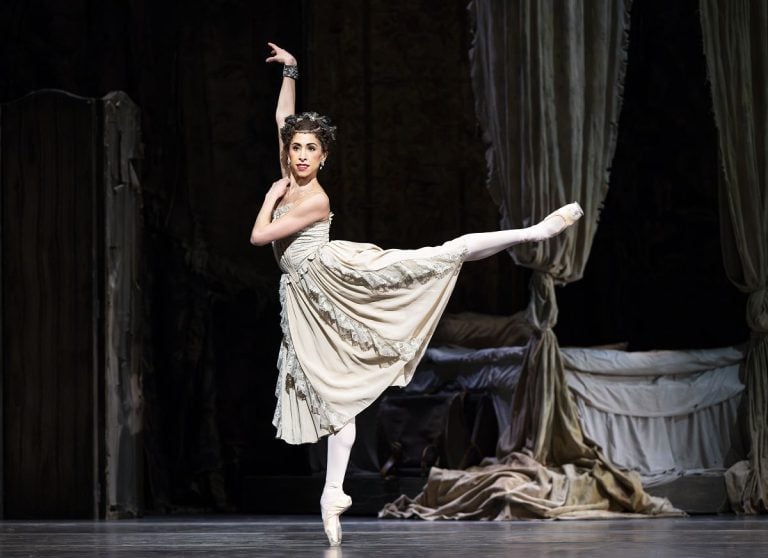
It was, most appropriately, on the bill again this season, starring once more the picture–perfect Maia Makhateli from Het National Ballet as the Sugar Plum Fairy and the American Julian Mackay, of the Bavarian State Ballet as her Cavalier.
A lovely production, full of action and charm, set in an elegant Art Nouveau scene combining hand-painted scenery and video projections, Chalmer’s Nutcraker has an unusually strong dramatic structure, well-shaped into a prologue and two acts. The first act is further divided into three scenes, while the second is an airy, colourful and joyous version of the classical divertissement meticulously conceived by the great Marius Petipa and choreographed, as far as we know, by his uniquely talented assistant, Lev Ivanov, for the 1892 debut at the Mariinsky Theatre in Saint Petersburg.
I first saw this production last year with the delightful Rebecca Bianchi, one of the theatre’s étoiles, as the Sugar Plum Fairy and found the production technically flawless and choreographically interesting. Disappointingly, on the night of the première this year, the technicalities didn’t look quite so flawless – I suspect, based on past experience, due to an insufficient number of rehearsals, as the company on the whole appears to be in very good shape. Yet the dramatic structure and the ingenious choreography still held well, quickly succeeding in wrapping up the audience in the magic of Tchaikovsky’s Christmassy musical poetry.
Chalmer, who had danced and watched innumerable versions of Nutcraker since his childhood – making his debut in Celia Franca’s production for the National Ballet of Canada – has thoughtfully pieced together the vast array of tiles that today make up the ballet’s mosaic after its 132 years of life: catching echoes of E. T. A. Hoffmann’s disquieting original tale, embracing the main storyline inherited by the Alexandre Dumas père edulcorated version of the story that Petipa used for the ballet libretto, and wisely selecting – with some inventions of his own – from the abundance of layered choreographic traditions that have nurtured the life of the ballet, first in Europe, later in the States, then worldwide.
From the moment the curtain goes up we are taken on a trip to a different world, differing not only in time and space from our world (later, in the second act, we’ll be in a land of dreams) but also gently frozen in a different culture. A culture so close to ours that the values on which it is built are still relevant to us and yet we can measure its vast distance from ours.
In the Christmas market of the Prologue, we see privileged children with the less fortunate who, though not actually mixing, can still all play happily and safely in the street, side by side. A very well-dressed little girl who is obviously warm enough, offers her woolly scarf to an underprivileged, shivering girl who smiles back at her and gratefully accepts the gift. It’s Christmas Eve and everybody feels safe and benevolent. No car bombs or knives round the corner.
Then, at the Christmas party in the first act, we see actual children playing children, and how convincing and excited and genuinely joyous the pupils of the Rome Opera Dance School are in playing their roles! Parents, and grandparents, are definitely grownups – nobody indulges in any prolonged adolescence. Boys are boys and play with swords, girls are girls and play with dolls, pushing a little chain of tiny pushchairs, while boys march like little soldiers. This resonates so clearly with Tchaikovsky’s music (which Chalmer shows he knows so well) and with the ballet’s original conception, that I felt grateful not to have to engage, for once, in an interior battle to disentangle my own memory of Nutcracker from what was actually being shown on stage.


And talking of battles… how well designed, vivacious and exciting is the Battle between the mice and the little tin soldiers! So much so that I could feel (maybe I only imagined) the light thrill of football-supporter-like spirit gently rippling through the audience until the Nutcracker Prince emerged from the fight as the winner.
Chalmer may not be a genius choreographer like Patipa, Ivanov or Balanchine, but he knows his craft very well and works with wisdom, passion and finesse. Being a strong narrator and an expert dance maker, he furnishes groups and soloists with sensible theatrical materials, dynamically rich movement compositions and elegant and complex academic enchainements. We might not be 100% sure whose choreography the original 1892 Nutcracker was by, but in the Snowflakes Tempest at the end of Act One, Chalmer’s homage to Ivanov’s universally praised Swan Lake second act designs is limpid and mostly generous and appropriate.
Always keeping a sharp director’s eye on the dancers’ expressions and promoting adequate interpretation, he brings out every dancers’ talent and thereby enhances the identity of the company. It is, after all, an Italian ballet company – that is a company at its best when vivid expressiveness and quick, sharp technicalities are required. Both Flavia Stocchi (Clara) and Alessio Rezza (the Nutcracker Prince) were excellent in these respects.
Against this rich theatrical and choreographic tapestry the talent and stylistic purity of Maia Makhateli stands out. Her rendition of the role of the Sugar Plum Fairy is a combination of quiet and elegant perfection of line, breathtaking balances, and exquisite mastery of the twentieth century tradition of the English ballet, of which Margot Fonteyn was the quintessential embodiment.
In the role of the Cavalier, Julian Mackay is supple, refined and technically more than proficient. However, he is so nobly detached and prim that he ended up reminding me of a cup of iced tea.
And it was tea that was missing in the second act. The one thing I did not appreciate in Chalmer’s version of Nutcracker was the fact that, in the second act, he chooses to ignore the traditional connection between the first three character dances – the Spanish Dance, the Arab Dance and the Chinese Dance – and their original related drinks… cocoa, coffee and tea. In doing so he makes the appearance of the dances illogical: why on earth should Spanish, Arabian and Chinese dancers appear in the Land of Sweets and Cakes?