Nutcracker-lite at La Scala – très chic Casse-noisette from Geneva

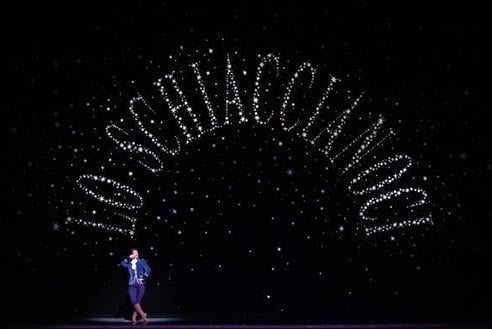
What a disappointment was La Scala‘s new Nutcracker. A shimmering front-cloth announced “Lo schiaccianoci” as though written in the stars, Tchaikovsky’s bewitching overture started and there was that Christmassy buzz of excitement… a feeling that only lasted five minutes or so. With the odd decision to have a narrative voice-over clash against the music – and saying nothing in particular – Nacho Duato’s low-key production limped away from the starting blocks.
Duato himself says of his production,
I don’t propose my own vision of the fairytale, I do not add anything.
He certainly didn’t, and there certainly wasn’t a vision. The choreography is bland, the story isn’t clearly told, the designer (Jérôme Kaplan) had some fun ideas which weren’t followed through and although the production was created for the Mikhailovsky Theatre, which boasts a large corps de ballet, the stage at La Scala appeared deserted. Strangely, the Milanese theatre hasn’t put on a Nutcracker for eight years, and the last time round it was Nureyev’s production, which has been seen since 1969 in Nicholas Georgiadis’ sumptuous designs. After the head-scratching difficulties of Nureyev’s choreography – especially for the corps – the Duato version seemed empty, almost unfinished: this was a preliminary sketch whereas Nureyev’s production was an oil painting.

The lack of magic in the steps and formations was matched by the scenery which didn’t ‘do’ anything: the Christmas tree of the first scene is later suggested by giant tree of stars which is a nice idea (though there was no transformation scene), but when a black cloth with a triangle cut out of it flies out to reveal the star-cloth behind, the stage magic is lost. There were many little ideas which came to nothing like the cute cellophane wrap tutus for the snowflakes which seemed to have drifted in from another production, the girls then added white fur-lined hoods for the closing moments of the first act, with candles in their palms, which made them look like something out of a Perry Como Christmas Special. There was a giant cupcake looking like a honeycomb paper decoration (it was the waltz of the cupcakes, not flowers) which was a fun idea, so why wasn’t it used for the other elements that represented the different dances? The Spanish dance had a two-dimensional cut-out fan suspended above the stage, and the Russian sailors (yes, sailors) danced under flat ship’s wheels, yet the dance of the reeds (here a pas de deux) had a series of hi-tech hearts dropping down like a Tetris game to form one giant pink heart. Odd. The Mouse King looked as though he’d stumbled in from a gay club’s Halloween party, and the mice were dressed as WWI aviators. Clara wasn’t scared, just confused. As was the choreographer; here’s Duato again,
The only thing I really don’t understand is why the Mouse King is hurt at the end of Act 1 and in Act 2 he’s still alive? I will have him dead in Act 1, and the Spanish Dance will open Act 2.
Great solution! That must have taken some thinking about, just like his decision on how to end the ballet. The Prince loses Clara among the cupcakes, gets struck by a series of muscle spasms and is taken offstage (to the physiotherapist or to become a nutcracker again), Drosselmeyer with his long cape swishes around the empty stage, gives Clara her toy nutcracker with the goofy teeth and she hugs it. Black out. Curtain. And a happy kitsch Christmas to you all.
The company gamely gave it all they had, with Walter Madau grinning wildly as Fritz, Antonina Chapkina seductive in the Arabian dance, and with Nicoletta Manni and Claudio Coviello in the leading roles using all their skill to make the best of the flimsy choreography. Angelo Greco, Mattia Semperboni, Matteo Gavazzi and Timofej Andrijashenko, as the four Querelle de Brest sailors, guaranteed a roar of applause. I’ve never seen a less happy bunch of people leave a theatre after a Nutcracker in my life.


Jeroen Verbruggen’s Casse-noisette from the Ballet du Grand Théâtre de Genève was something else indeed. Although it only loosely told the classic story, it was coherent and visually stunning from beginning to end. Livia Stoianova and Yassen Samouilov, the couple behind the French maison On aura tout vu, who devise many of Lady Gaga’s creations, were behind the look of the production, and the costumes and scenic elements were exquisite.
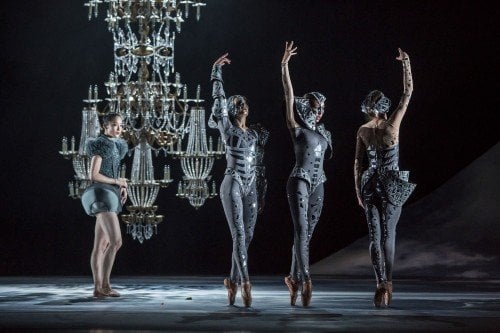
The company was guesting at Bolzano’s Civic Theatre close to the famous Christmas market. But there was no Christmas cosiness on stage. A serious of dancing soldiers – Drosselmeyer’s henchmen? – were straight out of a Tim Burton movie. They were threatening and disturbing, and the whole atmosphere was dark for Clara’s sexual awakening, though here she’s called Marie. The Nutcracker had a head like a pink Alessi loo brush which was the only note of true colour in the whole design. A massive crystal chandelier tried to lightened up the atmosphere, but it’s effect was temporary until the Nutcracker was stripped of his formal attire and was presented naked like an anatomical diagram. Marie was in love. Here, however, she finishes with her prince, in natural human form, as other wannabe nutcracker princes – pink loo brushes – begin to fill the stage. The choreography isn’t always the most inspired, (some of Matthew Bourne‘s leftovers crept in), but the whole is extremely pleasing and intelligent.
The company are committed and talented, with a courageous Sara Shigenari as Marie, and excellent performances from the super-talented Nahuel Vega as the Nutcracker Prince and Geoffrey Van Dyck as Drosselmeyer.
This Nutcracker was everything that the La Scala attempt wasn’t: atmospheric, challenging and exciting.