
Review: Alice’s Big British Ballet – Wheeldon’s Alice’s Adventures in Wonderland receives US premiere

Scott C Morgan sees the US premiere of Christopher Wheeldon’s Alice’s Adventures in Wonderland with the Joffrey Ballet – thoughtful with impressive dance and production dazzle.
| Title | Alice’s Adventures in Wonderland |
| Company | The Joffrey Ballet |
| Venue | Lyric Opera House, Chicago |
| Date | 5 June 2025 |
| Reviewer | Scott C Morgan |
There’s no doubt that The Joffrey Ballet is hoping family audiences will turn out strong for the US premiere of choreographer Christopher Wheeldon‘s hit 2011 adaptation of Alice’s Adventures in Wonderland, now running at the Lyric Opera House through June 22. But what about contemporary opera fans?
Among Alice’s many impressive production credits is an original ballet score by Joby Talbot. The British composer’s subsequent opera commissions include a 2019 silent movie score of the 1932 film Vampyr by director Carl Dreyer for LA Opera, plus two Dallas Opera world premieres: The Diving Bell and the Butterfly in 2023 and Everest in 2015 (the latter was also staged by Chicago Opera Theater in 2019 on a double bill with Aleko by Rachmaninov).
Alice’s Adventures in Wonderland also features live accompaniment by the Lyric Opera Orchestra led by Joffrey music director and principal conductor Scott Speck. The Joffrey Ballet had a previous Chicago home in the 1889 Auditorium Theatre of Roosevelt University and a partnership with the Chicago Philharmonic before switching performing venues in 2021 to the 1929 Civic Opera Building (home of the Lyric Opera of Chicago since 1954).
Hence, the Lyric Opera Orchestra has received extra work in subsequent seasons with The Joffrey Ballet. They’ve not only performed classic works, but several contemporary ballet scores like Thomas Newman’s Of Mice and Men, Lera Auerbach’s The Little Mermaid and Laura Rossi’s Atonement.
While I don’t suspect Talbot’s energetic three-act score for Alice’s Adventures in Wonderland will be getting the symphonic suite treatment like the classic ballets of Tchaikovsky and Prokofiev, it beautifully does its job in helping to aurally illustrate this international hit ballet. I even detected a quick and crucial Benjamin Britten reference that would only be caught by die-hard opera fans. But more on that later.


Since its London world premiere for the Royal Ballet at the Royal Opera House, Covent Garden, the ballet has gone on to be performed in Canada, Japan and Australia. The Royal Ballet & Opera has also staged a few London revivals of Alice’s Adventures in Wonderland, including a simultaneous one this month – this is possible since the Joffrey Ballet is using duplicate sets and costumes co-owned by the Royal Danish Ballet and Royal Swedish Ballet.
Alice’s production credits notably feature many creatives who have won multiple Tony Awards. Any Broadway musical fan will immediately note such marquee names as choreographer Christopher Wheeldon (MJ, An American in Paris), set and costume designer Bob Crowley (Aida, Mary Poppins), and lighting designer Natasha Katz (Once, Sweeney Todd). They all bring loads of Broadway razzmatazz, laughs, and visual spectacle in transforming this landmark 1865 fantasy novel by Lewis Carroll (aka Charles Dodgson) into a 21st-century ballet.
Working from a scenario devised by Nicholas Wright, Wheeldon taps into the worldwide craze for Downton Abbey at the top of the ballet by featuring a forbidden Upstairs Downstairs-type romance. This plot addition also allows for an emotionally involving love thread to run throughout Wheeldon’s take on Alice, and provides ample opportunities for romantic pas de deux partnering expected of any great story ballet.
Wheeldon’s Alice’s Adventures in Wonderland is framed by scenes in Oxford, England. Starting in the 1860s, a yet-to-debut teenage Alice (Amanda Assucena) is carrying on a cross-class flirtation with the handsome gardener Jack (Alberto Velazquez) who works in service to her wealthy family. (Since dance companies often double- or triple-cast most story ballets, I’m citing performers credited on the opening night performance of June 5).
Things come to a head at a fancy garden party thrown by Alice’s imperious Mother (Victoria Jaiani) and ineffectual Father (David Gombert). There are plenty of distinguished guests, ranging from a wealthy Rajah (Jonathan Dole) to a quirky Magician (Edson Barbosa). But the most notable visitor in terms of storytelling is the academic don and family friend, Lewis Carroll (Stefan Gonçalvez). Carroll is there to entertain Alice and her two sisters (Yumi Kanazawa, Natali Taht) with stories and to document the occasion with his newfangled camera.
Now, Wheeldon has shown in the past that he isn’t afraid to tackle disturbing topics in dance. His historically informed reinterpretation of Swan Lake (re-staged by The Joffrey Ballet in 2018) notably showed how a wealthy male patron preyed upon the young dancers of a 19th-century Paris ballet company. But a family-friendly ballet adaptation of Alice’s Adventures in Wonderland is not going to seriously tackle Carroll’s controversial hobby of photographing young girls, like the real-life Alice Liddellwho inspired his enduring novels. So, a more subtle way was found to quickly comment on this biographical detail.

In the ballet, an upset Alice turns to Carroll for solace when her actions unintentionally lead to her mother dismissing Jack. To underscore this precise moment of Carroll consoling Alice, composer Talbot and co-orchestrator Christopher Austin instrumentally feature the celeste. Opera fans no doubt will pick up on Britten’s similar use of the celeste to announce the arrival of the ghostly child predator Peter Quint in his opera adaptation of Henry James’ The Turn of the Screw. So, the ballet does not completely ignore Carroll’s questionable choice of photographic subject matter, even if it is a blink-and-you’ll-miss-it moment.
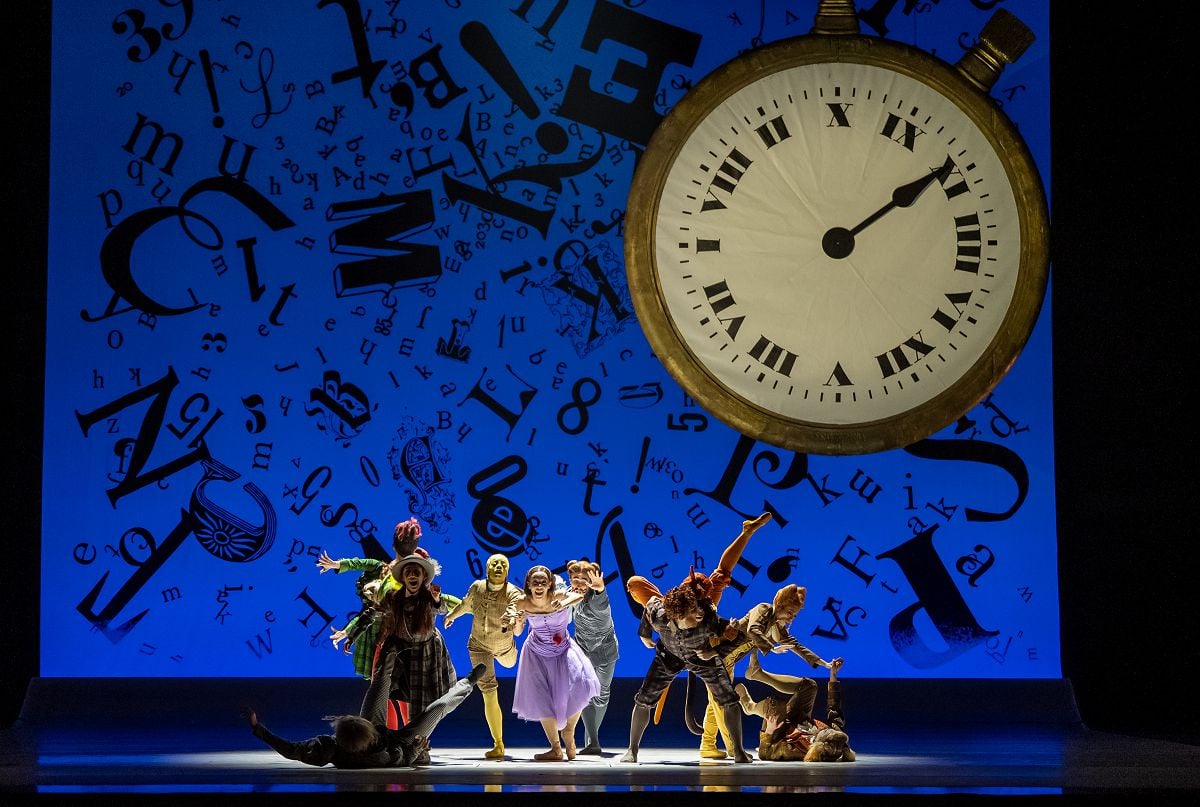
Carroll then takes a photo of the distraught Alice, and it’s at this precise juncture in the ballet when the fantasy takes over as he starts to transform into the White Rabbit. Alice follows him on a strange journey as she falls down an animated rabbit hole jumbled with a morass of typography (perhaps a symbolic nod by projection designers Jon Driscoll and Gemma Carrington to highlight the global impact of Carroll’s enduring and continually inspiring texts). And in a nod to The Wizard of Oz, Wheeldon has Alice’s other real-world relations and party guests turn into Wonderland characters. Hence, Jack becomes the Knave of Hearts, who is pursued throughout the ballet by the bloodthirsty Queen of Hearts (actually Alice’s mother, who is trying to control her daughter’s love life).
More fantasy-versus-reality fun is had as Wheeldon and his designers play with scale to depict Alice’s many size changes that happen when she imbibes or eats items that demand her to “Drink Me” or “Eat Me.” It’s also here where the novel’s original John Tenniel illustrations provide great imaginary templates as we see Alice “shrink” and “grow” onstage to emulate his iconic imagery.
More class warfare is in store when Alice enters the home of the Duchess (a fun panto dame drag turn by Dylan Gutierrez) who does battle with her blade-wielding Cook (Lucia Connolly). Here we also get the first introduction of the disassembling Cheshire Cat, ingeniously fabricated by conceptual puppet designer Toby Oliéand operated by a team of black-clad puppeteers.
Die-hard ballet fans will chuckle aplenty throughout Alice’s Adventures in Wonderland. That’s because there are plenty of times when Wheeldon spoofs iconic moments from ballet history. For example, the trio of the Magician-turned Mad Hatter (Edson Barbosa), the Vicar-turned March Hare (Fernando Duarte) and the Verger-turned Doremouse (Lindy Mesmer) all strike a pose similar to the muses in George Balanchine’s ballet Apollo during Wheeldon’s celebrated take on the Mad Tea Party in Act II. Could it be that Wheeldon was preemptively clapping back at ballet traditionalists who are upset by his idea of a tap-dancing Mad Hatter by drawing parallels to Balanchine and his 1930s Broadway choreography for such Rodgers and Hart musicals like On Your Toes and Babes in Arms?
Wheeldon also bawdily spoofs the famed Rose Adage from The Sleeping Beauty with a hilarious Act III showpiece called the Tart Adage. That’s when the Queen of Hearts nearly cuckolds her King while trying out a quartet of incompetent and terrified card cavaliers. But it’s clear that the Queen of Hearts already has an ardent lover-in-waiting with the leather-clad Executioner (Valentino Moneglia Zamora). Wheeldon also injects a touch of ballet Orientalism by having the Rajah become the hookah-smoking (and mushroom-pushing) Caterpillar (Jonathan Dole). This exotic insect appears after his wordy smoke clouds prompt Alice to face some tough existential questioning in a lovely Act II dance solo.


Wheeldon and Wright largely eschew borrowing from Carroll’s 1872 sequel Through the Looking-Glass, save for a scene when Alice encounters a garden of vain talking flowers. Wheeldon uses this sequel to stage an Act II sequence of dancing flowers, possibly to highlight how Alice will soon be coming out into society by attending any number of balls. That’s where Alice will be similarly festooned with flowers while likely being pressured into a suitable marriage with a man she might not love. Of course, Alice would prefer to dance with the Knave of Hearts instead.
So, will Alice have a romantic reunion with Jack following his trial as the Knave of Hearts for stealing those iconic tarts? Will they both escape from the clutches of the Queen of Hearts and her coed army of dancing playing cards?
I’ll leave that question up for Chicago audiences who actually see Wheeldon and Wright’s re-writing of Alice’s Adventures in Wonderland as a prolonged dream ballet. While some may be disappointed by the final scene, I was mightily impressed by this contemporary ballet and how well it was reset on The Joffrey Ballet. But that makes sense, since Wheeldon already has a long relationship with The Joffrey Ballet, especially with his 2016 Chicago-centric take on The Nutcracker. That’s when Wheeldon refashioned Tchaikovsky’s enduring 1892 Christmas ballet to draw historical connections to the Windy City’s globally influential 1893 World’s Fair (officially known as the World’s Columbian Exhibition).
Like his Nutcracker, Wheeldon creates a thoughtful ballet version of Alice’s Adventures in Wonderland that seriously takes in historical context. Meanwhile, Wheeldon also provides enough dance and production dazzle to impress both first-time ballet audiences and discerning veterans. Alice pays great homage to a piece of British heritage literature that continues to have a lasting impact on global culture, but more importantly, this ballet is also willing to explore and question the times surrounding its creation. And hopefully, it will help inspire more opera and ballet audience crossover. As much as both art forms are buttressed by the warhorse classics that are revived with regularity, opera and ballet also need to be refreshed with new works to remain relevant. You can’t go wrong with such an entertaining and enlightening proven contemporary story ballet like Wheeldon’s Alice’s Adventures in Wonderland.
The Joffrey Ballet’s U.S. premiere of Alice’s Adventures in Wonderland
continues through June 22, at the Lyric Opera House, 20 N. Wacker Drive, Chicago.
For more information, visit joffrey.org.


Chicago-based Scott C. Morgan is an avid opera and theatergoer. He is a frequent freelance contributor to the Windy City Times, and previously served as that publication’s freelance theater editor from 2008 to 2018. He also worked primarily as an arts writer for the Daily Herald in suburban Chicago from 2004 to 2022.
He has raised donations as an endurance race runner for AIDS Foundation Chicago via its charity training program Team to End AIDS from 2011 to 2023, and also co-hosted two Opera Tunes fundraisers at Chicago’s famed Sidetrack Video Bar in 2019.


“The Royal Ballet & Opera has also staged a few London revivals”
Not so few: tomorrow night’s performance at Covent Garden – which should have featured Osipova as the Queen of Tarts, except she’s gone off gala-ing hither and yon, replaced by Mayara Magri – will be the 84th in the House since its premiêre in 2011.
“…a few London revivals” does not mean “a few performances”, it means that the production has been programmed several times since the premiere in 2011 – namely 2011-12 (premiere season), 2013, 2014-15, 2017, and 2024-25.
Before rushing in to print, try reading properly first. You’re so keen to correct me you don’t even see the quotation marks – which means I’m quoting someone else, so you know – and have clearly not read the actual review for the context.I was correcting.
Sweetie, I was correcting the article, not you. If you’d read my comment you’d have seen I used quotation marks too. I was expanding on your comment. I await your apology.
When I was in journalism school, my professors advised us to use the term “a few” to mean “at least three” when we didn’t have time to get an exact number. When this review was published in June of 2025, I could discern that there were at least three London REVIVAL RUNS of “Alice’s Adventures in Wonderland” programmed by the Royal Ballet & Opera following its 2011 world premiere run. Of course, each of those revival runs featured multiple individual performances. If you are all so hung up on the word “few,” I’ll ask the website administrator to re-word the sentence in the original review to say “several” instead.