Review: Cathy Marston’s Jane Eyre – Northern Ballet shows off its flair and mastery

Kathrina Farrugia-Kriel sees Jane Eyre, Cathy Marston’s work for Northern Ballet – Marston is an outstanding storyteller, and the company is a joy to watch.
| Title | Jane Eyre |
| Company | Northern Ballet |
| Venue | Sadler’s Wells, London |
| Date | 13 May 2025 |
| Reviewer | Kathrina Farrugia-Kriel |
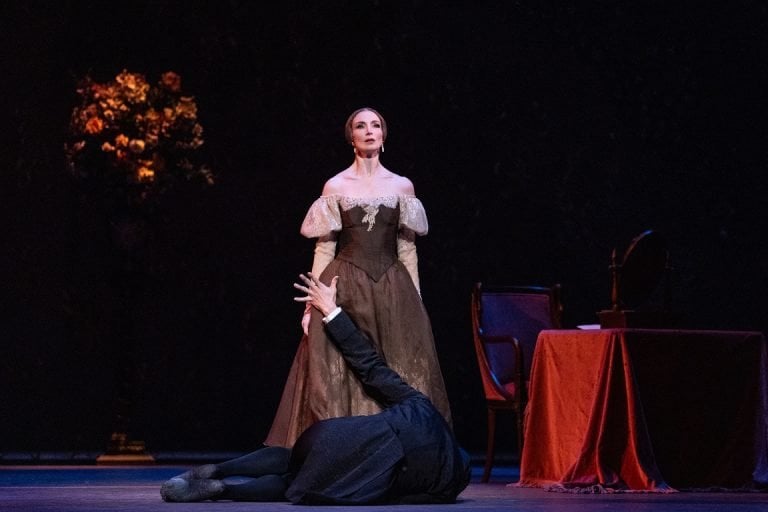
Cathy Marston’s Jane Eyre (2016) returned to Sadler’s Wells during Northern Ballet’s London tour. Set to compositions by Philip Feeney, the ballet explores Charlotte Bronte’s novel through Marston’s deeply honed signature movements and choreography. Jane Eyre retells the story through Jane’s retrospective reflection on her life; in Marston’s prologue, Jane is found by St John Rivers, after she has collapsed around the struggles that have led her to this point. Marston eloquently shapes the male corps de ballet that explores the metaphors of Jane’s conflict, a signature trait which emerges in later ballets, including San Francisco’s Snowblind (2018). Structured as a two-act ballet, the narrative unfolds as a reflection of Jane’s life as an orphan at Lowood Institution, her arrival at Thornfield, and the tragedy (a wedding that gets interrupted by Mr Rochester’s deranged wife, and the fire that destroyed Thornfield and left Rochester visually impaired).
Marston is an outstanding storyteller. At the hands of this pioneering choreographer, nothing is left to chance. The dancers (as metaphors, the young women at Lowood, or guests at Thornfield) move through the choreography which is shaped with meticulous detail. Gestures have meaning, and are used to serve the narrative throughout the ballet. Props, including gravestones, miniature desks, a high-backed chair, also offer references to the context of the narrative, working around a sense of minimalist design. Patrick Kinmonth’s set and costume designs effectively capture the period and the Yorkshire hills. The combination of storytelling in the movements, together with the use of contemporary period costuming and stage design, successfully brings all the various components together. In true Marston style, the presence of an elevated platform at the back of the stage supported a spatial and framing device for the complexity of the narrative to unfold.


Marston’s adaptation of the novel to the stage is easy to follow in part due to the effective collaboration between choreographer, composer and scenographer. Feeney’s compositions are an outstanding element of the collaboration – the motif of the first meeting between Jane and Rochester is truly sublime. In equal measure, the progression of the movement vocabulary as their relationship unfolds through the narrative is sublimely explored. As the relationship becomes closer, the choreography becomes more ambitious, and the composition ties up the ebb and flows of the performance. The unique gesture (hands crossed around Jane’s face) is visible in the first physical encounter and moves through their various duets until it culminates in Jane’s memories and instigates her return to Thornfield. Sarah Chun and Joseph Taylor’s performances on opening night eloquently narrated the transition between their first meeting, to the blossoming of their relationship, and finally the reunion after the tragic fire. As Jane walks into the light, Feeney’s final notes fade away and leave Jane owning her story. In our world, we have come full circle.
Northern Ballet is a joy to watch; each dancer commits to their role in the storytelling that Marston has shaped. Julie Nunes as Adele, together with Harriet Marden (Aunt Reed), Gemma Coutts (Bertha), and Heather Lehan (Mrs Fairfax), have uniquely shaped vocabularies that mark out their characters and create a broad palette of steps to narrate Brontë’s story. They delivered a fine performance. Jane Eyre is a ballet which is quintessentially ‘northern’, and the company showcases its golden ‘Marston’ ballet with flair and mastery.


Graham Spicer, aka ‘Gramilano’, is a writer, director and photographer based in Milan. He was a regular columnist for Opera Now magazine and wrote for the BBC until transferring to Italy. His articles have appeared in various publications from Woman’s Weekly to Gay Times, and he wrote the Danza in Italia column for Dancing Times magazine. Graham was the historical advisor on Codice Carla, the 2023 documentary on Italian ballerina Carla Fracci.
Graham also works as a dance photographer, and his photos have appeared in many books, theatre programmes, and magazines, including Dancing Times, Dance Spirit and Ballet2000, as well as all the major Italian newspapers.
He is a member of the Dance Section of The Critics’ Circle.