Review: La Fille mal gardée – opening night with The Royal Ballet in “the sunniest, funniest, twirliest romcom around”
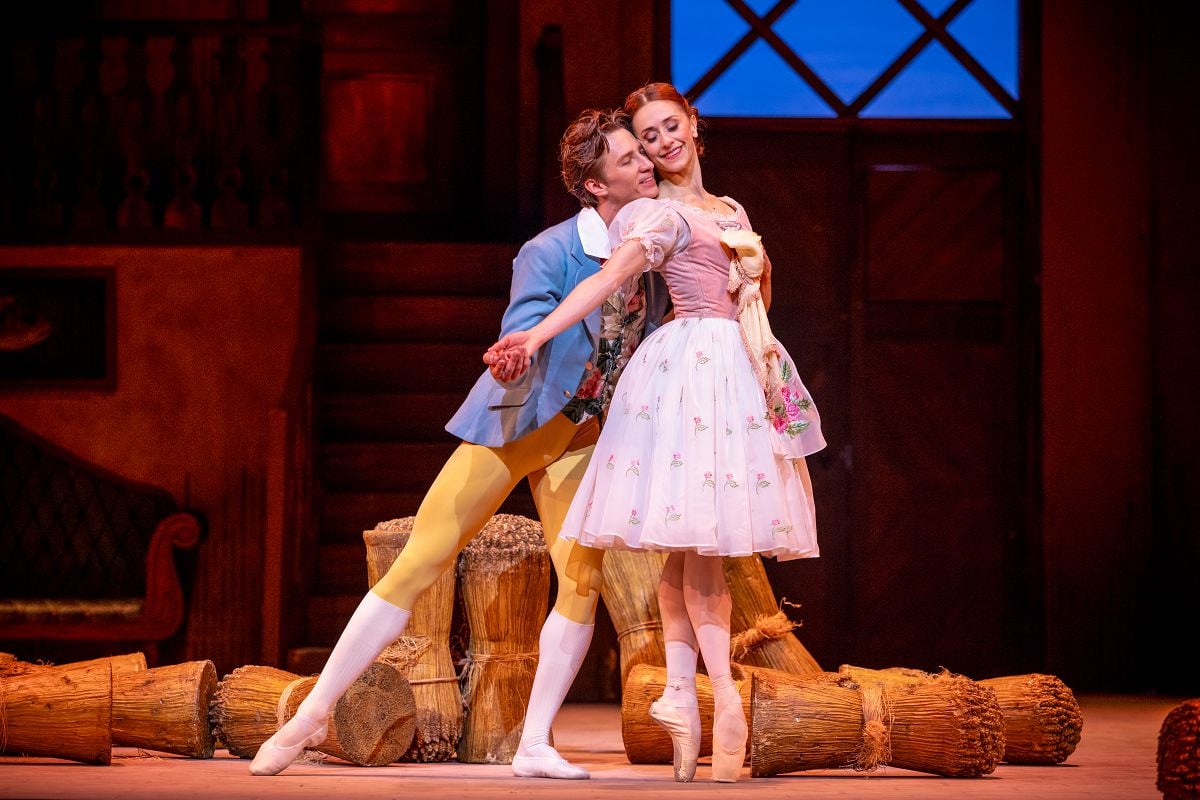
Georgina Butler sees La Fille mal gardée with Marianela Nuñez (youthful lyricism) and Vadim Muntagirov (bravura dancing) who together are radiant.
| Title | La Fille mal gardée |
| Company | The Royal Ballet |
| Venue | The Royal Opera House, London |
| Date | 18 October 2025 (evening) |
| Reviewer | Georgina Butler |
The Royal Ballet chases away the autumn chill with the warmth and mischief of a delightfully danced La Fille mal gardée – still the sunniest, funniest, twirliest romcom around.
Frederick Ashton, founder choreographer of the Royal Ballet, created this light-hearted, two-act love letter to the Suffolk countryside for the company in 1960. The original La Fille mal gardée (literally translated as ‘The Poorly Guarded Girl’ and known as ‘The Wayward Daughter’) was staged in Bordeaux by French ballet master Jean Dauberval in 1789 to celebrate the richness reaped by marrying for love, not money. His tale of a peasant girl whose mother hopes, and hustles, for a grand match but eventually permits true love to triumph was a pastoral pastiche that pioneered the use of ordinary people as characters in ballets. Inspired – and brimming with innovative ideas – Ashton took the French story and transformed it into a truly English ballet.
This season sees Fille back by popular demand (a long-awaited revival as the company has not performed it since 2016) and returning to the main stage 65 years after its Covent Garden premiere. Beautifully preserved, the production affectionately incorporates mime and traditional folk festivities, happily frolics from the fields to the farmhouse and deftly ties romance up with a ribbon. It is joyful escapism. A ray of sunshine that theatregoers of all ages can, and do, bask in.


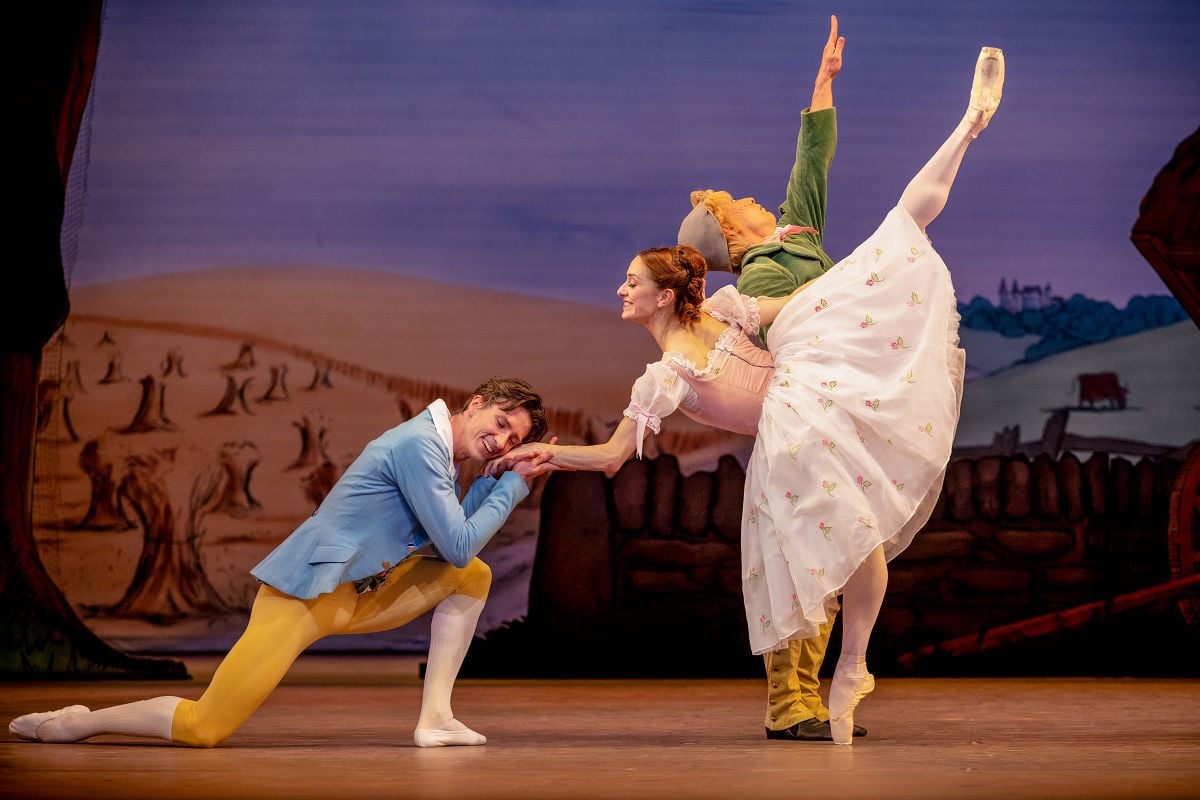
The action takes place on a farm, at harvest time, so the ballet boasts colourful characterisation, some horseplay and an abundance of dancing. Lise, the only daughter of widowed farm owner Simone, is in love with Colas, a young farmer. Simone, however, has far more ambitious plans and wants to marry Lise off to Alain, the simpleton son of a wealthy vineyard owner. Widow Simone (a role portrayed by a man, drawing on pantomime tradition) repeatedly strives to shoo Colas away and keep Lise occupied with chores. Miffed yet undeterred, Lise and Colas steal precious moments whenever possible. They share kisses while churning butter. Their bodies entwine during intricate knotting, winding and weaving ribbon-ography in an elaborate game of cat’s cradle.
At the cornfield, an amusing pas de trois [is a crowd] demonstrates that affluent but awkward Alain is no competition for Colas when it comes to wooing Lise. Simone is unimpressed to find Lise and Colas together (again!) but swiftly distracted by an invitation to relive her youth with a captivating clog dance. Exuberant maypole dancing and musical merrymaking follows, until a sudden rainstorm. Note, though, that this downpour doesn’t dampen spirits thanks to Alain’s high-flying antics with his much-adored red umbrella.
Back in the farmhouse, Lise unsuccessfully attempts to steal the house key from a dozing Simone so that Colas can enter. Love still finds a way: they sway together through the unlocked top half of the door. Determined to make hay while the sun shines – and make Lise’s endearing daydreams of their future as husband and wife a reality – Colas inveigles himself into the farmhouse with the help of the harvesters. Lise hides Colas in her bedroom, away from Simone. Convinced that Colas has been in the house, suspicious Simone sends Lise to the same bedroom and unwittingly locks the lovers inside together. When hapless Alain is handed the bedroom key and Lise and Colas are discovered, Simone finally concedes. She gives the union her blessing, and everyone rejoices.


The mood throughout La Fille mal gardée is one of expectation and elation – a tone enhanced by Osbert Lancaster’s nostalgically picturesque sets and pristine pastel costumes. When the curtain rises, it is dawn. The cockerel crows to welcome the new day before dancing with his four attendant hens. Heads bob, feet scratch, legs kick as the girls leave their coop. Then come bigger, bolder movements as the flock roams free. Daichi Ikarashi was a charismatic cockerel on opening night, accompanied by a charming chorus of chickens shaking their tail feathers (Madison Bailey, Bomin Kim, Leticia Stock and Marianna Tsembenhoi).
Dancing chickens are a tough act to follow. They are top of the farmyard pecking order until the unforgettable appearance of a real pony, who pulls a small cart to take Simone and Lise to the cornfield. Oscar, an adorable creamy white pony, is admirably professional. His hoof slipped when the cartwheel got caught on something in the wing, which meant there was a momentary delay during the procession to the harvest picnic, but he took it all in his stride.
The exuberant good humour is sustained by Ferdinand Hérold’s melodious, cheerful score (played under the baton of Jonathan Lo) and Ashton’s lilting, poetically sequenced steps. This is a ballet about normal country life, and the integration of folk-dance forms and props flows naturally. The corps dancers bend low with sickles to cut crops and reach high with sticks Morris-dance style. Bottles of wine are packed. Bales of straw are stacked. Everyday magic occurs as dancers weave around a majestic maypole. A flute is played and bodies are used percussively: feet tap, fingers click, hands clap – the harvesters even swap tilling for trilling when they sing while exiting the farmhouse. Perhaps the ensemble could be a fraction earthier and marginally more in sync on occasion. But the unity of this community feels fluid and fluent – as does the entire dance narrative.
Much of the joy of this ballet is the pleasure that the dancers take in their roles, the pleasure the audience takes in appreciating the dancers and the happiness that spreads when everyone shares in a good mood. Marianela Nuñez glows with youthful lyricism as wilful Lise. Her Lise is a lovely personality – silly, sweet, stubborn – with an easy confidence and bright energy. She slips past Simone, slides down the staircase on her bottom and sweeps us up in her reverie. Vadim Muntagirov charms as carefree Colas. His long limbs so easily lend themselves to noble roles, but his bravura dancing as cheeky chappie Colas takes on a down-to-earth sparkle that seems spontaneous and attuned to his Lise. Together they are radiant.
Thomas Whitehead is exquisitely exasperated as Widow Simone – he plays her with a lot of heart, so it is believable that Simone just wants the best for her headstrong daughter. This tenderness is playfully explored by Nuñez and Whitehead in their interactions: mother’s desire for daughter to marry up is motivated by love, not greed. Not that good-natured, nervy Alain, danced with pep and precision by Luca Acri, ever has even the slightest chance of winning Lise, of course.
Gentle and just wayward enough to ignite imaginations, La Fille mal gardée is a must-see ballet and a must-remain offering in the Royal Ballet’s repertoire. The convincing country characters, portrayed by stellar dancers, whisk an audience off to a riveting rural world, where comic capers and a ribbon of interweaving dances enchant and entertain. There are no dark forces, no tragic events or dramatic plot twists – just the inconvenience of mild maternal disapproval to be sweetly squared up to before the happily ever after. The real world disappears for the duration and, although everything can’t be tied up quite as neatly as it is in Fille, life may well seem a little lighter and brighter by the time you step back out onto Bow Street.

La Fille mal gardée continues on the main stage until Thursday 13 November and returns next year, with performances from Saturday 23 May to Tuesday 9 June 2026.
There will be a live cinema relay on Wednesday 5 November 2025, with encore screenings from Sunday 9 November 2025.

Georgina Butler is an editor, a dance writer and a ballet teacher.
Georgina is a first class honours graduate and registered teacher of the Royal Academy of Dance (BA (Hons), RAD RTS). Following further training at the Royal Ballet School, she also holds the ‘Inspire’ professional development certificate for classical ballet teachers.
Outside of dance, Georgina is a graduate of the London School of Economics and Political Science (BSc (Hons) LSE), a qualified journalist (National Council for the Training of Journalists) and a certified editor (Publishing Training Centre).
Georgina is a fellow of Advance HE (FHEA). This is a professional status awarded in recognition of her expertise in teaching and learning and her commitment to enhancing the student experience.