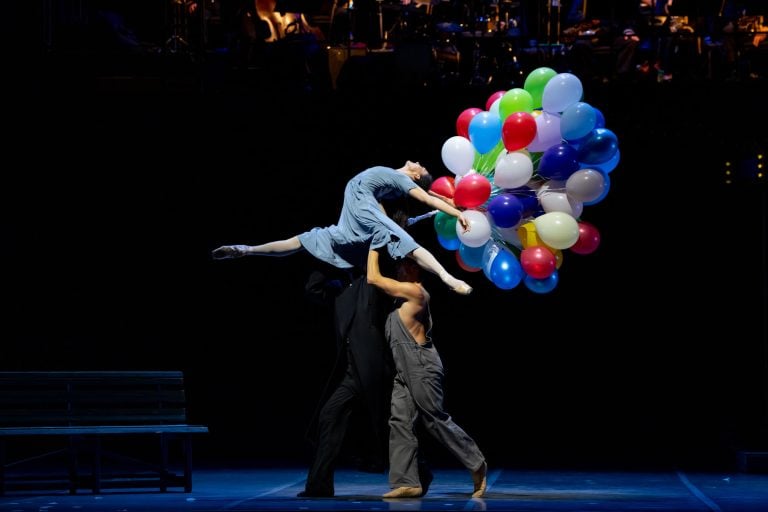
Review: Norwegian National Opera’s Barber of Seville

Graham Watts sees Il barbiere di Siviglia with the Norwegian National Opera and Alasdair Kent (a mesmerising performance), Lilly Jørstad (great beauty and clarity of tone), and Gurgen Baveyen (confident expression).
| Title | The Barber of Serville |
| Company | Norwegian National Opera |
| Venue | National Opera House, Oslo |
| Date | 6 February 2026 |
| Reviewer | Graham Watts |
This modern interpretation of The Barber of Seville (in Norwegian, Barberen I Sevilla), directed by Jetske Mijnssen, was her second attempt to create a production of Gioacchino Rossini‘s classic opera buffa. Her first, back in 2011, set the opera within a cosmetic beauty surgery; while this version, which premiered in 2021, treats the whole cast as some form of dysfunctional household. The director has talked about the characters of Figaro and Rosina, who of course are not related, as ‘adopted twins’ and Basilio, the itinerant music teacher, seems to reside within Dr Bartolo’s home.
The plot is the simple stuff of farce. Rosina lives in the household of the much older Dr Bartolo who plans to marry her when she comes of age. But Count Almaviva, masquerading as a poor student, has fallen in love with Rosina and enlists the help of the town’s self-proclaimed handyman, Figaro, to win her over. The cast is supplemented by Berta, here transformed from the original elderly governess into a younger and more seductive woman, the lead among a handful of sexy maids in Bartolo’s household; the music teacher, Don Basilio, played as a kind of buffoon; and Fiorello, Almaviva’s shape-shifting servant

Mijnssen has particularly focused on creating an ending that acts as a bridge to the Marriage of Figaro, which was written by Pierre Beaumarchais as a direct sequel to The Barber of Seville, by including the bravura long aria Cessa di più resistere (often omitted from the opera) by Count Almaviva in the concluding scene, which can be read as an indicator of the womaniser to come! Here we see Rosina throw her wedding bouquet away and refuse the Count’s entreaties to make up after he has canoodled with Berta and the other maids.
The leading role of Count Almaviva is sung and expressed by Australian high tenor, Alasdair Kent, who brought his huge experience of bel canto and Rossini, in particular (he has at least ten Rossini roles in his repertoire), to bear on a mesmerising performance. The mix of modern dress and character transformations has Kent performing in his “budgie smugglers”, showing off a muscular physique in the process. It can’t be easy to sing seriously, even comedically, in such circumstances, but he carried the whole charade off with aplomb.
Herbert Murauer’s rotating set of external wooden panels provides many platforms for these intrigues and other interactions between characters with stairs, cupboards, recesses and wardrobes. It’s intriguing because at almost every turn the configuration of the set seems different. At one point, when Figaro re-enters the internal set, he asks with surprise where the stairs have gone! I was disappointed by the opening where the local musicians of the first scene have gathered in a kind of Community Centre committee room with folding chairs dotted around the stage, but once this opening gave way to the main set it all clicked into place.

The mezzo-soprano, Lilly Jørstad, a former competitor in the BBC Cardiff Singer of the World, performed the role of Rosina as enticingly as the plot demands, with great beauty and clarity of tone, lyrically expressing the coloratura passages in the cavatina, Una voce poco fa with memorable flow.
Gurgen Baveyen played the enterprising general factotum, Figaro, with a mischievous charisma, different from the Beaumarchais libretto, the “brother” of Rosina in this production, self-introduced with one of the most famous male arias (Largo al factorum) in opera buffa, with its multiple repetitions of Figaro and Uno alla volta, sung as throughout the opera with exceptional clarity and confident expression.
Peter Kálman was an imposing Dr Bartolo, delivering his first act, virtuosic aria with great emotion and colour. The cast included five sexy French maids in Bartolo’s household, one of whom took the place of the old governess, Berta, played captivatingly by the Norwegian lyric coloratura soprano Frøy Hovland Holtbakk. The Romanian bass, Adrian Sâmpetrean was an excellent foil as the music teacher, Don Basilio, his academic credentials represented in what seemed like American university cardigans and now ensconced as a lodger in Bartolo’s packed house. And British-Irish baritone, Rory Green was an important supporting player as Almaviva’s servant, Fiorello (also the notary and a policeman). Some sinister henchmen, in dark glasses, guarded Bartolo’s property.
The whole cast seemed to be enjoying the experience of working together, so important for the success in any farce, including those of the opera buffa kind. The orchestra, conducted by Giuliano Carella, was also on fine form.
It’s always been a little difficult to come to the happy denouement in The Barber of Seville, knowing that the marriage in the sequel is in such difficulties due to the amorous activities of the older Almaviva. And it’s enjoyable to see how Mijnssen prepares us for Mozart’s masterpiece in the altered ending and also by showing the conniving, scheming, selfish sides of the characters in this prequel.