Review: Alexander Whitley Double Bill, Mirror and Rite of Spring – missing the point?
Lydia Wharf sees Alexander Whitley’s double bill and appreciates his rich, interesting vocabulary, but, although enjoyable, she remains disappointed.
| Title | Mirror | Rite of Spring |
| Company | Alexander Whitley Dance Company |
| Venue | Sadler’s Wells East, London |
| Date | 19 March 2026 |
| Reviewer | Lydia Wharf |
In my advancing years, I’ve become quite particular about where I like to sit to watch dance. Particular… or perhaps ridiculous, I don’t know, but I’ve developed a predilection for sitting just a couple of rows away from the stage itself, in the very front of the stalls if my budget will stretch that far, never mind my neck. This vantage point is not ideal, of course, as it doesn’t afford me a good sense of the arrangement of multiple bodies making patterns in space. What it does give me, though, is a close, perhaps more intimate view of the dancers, their interactions, the intricacies of their performance, and more insight into their experience and interactions, maybe.
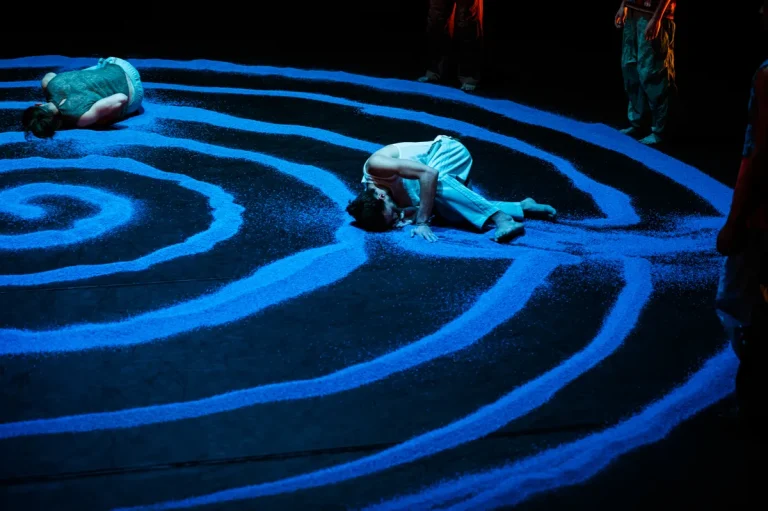
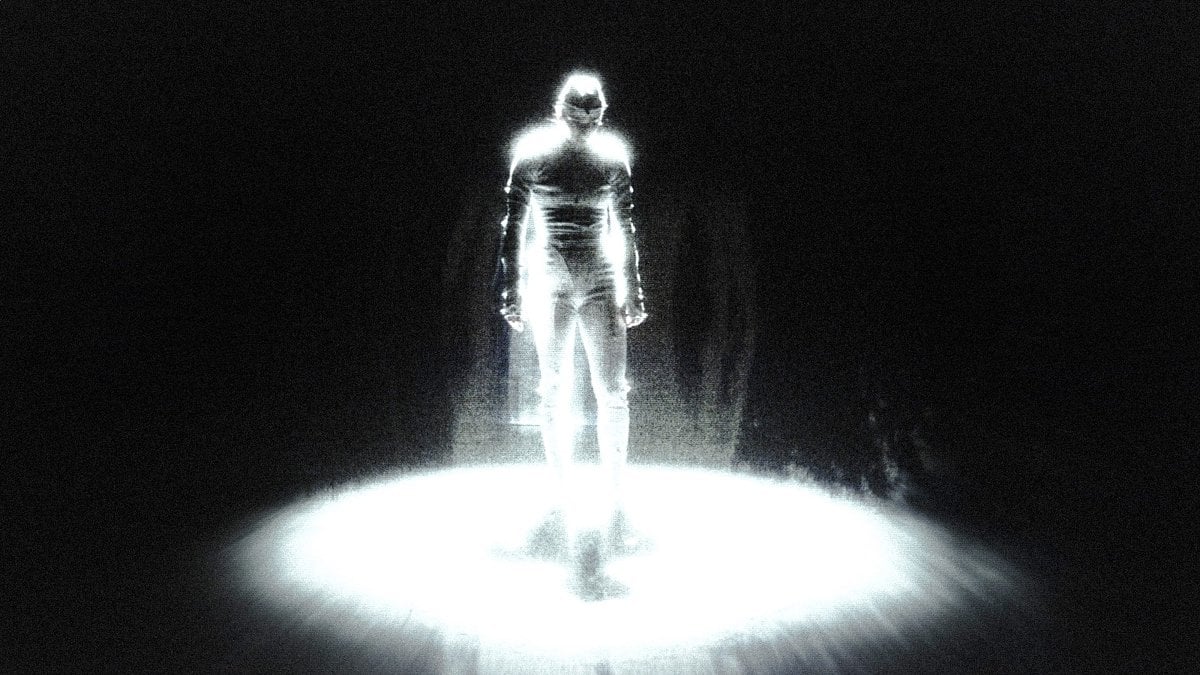
Watching Mirror, the first half of Alexander Whitley’s double bill, I couldn’t have been more pleased with this seating choice. The two dancers performing this work, Gabriel Ciulli and Daisy Dancer, are exceptional from the outset; their bodies articulating the finest of details; every twitch, reaction, contraction and pulse conducted with the degree of clarity that brings choreography to life. They begin a slow duet, somewhere between co-dependency and synchronicity, occasionally breaking out to walk slowly, circling each other, arms outstretched. Duskily lit, the sinister glow of cameras surrounds them, green lights like eyes, perched atop a large circular gauze. In these opening moments, and onward to a degree, it’s clear that Whitley is a master at manipulating bodies – his is a rich, interesting ‘vocabulary’ and these dancers make real sense of his language, using it as a form of expression for the complex relationship between them, physical and cerebral. The ebb and flow of their duet builds a growing tension – there are infinite possibilities here, it seems.
As the cameras begin to capture these super-human bodies in three dimensions via the motion sensors on their monochrome unitards, they generate live avatars, which are projected onto gauzes at the front and back of the stage. Digitally manipulating this movement, the dancers become live scenographers, illustrating their surroundings, then performing amongst them, mutations of themselves filling the stage like an eerily indefectible corps de ballet. Think about all the terrifying images of hordes of identikit robots you’ve seen (I-Robot?) and imbue them with the somatic complexity of a dancer’s realtime motion. It’s quite a spectacle… uncomfortably so.
With the surging sea of gently transmogrifying digital Wilis threatening to drown the stage entirely, Whitley makes his point. His ‘real’ dancers experience a growing and significant shift in focus. Once captivated by each other, they become increasingly alienated, as awareness of their god-like relationship with the avatars becomes central. In place of their intimate pas de deux, the dancers become the all-powerful choreographers of their own ballets, transfixed by their command of the corps de ballet, eventually consumed by it. They lose traction on interpersonal connection until eventually one leaves the stage entirely, and the other doesn’t even notice. Of course, it’s possible to read this as a metaphor for the proliferation of digital technology and its isolating impact on society, and yes, it’s a good point well made. Whitley is no fool. But, if I’m completely honest here, I will confess that, rather than appreciating the expensive, cutting-edge technology that makes the point, I ignore the choreographer’s intention by using my privileged proximity to the stage to peer beyond the gauze and simply watch the live dance. Because I can and because I want to so badly. Because much of my day-to-day life involves solitary interactions with AI, digital technology and a lack of real connection – my own and others’. I’m just as concerned about it as anyone. And here, in the theatre, is my opportunity for live-ness, for connection, for a shared experience. An escape!
I know, I know, I’m missing the point. But perhaps so does Mirror?


My appetite had been thoroughly whetted for The Rite of Spring. Thanks almost entirely to the power and intensity of Stravinsky’s thundering score, I cannot recall an iteration of this primordial tale that I haven’t appreciated for one reason or another – I find it as endlessly interesting as choreographers seem to. And so (spoiler alert) whilst Whitley’s interpretation is enjoyable, I’m disappointed to find that there are no surprises in how he approaches the work in terms of stamping his own creative identity on the seminal story. Hello again, AI Wilis.
Streaks of blood red in Mirella Weingarten’s set and costumes, an all-seeing eye hanging low in the sky, and Joshie Harriet’s dark gloaming lighting set an ominous tone to meet the rumbling of opening chords. In the dimness, silhouetted figures solemnly move the red ropes of a kind of circular maypole that sits centrestage, an early reference to the ritual and barbaric sacrifice that will inevitably come.
This bold, dark imagery is soon matched by movement, as the iconic score thunders into motion, bringing with it deep pliés, swinging limbs, and rapid changes of direction. The dancers are, again, excellent vessels for the embodiment of Whitley’s ideas – this time, they move with a more deliberate equilibrium, using gravity rather than working against or despite it. Without losing the uniqueness of his own style, the choreographer finds a denser, bolder dynamic in his movement to match the dramaturgy of the score.
Digital elements become part of the story; arguably, they engulf it. Again, projected against gauzes, this time more consistently as an endless stream of anonymous bodies mimicking the live dance, they muddle the narrative – where our focus would gradually hone in on the ‘chosen’ dancer and their brutal sacrifice, we are immersed in a hellish vision of long-limbed dupes, exploding into life across the eyeline and congregating in red clusters across the backdrop.
Interestingly, Whitley says that he’s “drawn to revisiting The Rite of Spring now because it was forged in a time of social rupture that echoes the paradigm shift we’re experiencing in the age of AI”, but I’m not convinced that this manifesto really holds water. Today’s society may be heading to hell in a handcart by relinquishing agency to AI, but illustrating this point via the medium of digital technology feels like a paradox, and whilst, aesthetically, Whitley captures the earthy, inherently human elements of this timeless story in his choreography, he fails to double down with the use of the digital imagery, rather losing impact.
Lydia wharf is an independent producer working in contemporary dance theatre, tending to specialise in practices of care, access and inclusion.
She works directly with a range of artists and companies, most recently BirdGang Ltd, Dance Umbrella, Julie Cunningham & Company and Stuart Waters. Lydia has a long, twisty relationship with dance, as performer, writer, advocate and producer.