Review: Mayara Magri’s ‘revelatory’ debut as Giselle with Matthew Ball and The Royal Ballet

Lily Hyde sees Mayara Magri’s debut as Giselle and thinks it ‘will go on to be regarded as timeless and perennial as Wright’s ballet itself’.
| Title | Giselle |
| Company | The Royal Ballet |
| Venue | Royal Ballet and Opera |
| Date | 28 February 2026 |
| Reviewer | Lily Hyde |
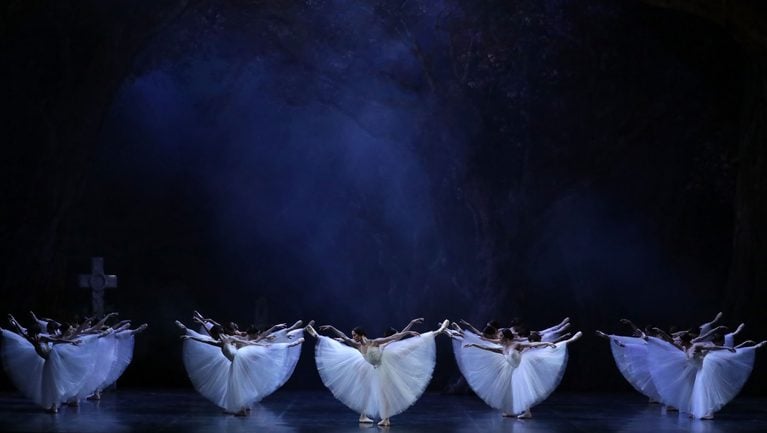
There’s a darkness to Peter Wright‘s Giselle. In the literal sense, the production’s colour palette is muted, the stage awash with autumnal browns, reds, and oranges. Giselle’s peasant dress, usually frothy shades of blue and white, is a faded yellow and brown. Wright’s Giselle is also tonally darker than many other productions. Giselle’s death at the end of Act 1 is more intentional than accidental, and the location of Act 2, not the standard churchyard, but rather a desolate forest, suggests a stain upon a character renowned for her innocence and purity. As the second act sees Wright’s world darken further, now full of vengeful spirits ill met by moonlight, it is a radiant Mayara Magri who illuminates the stage and casts her spell over the audience.
Giselle is sometimes referred to as ‘the Ballerina’s Hamlet’, and from the outside, Magri did not feel like the most natural fit. Hailing from Brazil, she has a fiery stage presence, and since her promotion to Principal in 2021, has made light work of roles like Kitri, Odile, and Myrtha. With her grand leaps and dizzying turns, Magri’s a forceful dancer whose quality doesn’t seem to easily translate to a role like Giselle. And yet, from the moment she cautiously emerged from her ramshackle cottage, she was transformed beyond measure. Magri’s performance was revelatory – it was as if I was seeing the ballet for the very first time.

Magri brought a radiant innocence to Giselle, equal parts playful and vulnerable. Her jumps were light and soft, but the manner in which she clutched her chest and burrowed into her mother, Berthe’s, side (played by the always excellent Elizabeth McGorian) suggested a real fear. Magri employed her technical prowess very tactfully; she has a wonderful ability to use crescendo in her dancing – her steps maintained a breezy quality, but she ensured that her final arabesque in her Act 1 solo was the highest.
Her Albrecht was Matthew Ball, who has been dancing the role since 2018 and is Magri’s real-life partner. Matching his technical bravura with an affectionate playfulness, he makes his exceptionality look effortless. It’s very easy to fall in love with him; he’s incredibly funny (his miming made the audience audibly laugh on multiple occasions) and is devoted to Giselle. As unconvinced as I am by the Royal Ballet’s current penchant for casting its real-life couples to play couples on stage, it paid off in spades here.
It also feels like the Royal Ballet is using this revival of Giselle to interrogate masculinity and what it means today; Ball’s Albrecht shows an open disdain for his position but still expects its privileges. Luca Acri’s Hilarion has an easy chivalry, until he doesn’t. Thomas Whitehead and James Hay also brought an uncomfortable haughtiness to the Duke and Leader of the Hunt.
As Giselle descended into madness, Ball forcefully charged across the stage, knocking into dancers, whereas Magri was still and contained, her ghostly exhale of pain echoing throughout the auditorium as she clutched her stomach. To refer to the conclusion of Act 1 as ‘The Mad Scene’ feels like a disservice to Magri. Her Giselle was not overcome by madness, but rather, a strange and devastating clarity of an innocence lost, never to return. Indeed, there is an argument to be made that as Giselle’s awareness of the world and her low place within it increased, such an ending was inevitable.

Magri and Ball were wonderfully supported by the rest of the cast. Lara Turk’s Bathilde was viciously bratty with a simpering noblesse oblige. The pas de six, led by Yuhui Choe and Taisuke Nakao, was a little stiff, but the other dancers (including Marianna Tsembenhoi, who made her debut as Giselle last week) brought an exuberant sprightliness to their jumps, and a warmth to an increasingly dark stage.
Julia Roscoe was a superb Myrtha – tall, imperious, and menacing in her stillness. She commanded the stage during her solo, her grand jetés unnervingly silent as she all but flew. Equally imposing were her aides – Olivia Cowley, who brought a controlled rigidity to Moyna, and Hannah Grennell, whose Zulme was measured and uncompromising. The three towered over the Wilis and made it clear they were in control.
When they awakened Giselle, Magri’s dancing had a Petrouchka-like quality; she did not jump into the air, but was seemingly thrust into it by a cruel, invisible puppet master. She brought a despair to her reanimation, writ in the slope of her shoulders and her quaking bourrées. Her decision to save Albrecht felt like rebellion – Wright’s Giselle is deeply gothic; the natural order has been disturbed, and Giselle has taken it upon herself to restore it.
Magri and Ball started Act 2 with very different qualities; Magri danced as if moving through water, whereas Ball was heavy and grounded. This gulf between them was employed to devastating effect in the pas de deux, expertly conducted by Vello Pahn, but as Albrecht’s doom felt increasingly certain, Magri’s ethereal dancing developed a steely confidence. They jumped as one, but Magri led. The church bells are heard only from a distance, but Magri’s smile upon hearing them was entirely serene. Her plan had succeeded, and there seemed to be no question that she had been in control from the very start.
Wright’s Giselle premiered in 1985 and will feel as timeless and perennial in another forty-one years as it does now. It is a ballet of such incredible balance that one could argue its structure is chiastic; almost everything within Act 1 has a rhyme or counterpoint in Act 2. Consider how Albrecht rejects Giselle’s pleas in Act 1 but Myrtha rejects Albrecht’s in Act 2, how the Temps Levé in the Act 1 Galop bear a striking resemblance to the Wilis’s iconic hops in Act 2, or even how Giselle is given a floral wreath in Act 1’s harvest scene, and Hilarion lays a floral wreath on her grave in Act 2.
At a reception given after the performance by the Ambassador of Brazil, Antonio de Aguiar Patriota, to celebrate the UK-Brazil Season of Culture, the Royal Ballet’s Director, Kevin O’Hare, noted that Giselle marks Magri’s final classical role debut. As tempted as I am to say that she saved the best for last, I instead find myself looking to the future and how Magri will further develop these roles. She is still being coached before her next performance on 10 March 10 and will, I’m sure, continue to bring something new and devastating to her interpretation. I am certain that her Giselle will go on to be regarded as timeless and perennial as Wright’s ballet itself.

Giselle is on until March 20th. Mayara Magri and Matthew Ball will next perform on March 10th.