Review: Brother to Brother – from Etna to Fuji – a new work from Zappalà Danza

Graham Spicer sees Roberto Zappalà’s new work, Brother to Brother – from Etna to Fuji, in Slovenia, part of the VISAVÌ Gorizia Dance Festival.
| Title | Brother to Brother – from Etna to Fuji |
| Company | Compagnia Zappalà Danza |
| Venue | Slovene National Theatre | VISAVÌ Gorizia Dance Festival |
| Date | 17 October 2025 |
| Reviewer | Graham Spicer |
When is a premiere not a premiere? Tonight, in Modena, the opera house’s dance season opens with the ‘prima assoluta’ (the absolute first performance) of Compagnia Zappalà Danza’s Brother to Brother: dall’Etna al Fuji. However the piece has already been seen in July in Rome and Civitanova Marche, and in Nova Gorica in Slovenia in mid-October (called a ‘national preview’), which is the performance I saw as part of the VISAVÌ Gorizia Dance Festival.
Roberto Zappalà’s performance was worth the build-up. The 70-minute work is extremely slick, beautifully and dramatically lit, and is accompanied by the exciting sound of the Munedaiko drummers who play traditional Japanese Taiko drums. The three bare-chested performers were onstage throughout, with great energy but also with moments of delicate upper-body choreography.

Brother to Brother takes the two volcanoes, Etna and Fuji, to represent two civilisations. East and West. Zappalà Danza is based in Catania in Sicily, an hour’s drive from one of the world’s most active volcanoes, Etna. As Etna spews and belches towards its 600,000th birthday, Fuji is very much its younger sister at just 10,000 years old.
The programme blurb says, “Just as volcanoes are at the origin of the current formation of the planet, percussion is at the origin of the musical and cultural art created by man, starting with the rhythm of the heartbeat.” Percussion starts the evening with a bang, literally, as a Munedaiko drummer whacks his instrument with force.
Zappalà takes his dancers to a Japan of the past, and they ‘evolve’ towards a modern-day Sicily, with Giovanni Seminerio’s soundscape taking the drumming of the opening scenes across religious music, a violin, an electric guitar, to a throbbing club beat finale, a sound that seems to be trending in contemporary dance right now.
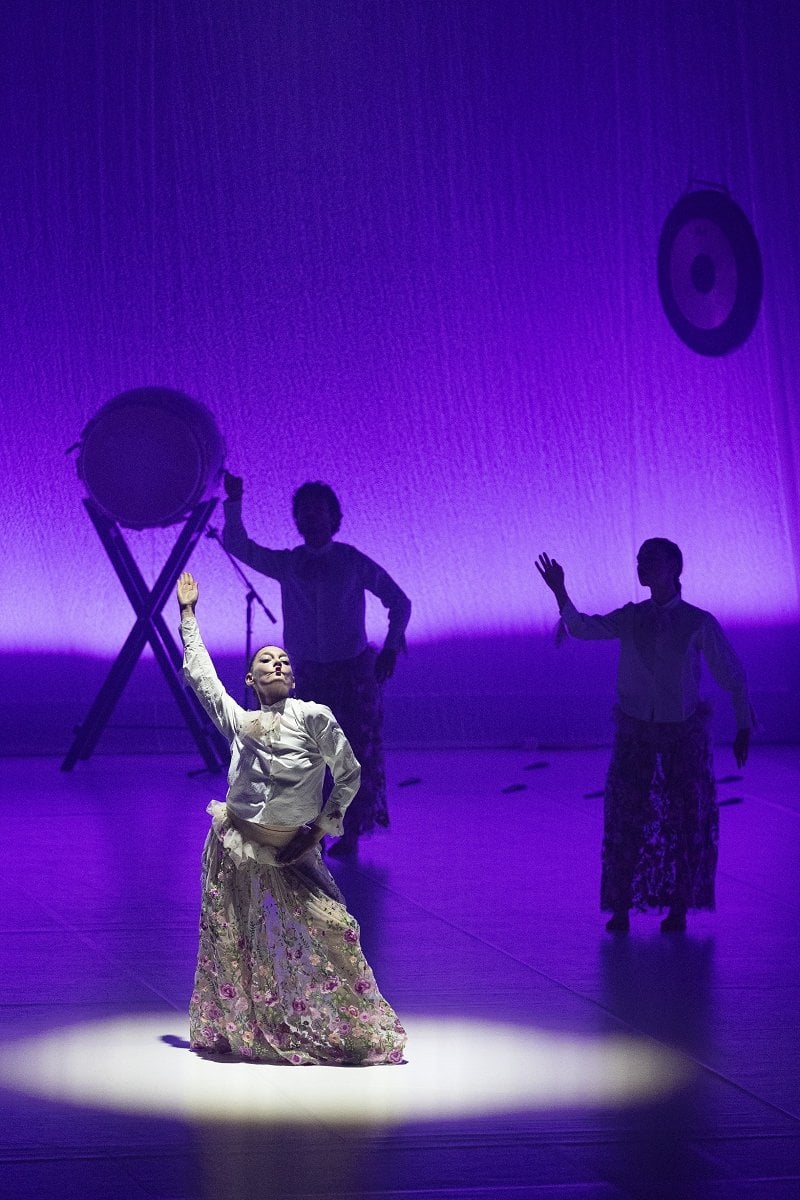


In a slap in the face to the concept of cultural appropriation, Zappalà has his dancers shuffle on, geisha-style, all wearing gauzy skirts and white blouses adorned with pink flowers, and sucking in their cheeks to exaggerate their red rosebud lips! They adopt oriental hand gestures (I deliberately use ‘oriental’ and not ‘Asian’ in keeping with the spirit of the piece) and sometimes make ‘Japanese’ song noises. The dancers at one point had little bells on a wrist band that jingled, echoing their movements, and they used fans too.
The large stage of the Slovene National Theatre was opened up to its maximum dimensions with white cloth delimitating the entire space, stretching up to the grid, a good 12 metres or so above the stage. For several minutes during the opening scene, blue ‘petals’ fell lazily from on high and remained scattered around the stage.
The well-drilled dancers slipped in and out of ensemble numbers and individual sequences, with most of the dancers remaining onstage throughout. Unusually for a small group of nine performers, individual personalities didn’t emerge, except that of French dancer Loïc Aymé, who also had a superior quality of movement, but the group numbers were effective.


Zappalà has given a name to his choreographic style, which is also taught on courses: MoDem, an acronym from the words Movimento Democratico (democratic movement) and his movement is indeed available to all, with nothing showy, but based on control and style.
The long skirts give way to puffy pastel tutus, maybe indicating a gauzy passage towards more modern times by way of classical ballet. The final change is to black and red jumpsuits, which are harsh in the soft, light surroundings. With the arrival of the jumpsuits comes the incessant modern EDM thump, combining well with the Japanese drumming. The final scene is incessant too, not quite knowing when to stop – just when it seems that the end has been reached, it sets off again, as though a 60-minute show seemed too short, so let’s push on until we get to 70.
Customary whooping (at least it has become de rigueur in Italy) greeted the dancers who had given their all, especially during the closing minutes. Rather like the expected Oscar nomination for an actor in a transformational performance, so modern dance audiences reward performers who have ‘suffered’ (nudity and violence guarantee a whoop, as well as sweaty finales), even if the exhausting closure to so many performances I’ve seen recently is something some in the audience do for free, clubbing on a Saturday night.
For new audiences to dance, this is a good starting point – it is flashy, constantly changing, rhythmically exciting, and easy to read… entertaining and a good night out.


Graham Spicer, aka ‘Gramilano’, is a writer, director and photographer based in Milan. He was a regular columnist for Opera Now magazine and wrote for the BBC until transferring to Italy. His articles have appeared in various publications from Woman’s Weekly to Gay Times, and he wrote the Danza in Italia column for Dancing Times magazine. Graham was the historical advisor on Codice Carla, the 2023 documentary on Italian ballerina Carla Fracci.
Graham also works as a dance photographer, and his photos have appeared in many books, theatre programmes, and magazines, including Dancing Times, Dance Spirit and Ballet2000, as well as all the major Italian newspapers.
He is a member of the Dance Section of The Critics’ Circle.