Review: Stephanie Lake’s COLOSSUS arrives in London – young dancers fulfilled Lake’s vision with ebullience

Graham Watts sees COLOSSUS – Stephanie Lake creates fascinating, kaleidoscopic movement from a mass of bodies made the more powerful by the rarity of the quantum.
| Title | COLOSSUS |
| Company | Stephanie Lake Company / London Contemporary Dance School / Southbank Centre |
| Venue | Queen Elizabeth Hall, Southbank Centre, London |
| Date | 26 June 2026 |
| Reviewer | Graham Watts |
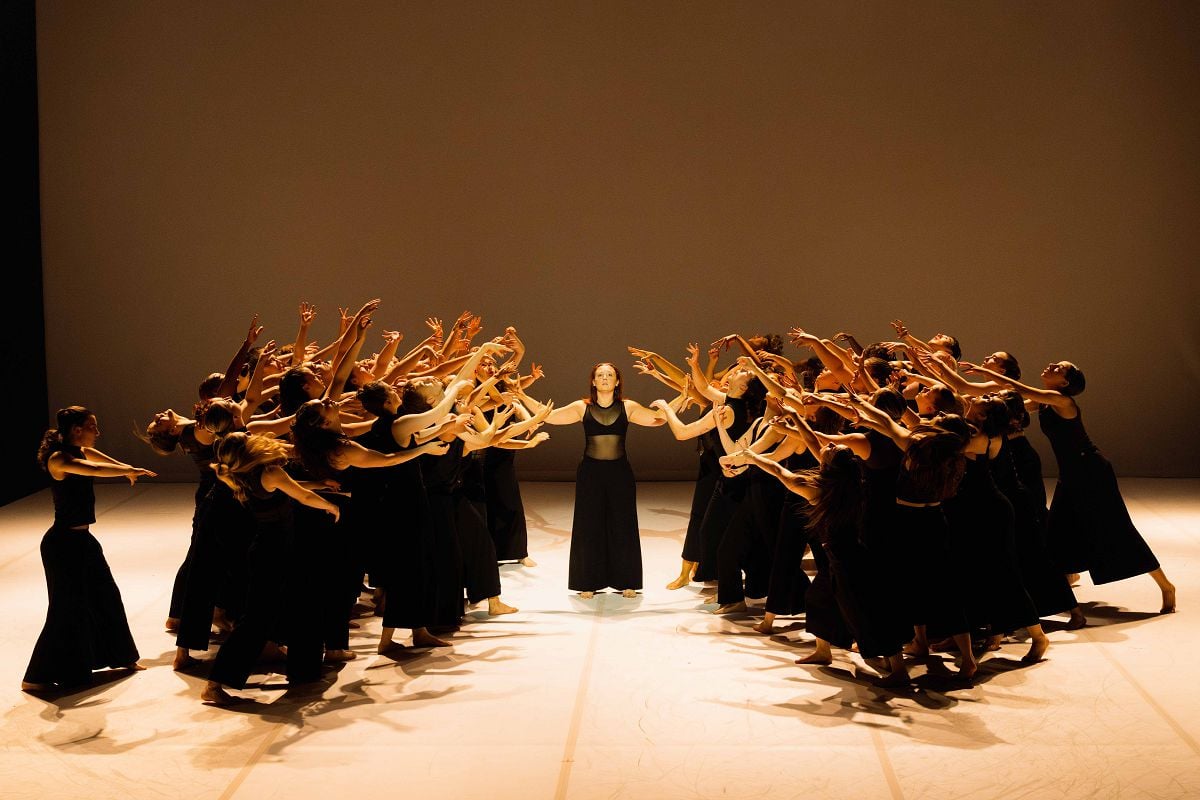
In an exceptionally crowded dance marketplace, Stephanie Lake’s COLOSSUS stands apart for two important reasons. For one, it’s virtually unheard of to find contemporary dance at this scale (approaching sixty dancers); and secondly, to make the performance work commercially, this Melbourne-based choreographer has travelled the world to partner the best contemporary dance schools in reviving her signature piece. For the UK premiere of COLOSSUS, this co-production was with the London Contemporary Dance School for the performers and the Southbank Centre for the venue.
COLOSSUS opens with a spectacular design statement. As the audience was admitted, they were confronted with a silent tableau of the dancers lying in a huge circle, heads on the outside, toes pointing into the clock face and touching their neighbours’ feet. Dressed in a variety of costumes, all in black, they lay motionless for several minutes. I had assumed that these were “own clothes” although a costume designer (Harriet Oxley) was credited. Something about the circular configuration was immediately reminiscent of Maurice Béjart‘s Boléro, although the “table” was an optical illusion created by the central space seemingly elevated above the dancers’ bodies from my position in the audience.
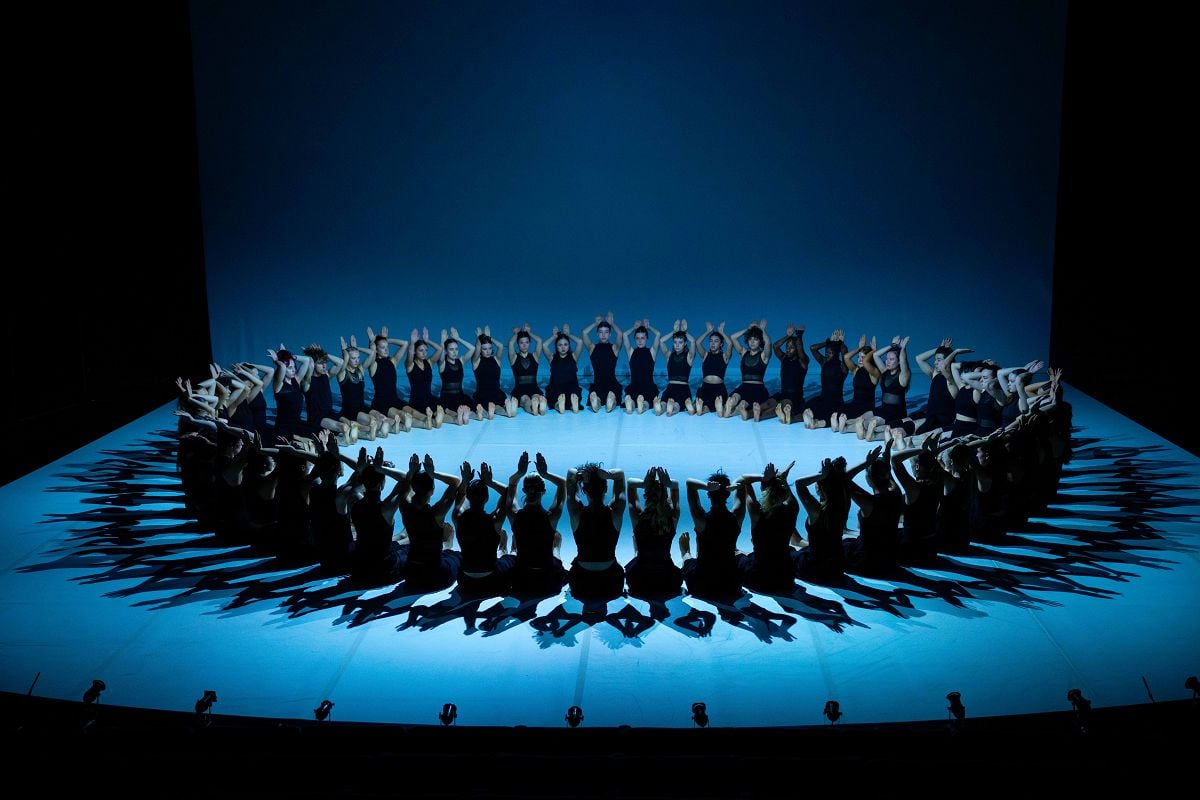
The action began once the audience had settled, featuring just about every movement that can be made from bodies lying on their back: turning to the side, rising to the waist, twisting, etc. A leitmotif throughout Lake’s choreography contrasted the idiosyncrasies of individuals against the dominion of the group, with movements either in unison or, more commonly, in canon like a hundred variations on a Mexican wave.
Eventually, the dancers found their feet and the psychology of crowd behaviour became the focal point, always allowing leaders to come to the fore, to be followed and challenged. To begin with, they split into two groups like opposing cohorts of football fans taking silent orders from their leadership. In one poignant sequence, intimate hugs of an individual turned into violent rebellion against him.
It is impossible – and probably unwise – to credit individuals, although several projected an individual presence and charisma beyond the confines of the group. Others remained anonymous within the mob, although some individuals came to the fore late into the fifty-minute performance. It was an interesting exercise to follow a particular dancer, or to spot a new one.
After a blackout there was an immediate humorous respite when the lights abruptly returned with the dancers assembled as if in a school or team photo, moving their heads, arms and mouths in unison.
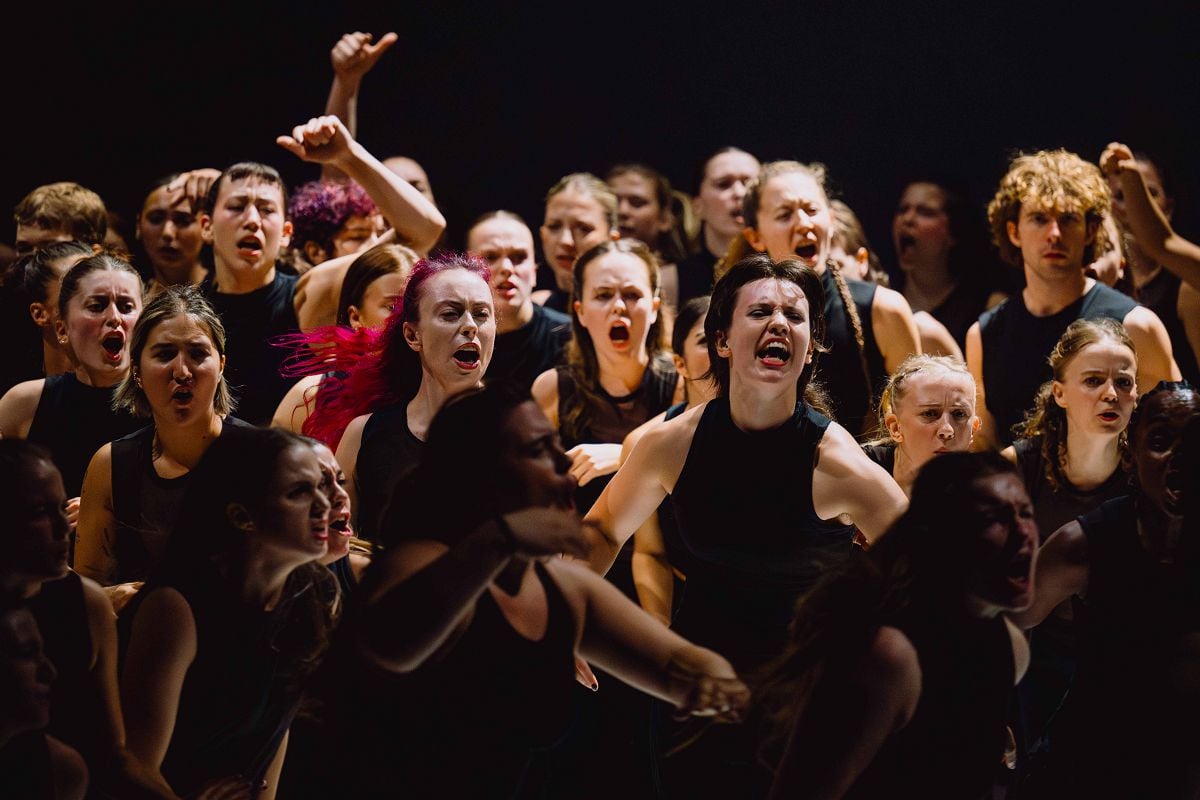
The performance was partly in silence and mainly to the accompaniment of a recorded electronic score by Robin Fox, which included the fascinating aural illusion of beeps and trills coming from the audience (the first of which I thought was someone’s mobile phone) and a sound not unlike a motorbike revving up. The electronic score was augmented by the sounds coming from the dancers: hisses, sighs, gasps and flamenco-style body percussion.
Lake’s choreographic skill is closely aligned with that of Crystal Pite in terms of creating fascinating, kaleidoscopic movement from a mass of bodies, fluidly moving either in unison or layered, as if a single organism, made all the more powerful by the rarity of the quantum. Lake has an unerring capacity for moving things along by introducing abrupt switches both from the group to an individual or in terms of sudden angular and flexed poses.
The dancers belied their graduation status by giving a solidly professional performance that sustained an accelerating momentum throughout the many sections with no diminution in their collective energy.
COLOSSUS has been touring the world since its Melbourne premiere in 2018 and this visit to London has been well worth the wait, especially since Lake has found such an excellent cohort of graduate students to fulfil her vision with such ebullience. I would like to think that several of them will find satisfying professional dance careers but, in the rarified world of contemporary dance, I fear that the odds are against them. Undoubtedly, whatever their futures, this performance will be a highlight of their student lives.

Graham Watts is a freelance writer and dance critic. He writes for The Spectator, Tanz, Shinshokan Dance Magazine (Japan), Ballet Magazine (Romania), BachTrack and the Hong Kong International Arts Festival and has previously written for the Sunday Express, Dancing Times, Dance Europe, DanceTabs, London Dance, the Edinburgh International Festival and Pointe magazine (USA). He has also written the biography of Daria Klimentová (The Agony and the Ecstasy) and contributed chapters about the work of Akram Khan to the Oxford Handbook of Contemporary Ballet and on Shobana Jeyasingh for the third edition of Routledge’s Fifty Contemporary Choreographers.
He is Chairman of the Dance Section of The Critics’ Circle and of the UK National Dance Awards and regularly lectures on dance writing and criticism at The Royal Academy of Dance, The Place and (until the war) for Balletristic in Kyiv. He was a nominee for the Dance Writing Award in the 2018 One Dance UK Awards and was appointed OBE in 2008.