Review: Omar at Lyric Opera of Chicago gives voice to an enslaved Muslim scholar
From a tree of giant fabrics to an Act I auction watched by indifferent onlookers, Kaneza Schaal’s staging keeps the story of an enslaved Muslim scholar uncomfortably close to the present.
| Title | Omar |
| Company | Lyric Opera of Chicago |
| Venue | Lyric Opera House, Chicago |
| Date | 23 October 2026 |
| Reviewer | Scott C Morgan |
The past is always present and vice versa in the thoughtful Windy City premiere of Omar at the Lyric Opera of Chicago.
Co-written by Rhiannon Giddens and Michael Abels, Omar is inspired by the life of Omar ibn Said, a 19th-century West African Islamic scholar who was forced into the transcontinent slave trade. Crucially, Said left behind a brief 1831 autobiography written in Arabic – the only known surviving autobiography of an enslaved person written in Arabic in the US.
Omar was co-commissioned by Lyric and six other companies – notably the Spoleto Festival USA in South Carolina, where the opera had its world premiere in 2022, and Carolina Performing Arts in North Carolina, which staged the work in 2023. Said was enslaved in both of these states before his death in 1864 – after President Abraham Lincoln issued the Emancipation Proclamation in 1863 freeing most enslaved people in Confederate states, but before the end of the US Civil War in 1865.
Omar at Lyric is the penultimate stop for this shared production, with Detroit Opera having yet to announce its planned dates. Omar was also previously staged by LA Opera in 2022, and then by Boston Lyric Opera and San Francisco Opera in 2023 – the same year that Giddens and Abels won the Pulitzer Prize for Music for their collaboration on Omar.
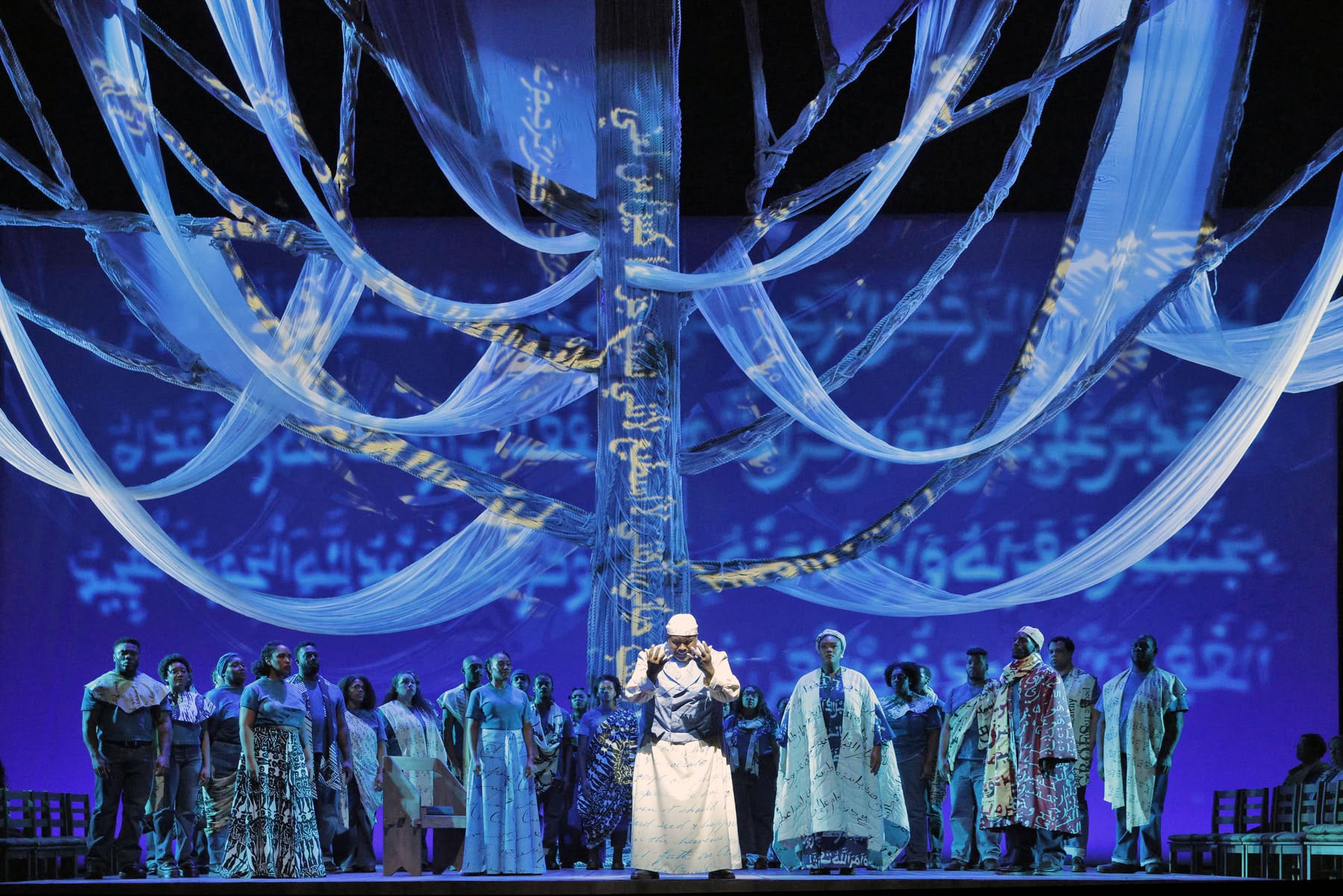
Drawing from translator and editor Ala Alryyes’s book A Muslim American Slave: The Life of Omar ibn Said, Giddens’s Omar libretto traces the outlines of Said’s life while also sharing stories of several other enslaved people. As co-composers, Giddens and Abels sonically infuse their eclectic and melodic score with a blend of musical styles including African percussion, waltzes, spirituals and even a bluegrass hoedown in Act II.
Omar begins in Futa Toro (now part of Senegal), where Said (tenor Issachah Savage) discusses his faith with his wise mother, Fatima (mezzo-soprano Zoie Reams). Said’s brother, Abdul (bass-baritone Matthew Dexter), is trying to negotiate with slavers in the region, but is thwarted when their village is attacked. Said is captured and his mother is killed (though Reams as Fatima reappears throughout Omar as a guiding spiritual voice).
Omar then details the horrific human trafficking conditions of the Middle Passage. Said witnesses several ship prisoners who do not survive.
More horror is in store with an upsetting auction scene in the Charleston Slave Market. There, Said meets the kidnapped enslaved woman Julie (soprano Kearstin Piper Brown), who plots an escape and shares advice to head to Fayetteville in North Carolina should he ever escape.
As an enslaved man, Said experiences violence on the Johnson Plantation in South Carolina, compelling him to flee northward. But when Said is captured in North Carolina, his ability to write Arabic on the walls of his prison cell captures the attention of the community.
Plantation owner Owen (bass-baritone Kyle Ketelsen) purchases Said at the prodding of his wide-eyed daughter, Eliza (mezzo-soprano Camille Robles). A self-styled ‘benevolent Christian’, Owen announces his intention to educate and convert Said to Christianity.
Said is coincidentally reunited with Julie, who shares stories of her own father to explain why she took a shine to him and saved his African cap. Owen then gifts Said with a Bible translated into Arabic, but he struggles with the faith implications of this imposed religion from the man who enslaved him.
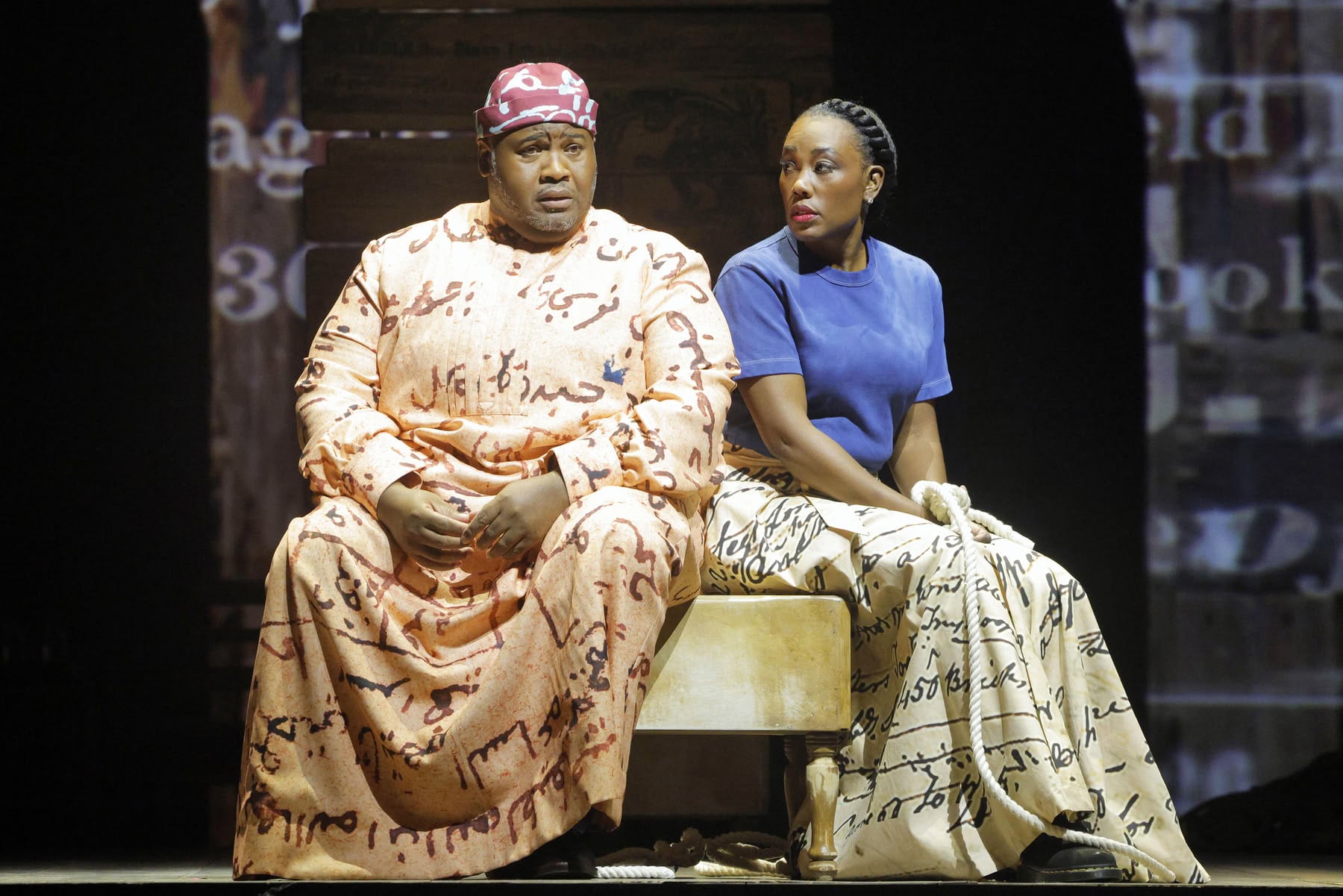
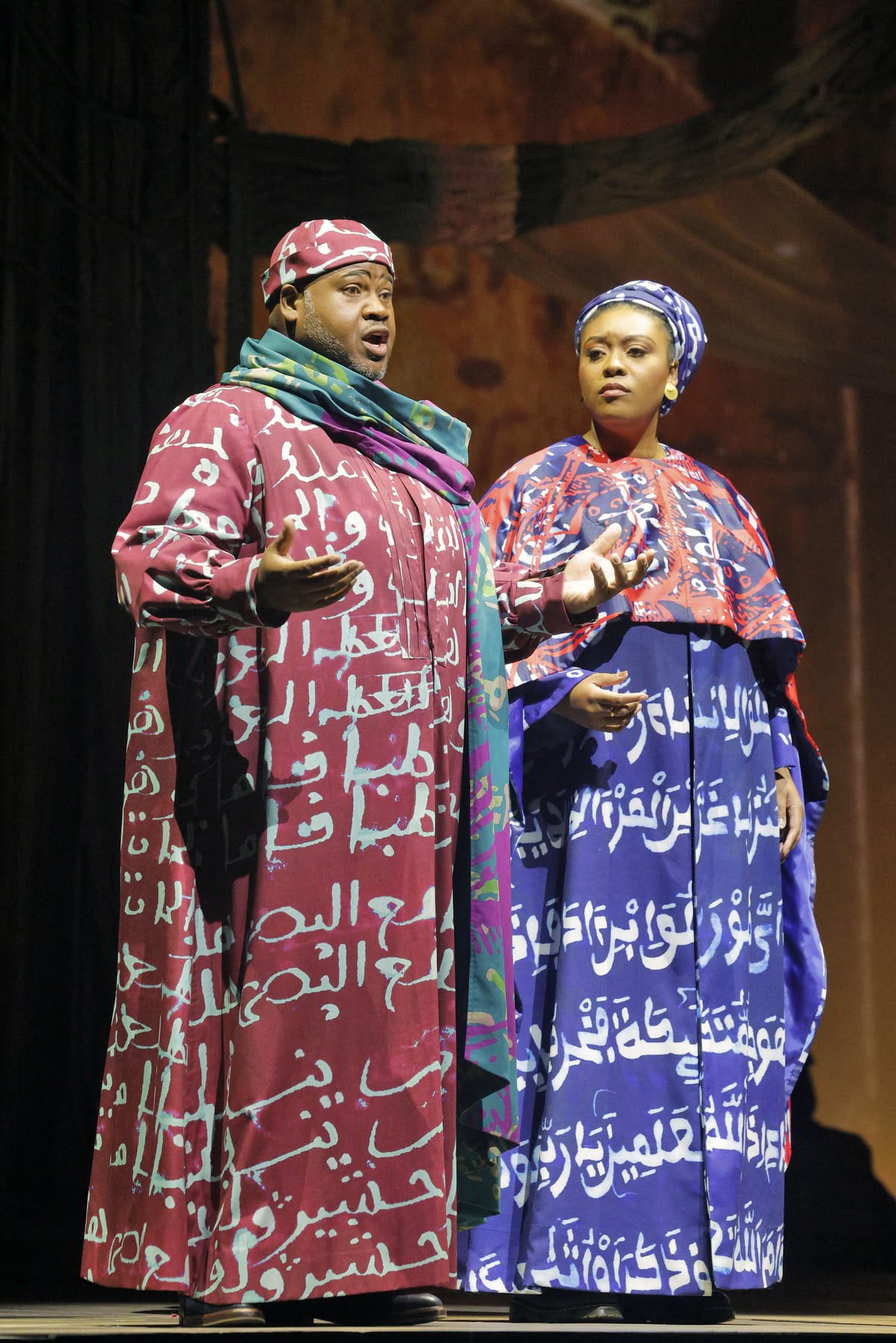
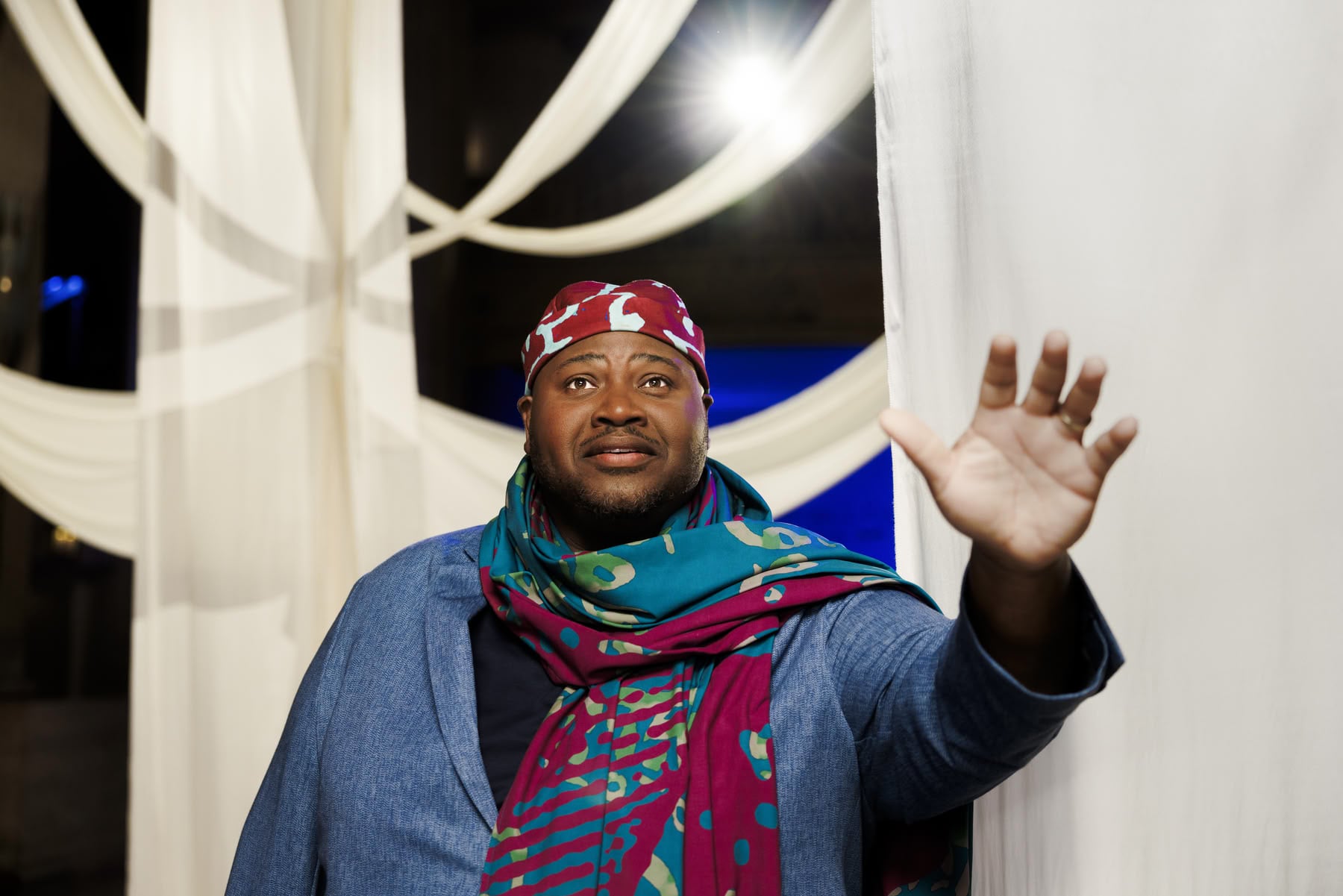
Ultimately, Said is encouraged to write down his own story – a feat considering how it was illegal in some states to teach enslaved people to read and write. Audiences aren’t given a hint that Said’s autobiography could also have been written under duress, but ultimately it does survive as a first-hand account of an enslaved Muslim from American history.
Since the life of Said isn’t generally well known or taught in schools, director Kaneza Schaal has opted to present Omar in the style of a semi-staged oratorio. There are constant staging and visual reminders that the performers are only assuming their roles instead of fully inhabiting them as would be demanded in a more naturalistic staging.
For example, Issachah Savage as Said assumes his character’s clothing on stage at the start of the opera, and changes out of his robes and shoes at the conclusion. He literally walks in another person’s shoes. And the chorus is a constant onstage presence, often seated on stage facing each other as if they were church parishioners or students in class before they rise up to take on any number of smaller roles.
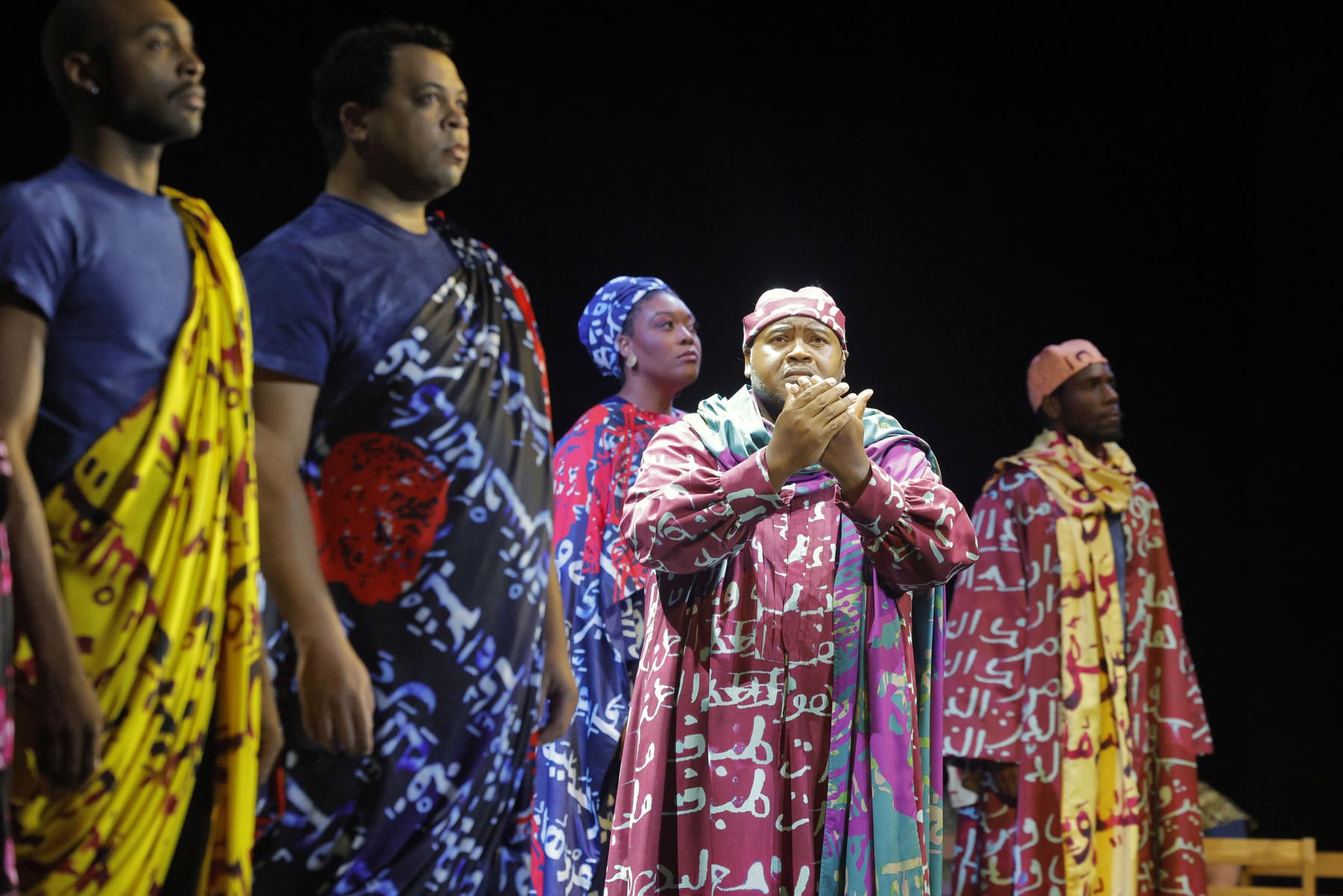
The basic uniform for most of the performers is indigo-blue jeans and shirts (a nod to that valuable cash crop that was historically farmed by enslaved people in the US). There are also added on fabrics printed with Said’s written text that are worn by the ensemble (the original costumes are credited to Micheline Russell-Brown and April M. Hickman, with Charlese Antoinette Jones as the current designer).
While some might accuse this symbolic costuming tactic in Omar as being cheap, for me it helped to telescope and connect the years between the events in the opera to the current performers depicting them. A disquieting moment for me came during the Act I slave auction, when white choristers stood observing in the background, looking just like the contemporary passers-by who would nonchalantly watch a busker in a city’s high street.
You could also see symbolism in the dominant indigo colours, especially when the Black choristers as ship prisoners sing about their Middle Passage deaths. These choristers all remove their overlay fabrics until they become a mass of blue to match the ocean waters where their bodies were disposed of.
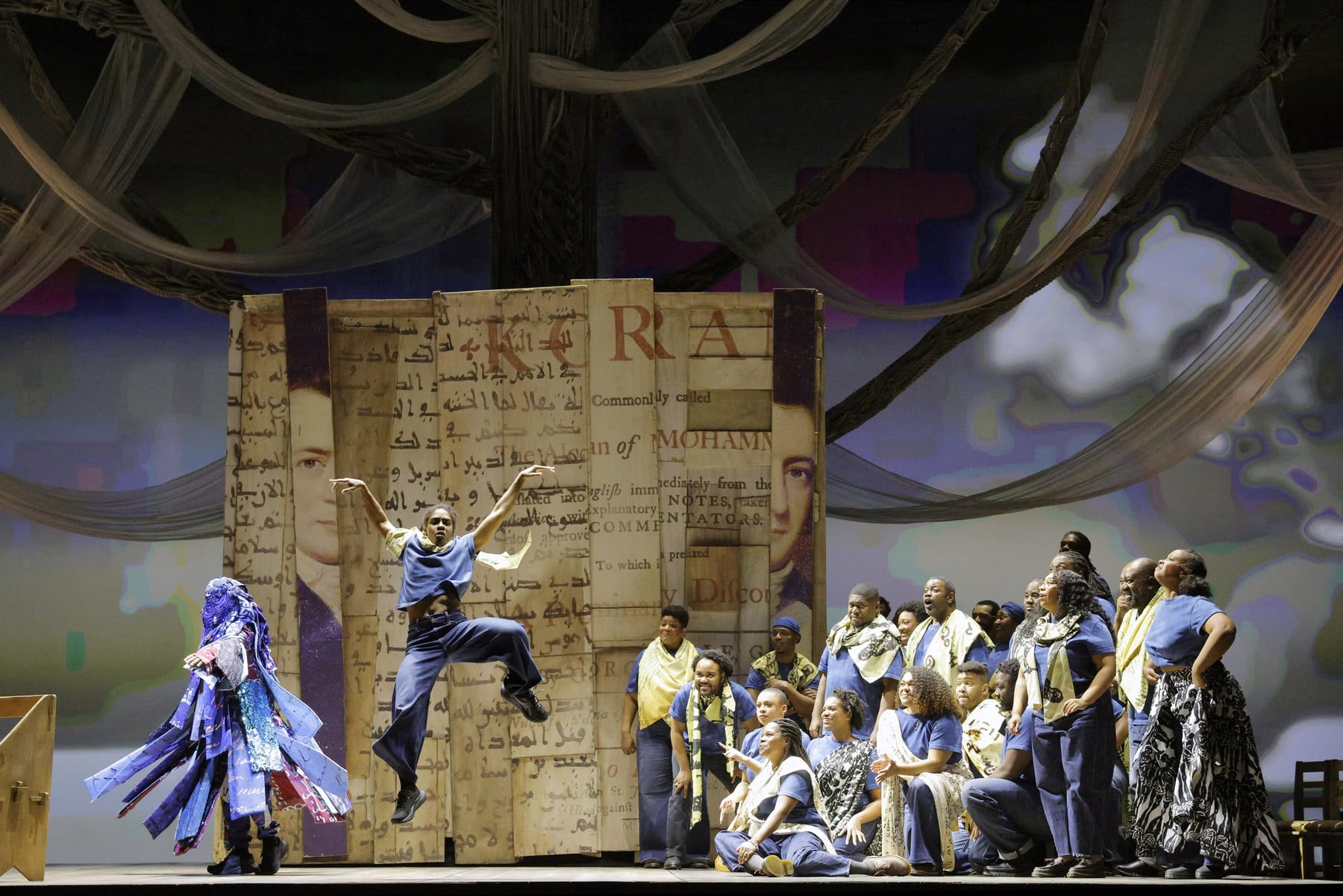
Said’s Arabic script – both printed on fabrics and projected – dominates the opera’s simple production design. Scenic designer Amy Rubin’s main set piece is a tree of giant fabrics – perhaps a metaphor for Said being forced to lay down roots in a strange land?
Projection designer Joshua Higgason provided some more complex and targeted animations to spell out Said’s words and prayers, while lighting designer Pablo Santiago did a good job in focusing the attention and shifting moods between living characters and singing spirits. And though Omar is mainly sung in English, Arabic is also occasionally used at key points by Said.
As Said, Savage provided a clarion tenor voice to match the piety of his deeply religious character. He could have possibly worked more on creating a stronger African accent, or portrayed more personal turmoil in Act II as Said comes to grips with the biblical Psalm 23 as an enslaved man. But ultimately Savage’s Said provided a grounding presence to the entirety of Omar, and allowed other performers to also shine.
As the determined Julie, Brown got one of the biggest ovations with her Act II aria drawing the many parallels between Said and her character’s late father. Brown was also very down-to-earth alongside the fine and sometimes comical work of mezzo-soprano Briana Hunter as both The Caller and Katie Ellen.
Other good dual-role performers include tenor Daniel Luis Espinal as the Charleston Auctioneer and visiting northerner Taylor, Ketelsen as two slave owners and Dexter as both Said’s brother Abdul and the enslaved man Abe, who is auctioned and pleads to keep his family together.
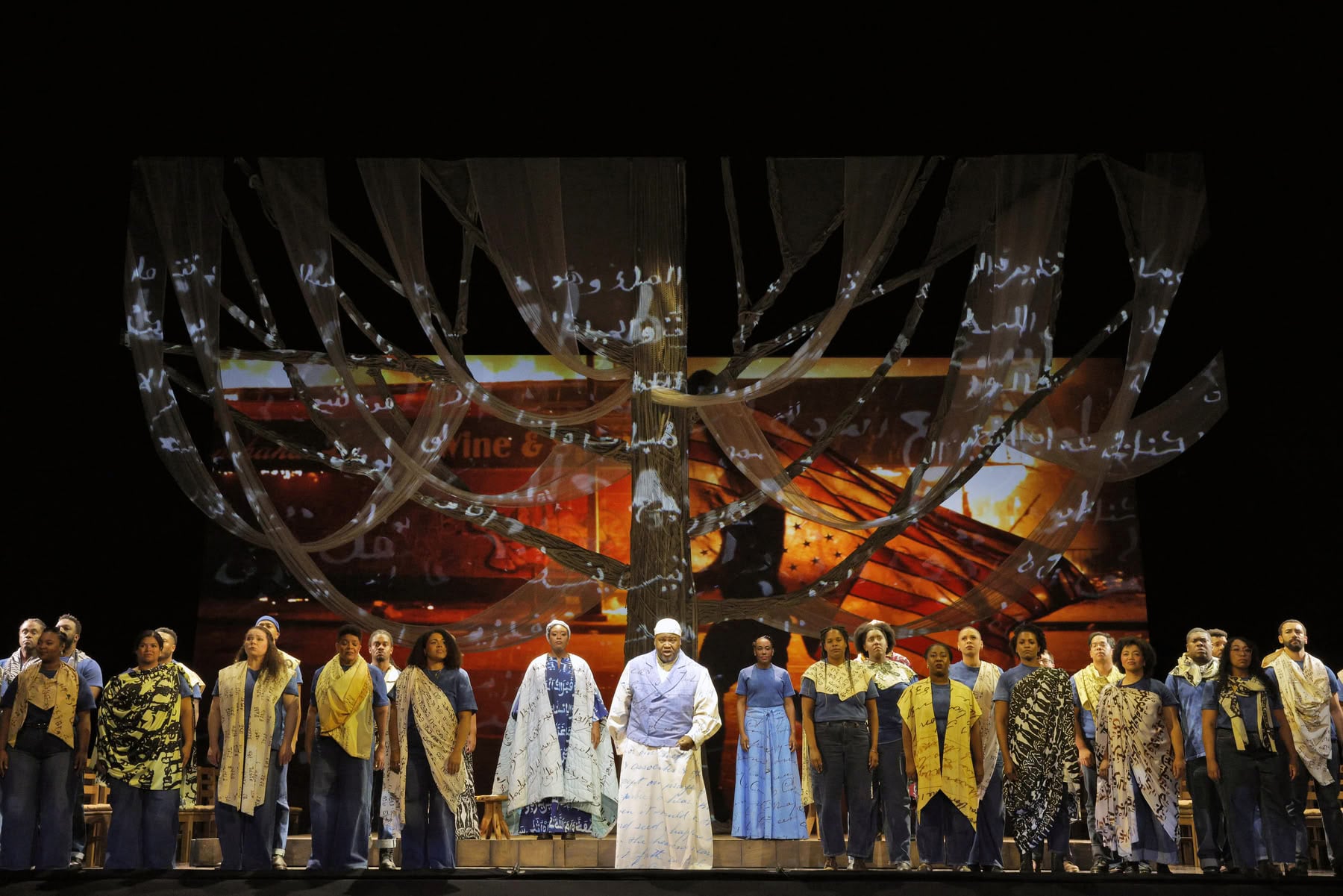
Conductor Kazem Abdullah led the Lyric Opera Orchestra in a fine reading of the Omar score, while chorus director Michael Black also did a solid job with the Lyric Opera Chorus. Many choristers were also given opportunities to be credited for several smaller roles with individual lines.
It’s too bad that Omar had such a short run compared to other subscription works in the Lyric’s 2026–27 season. No doubt the difficult subject matter of Omar could be seen as a hard sell for audiences who would rather forget (or are actively trying to paper over) America’s painful history of slavery and its ongoing fallout.
So, it’s very admirable that Giddens and Abels wrote Omar so that Said and his enduring faith are not forgotten. Humankind needs stories to learn and understand our past, and Omar finely gives voice to someone who was emblematic of countless enslaved people who were prevented from being able to share or leave their personal histories behind.