[Review] Robert Binet’s Dark with Excessive Bright – “a component of the bigger, balletic evolutionary journey”

Matthew Paluch sees Robert Binet’s immersive work Dark with Excessive Bright, part of The Festival of New Choreography at The Royal Opera House
| Title | Dark with Excessive Bright |
| Company | The Royal Ballet |
| Venue | The Linbury Theatre, Royal Opera House, London |
| Date | 10 February 2024 |
| Reviewer | Matthew Paluch |
The Festival of New Choreography that opened last night at the Royal Opera House feels like a different proposition. Newness will be found in the expected environments – Clore Studio and the Linbury Theatre – but also make its way to the main stage for the premiere of four works as part of the bigger programme.
The Linbury Theatre is a reworked space for Robert Binet’s immersive work Dark with Excessive Bright, and the write-up promises a lot with elements of growth, decay, chaos, consistency, care, and community on the agenda. The latter two being very prominent of late.
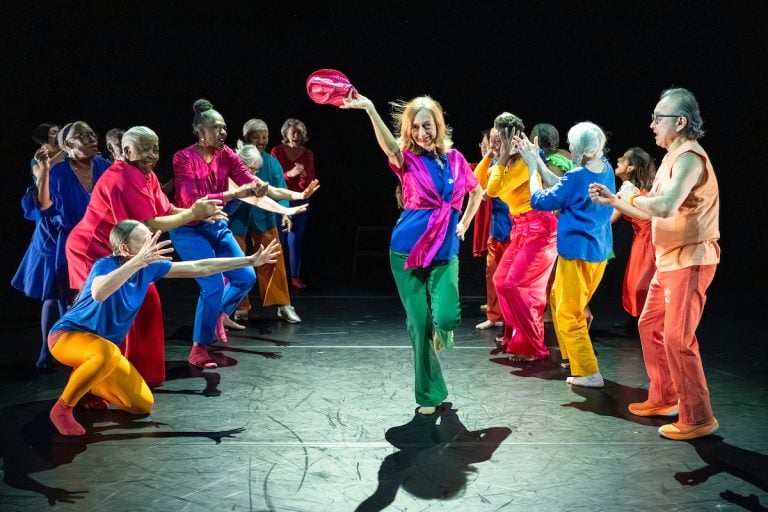
Gone is the predictable 4th wall situation, and what’s offered instead is an “environment already alive with music, light and movement” as audience members enter. The floor space has been divided into three separate areas, and the observer is the decision maker (for a change!); does one overlook the whole event from the balcony, or get onto the floor and immerse oneself in the spectacle?
Binet confirms the movement isn’t improvised, but also won’t be the same twice due to existing choreographic structures that allow the dancers to make decisions in the moment. He feels this approach will allow for a work more shaped like an “intimate exchange” and an “expression of free will”.
I started upstairs to get a feel for the whole experience, and experience is the word that defines what Binet has created.


There was probably one distinct moment during the 45 minutes that the choreography made an impact on me, and this was when the atmospheric muzak found a regular pulse, and two, or perhaps three dancers on different stage areas executed phrasing in unison that followed the rhythm of the score. What they did is almost irrelevant, it’s more the fact it communicated harmony through connection to the sound and each other, because until then, and subsequently after, the majority of the work was indeed attractive, but significantly disassociated.
Binet has skill though. He creates an organic language that feels perpetually fluid without laboured preparation; offers same-sex duos with no obvious agenda; includes sound in the form of clapping or thigh slapping to slice the vast space and interweaves aspects of the danse d’école vernacular with taste. Specifically épaulement and port de bras with emphasis on super soft elbows and wrists.
I was glad to see the dancers sporting little to no makeup, as anything too obvious would be problematic with such proximity, likewise their performance execution. The entire cast danced beautifully, communicating involvement and expression without overselling, though none of the blurb nouns felt part of the equation.


The set design by Shizuka Hariu uses minimal, never-ending wire and gentle curves to define the void, offering the right balance of presence without pulling too much focus, however I wish Simisola Majekodunmi’s lighting design had done a tad more. There’s an impressive futuristic chandelier (Hariu again?) that lowers and radiates intense light of different hues, but otherwise the light aspect feels underused. The costumes by Thomas Tait have an apparent Iris van Herpen feel, though a lycra and chiffon combo doesn’t equate to groundbreaking – think Oberon circa 1964.
The collaborative score by Missy Mazzoli (composer) and Jon Nicholls (sound designer) offers both live and recorded elements, and it can be difficult to tell which is which. When on the move and walking past the musicians, feeling their reverb in real time is a wonderful sensation.
So do we have a success on our hands? Binet and the ROH should be applauded for experimentation, and the fact ballet companies are now in the business of art installations is absolutely progress of sorts. But will this experience stand the test of time? Will we be desperate to see Dark with Excessive Bright in 20 years? I’d say no, as the fundamental content is inconsequential, with nothing feeling distinctive enough to transcend time and place. Though I’d like to think it’s a component of the bigger, balletic evolutionary journey.

Matthew Paluch was awarded a place at The Royal Ballet School in 1990 where he graduated in 1997. His first four years as a professional dancer were spent working with London City Ballet, Scottish Ballet, K-Ballet and English National Ballet, becoming a full-time member of ENB until leaving in 2006.
Matthew graduated from the Royal Academy of Dance, Professional Dancers’ Teaching Diploma in 2007, and was formerly on faculty at The Royal Ballet School. He completed his Masters in Ballet Studies at Roehampton University in 2011, has been a freelance writer since 2010 and currently works in the Law Sector.
He is a member of the Dance Section of The Critics’ Circle.