
Review: Covent Garden Dance’s Ballet Under the Stars at Hatch House
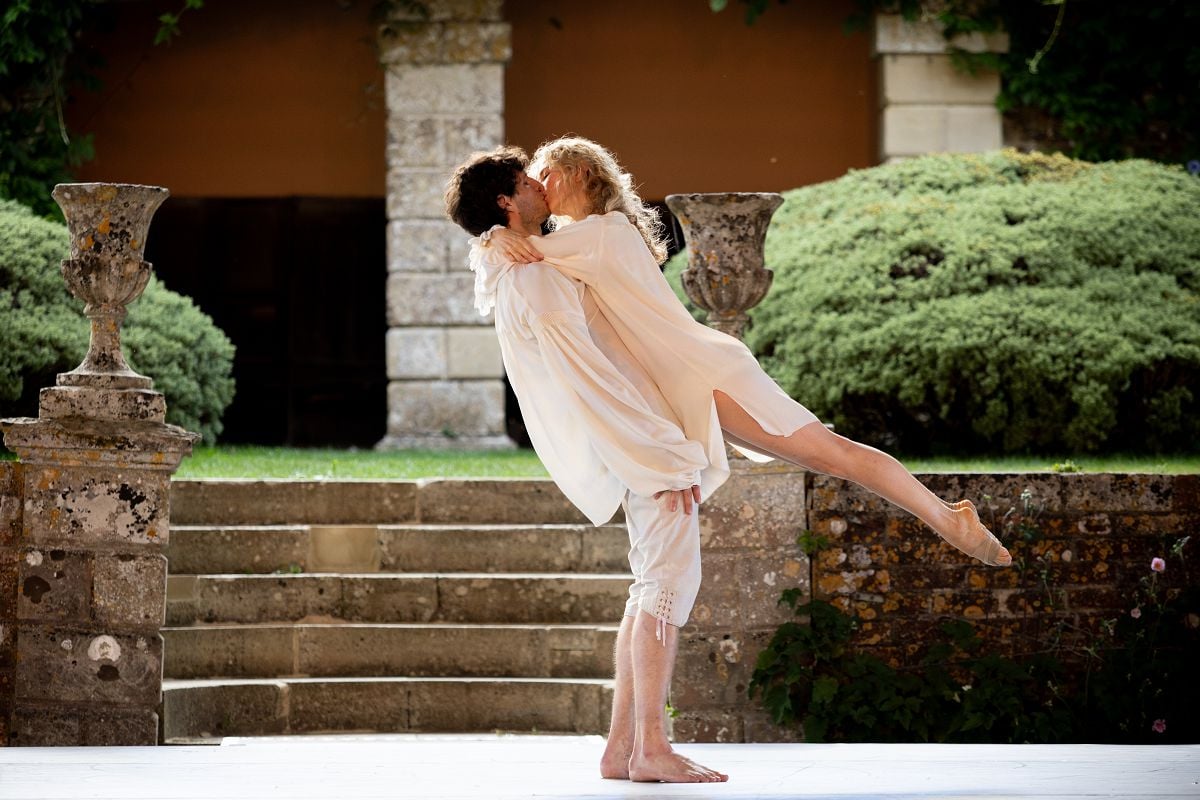
Graham Watts sees Ballet Under the Stars in the beautiful Dutch Garden at Hatch House, where starlight ballet said adieu on a high.
| Title | Ballet Under the Stars |
| Company | Covent Garden Dance |
| Venue | Hatch House, Wiltshire |
| Date | 24 July 2026 |
| Reviewer | Graham Watts |
Ballet Under the Stars in the beautiful Dutch Garden at Hatch House in Wiltshire has become a social highlight of the summer, but alas, this twentieth-anniversary season will be the last, at least for the time being. And it is fair to say that starlight ballet said adieu to Hatch House on a high.
It is not the end of Covent Garden Dance, the company that has presented ballet at Hatch House since 2006 and funded 30 world premieres in the process, since its supremo, Matt Brady – who has already introduced the brand to the Bahamas – is in the process of creating a new venue for 2027 onwards. Named Charlotte’s Lake, in tribute to his mother, the novelist and playwright Charlotte Bingham, who died last November, it will be a purpose-built venue that promises to take the Hatch House experience to a new, even more spectacular level.
Ballet at Hatch House started with an audience of just 100 and has grown over 20 years to accommodate sold-out audiences totalling almost 1,500 people over three nights, in a fine-dining experience with three acts of entertaining ballet between each course and an exciting jazz-themed after-party until 1am.
The food was excellent and the wine delicious, with a fascinating mix of past, present and future in dance, performed by a small ensemble of outstanding artists, some of whom have been providing ballet under the stars for a decade and more.


Unfortunately, the planned extract from Wayne McGregor’s Infra, to have been danced by Viola Pantuso and Joseph Sissens, was pulled at the last minute and, in its place, we had the Black Swan pas de deux, danced with great expressiveness by Joy Womack and Xander Parish. It was a pleasure to see the latter back on stage and his partnership with Womack – such a force as Odile – was excellent. Parish had proven his invaluable versatility by sweeping the outdoor stage before the show began!
Thankfully, we were not denied Pantuso and Sissens because they gave a memorable account of The Sleeping Beauty pas de deux, including the coda but minus variations due to the lack of depth in the stage. It was a consummate performance, and I would love to see these exceptional dancers partnered more often at The Royal Ballet.

Parish and Womack returned twice more to perform the Tango scene from Yuri Grigorovich’s The Golden Age, an unusual but fiery contribution to any gala; and Remember Me, a modern duet by Sofya Gaydukova, performed to Dido’s Lament, which is a regular party piece for Womack. Performed in black outfits, the highly physical choreography included an impressive upside-down lift with Womack’s tight-knit body at six o’clock, legs pointing up to 12.
Another in a treasure chest of memories was the unique opportunity to see Ksenia Ovsyanick, a Hatch House regular, performing with her life partner, Zdenek Konvalina, who retired from full-time dancing to concentrate on his career as a much-sought-after painter, working from his studio in Brno. Ovsyanick and Konvalina were stars of the English National Ballet, winning Outstanding Classical Performance Awards in the same year (2012). English audiences will have the pleasure of Ovsyanick returning to ENB as a guest artist for the Autumn season.

Ovsyanick gave a sensual account of a solo from Alberto Alonso’s Carmen before becoming the ‘cello’ in Nacho Duato‘s intriguing Multiplicity: Forms of Silence and Emptiness, with the flamboyant cellist performed with a flourish by Konvalina. They returned in the final act to perform Ovsyanick’s own choreography in Lightness of Being, set to the Six Etudes for Piano by Philip Glass – a slow, wistful opening, with the pair dancing apart, morphs into a gentle neoclassical pas de deux with soft, secure partnering. The complex interplay of joined arms, perfect balances and lifts was mesmerising: Ovsyanick’s white leotard contrasted with her partner’s all-black costume, and just as in the earlier Duato piece, she was the instrument of artistry while he provided the strength of secure partnering. It was a highlight of the evening to see these two dance together again.


Just as it was a delight to see the Hatch House returnees, the future was also represented, firstly in a charming piece by Annette Hind, entitled The Statue of Affinity (I’m guessing that this might have been a reference to the many statues in the Dutch Garden), danced by pupils of the Dorothy Coleborn School of Dance in Bath. And, at a professional level, it was another delight to see recent ENB recruit Zai Calliste performing outside of the corps de ballet: firstly, in the virtuoso pas de deux from Petipa’s Le Talisman, partnering his excellent and more experienced ENB colleague, Anna Nevzorova; then in Rentaro Nakaaki’s highly expressive Nature Boy solo, dressed in a vivid orange suit over a white singlet; and finally, proving impressive versatility, in another duet alongside Nevzorova to Nina Simone singing Black is the Colour of My True Love’s Hair, with choreography by yet another ENB colleague, Jakob Wheway-Hughes.
Every piece in this well-curated programme was excellent, but the two contributions by Paris Opera Ballet étoile, Myriam Ould-Braham, partnered by sujet, Mikaël Lafon, were especially captivating. They began with an extracted duet from a contemporary work by Imre and Marne Van Opstal entitled Drift Wood, performed to a bespoke composition by Amos Ben-Tal incorporating a naturalistic soundscape by Salvador Breed. It was one of those fascinating works where it is easy to forget to breathe.
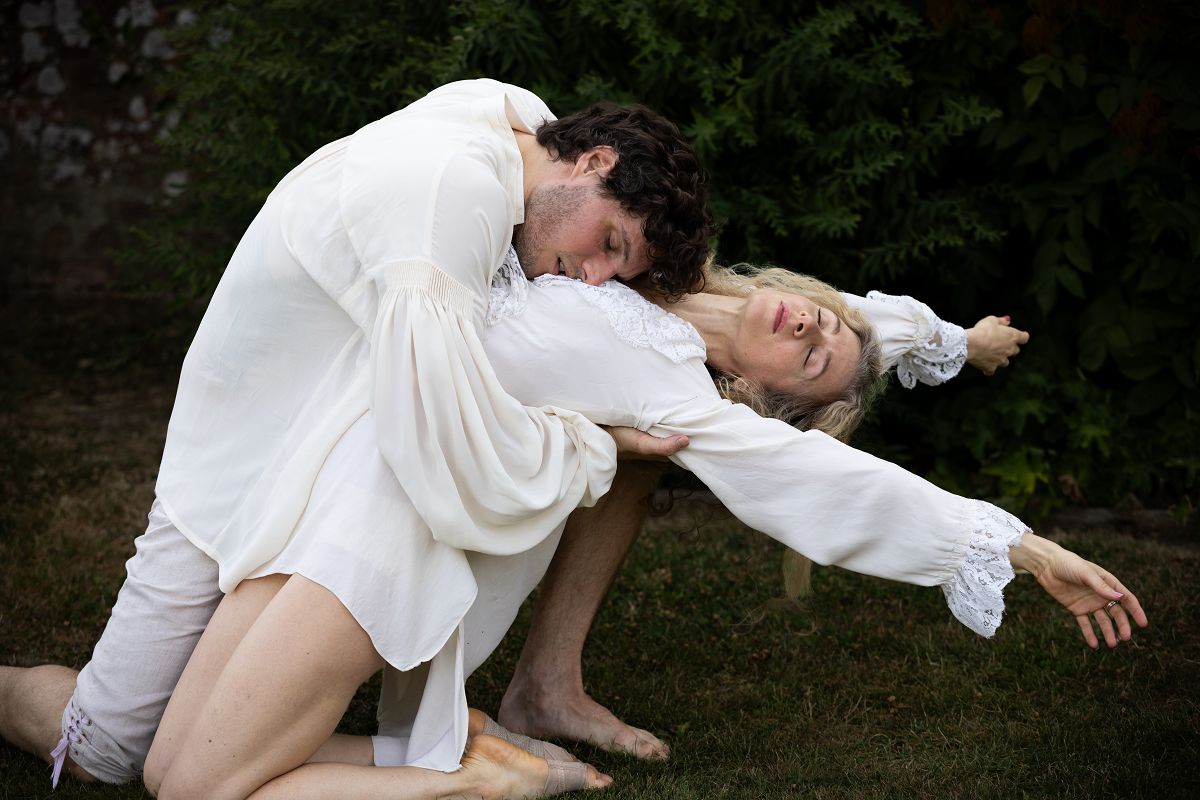
The whole programme concluded with the exciting Kiss pas de deux from Angelin Preljocaj‘s Le Parc, an extraordinary physical duet, danced beautifully with the strength of Lafon enabling Ould-Braham to float through multiple horizontal spins while their lips remained connected.
As a gala, the works were an excellent representation of the past, present and future, and the venue was as good as it gets, greatly enhanced by the balmy summer evening and delicious food. It will be a hard act to follow in the new Somerset venue next year, but I expect that, once again, the outcome is likely to exceed high expectations.

Graham Watts is a freelance writer and dance critic. He writes for The Spectator, Tanz, Shinshokan Dance Magazine (Japan), Ballet Magazine (Romania), BachTrack and the Hong Kong International Arts Festival and has previously written for the Sunday Express, Dancing Times, Dance Europe, DanceTabs, London Dance, the Edinburgh International Festival and Pointe magazine (USA). He has also written the biography of Daria Klimentová (The Agony and the Ecstasy) and contributed chapters about the work of Akram Khan to the Oxford Handbook of Contemporary Ballet and on Shobana Jeyasingh for the third edition of Routledge’s Fifty Contemporary Choreographers.
He is Chairman of the Dance Section of The Critics’ Circle and of the UK National Dance Awards and regularly lectures on dance writing and criticism at The Royal Academy of Dance, The Place and (until the war) for Balletristic in Kyiv. He was a nominee for the Dance Writing Award in the 2018 One Dance UK Awards and was appointed OBE in 2008.


