
Review: Joffrey Ballet revives Christopher Wheeldon’s Chicago-centric re-imagining of The Nutcracker

Scott C Morgan sees the Joffrey Ballet in Christopher Wheeldon’s The Nutcracker – in these uncertain times, the Joffrey’s Nutcracker has grown into the political moment.
| Title | The Nutcracker |
| Company | The Joffrey Ballet |
| Venue | Lyric Opera House, Chicago |
| Date | 5 December 2025 |
| Reviewer | Scott C Morgan |
Chicago will forever boast that it hosted the World’s Columbian Exposition of 1893. This globally influential world’s fair, which introduced engineering marvels as big as the Ferris Wheel and as small as the zipper, is symbolically represented as one of four red stars on Chicago’s city flag (it’s the second star from the left).
So, it made perfect sense that the Chicago-based Joffrey Ballet and British choreographer Christopher Wheeldon chose in 2016 to centre a new production of The Nutcracker around the creation and dreamy anticipation of the 1893 Columbian Exposition. But it’s not just pandering to Windy City civic pride, since The Nutcracker itself is also of a similar vintage to the fair.
Composer Peter Ilyich Tchaikovsky‘s final ballet, The Nutcracker, and his final opera, Iolanta, both shared a world-premiere double bill in December 1892 in St. Petersburg, Russia. And December of 1892 is exactly when the Joffrey’s re-imaging of The Nutcracker takes place.
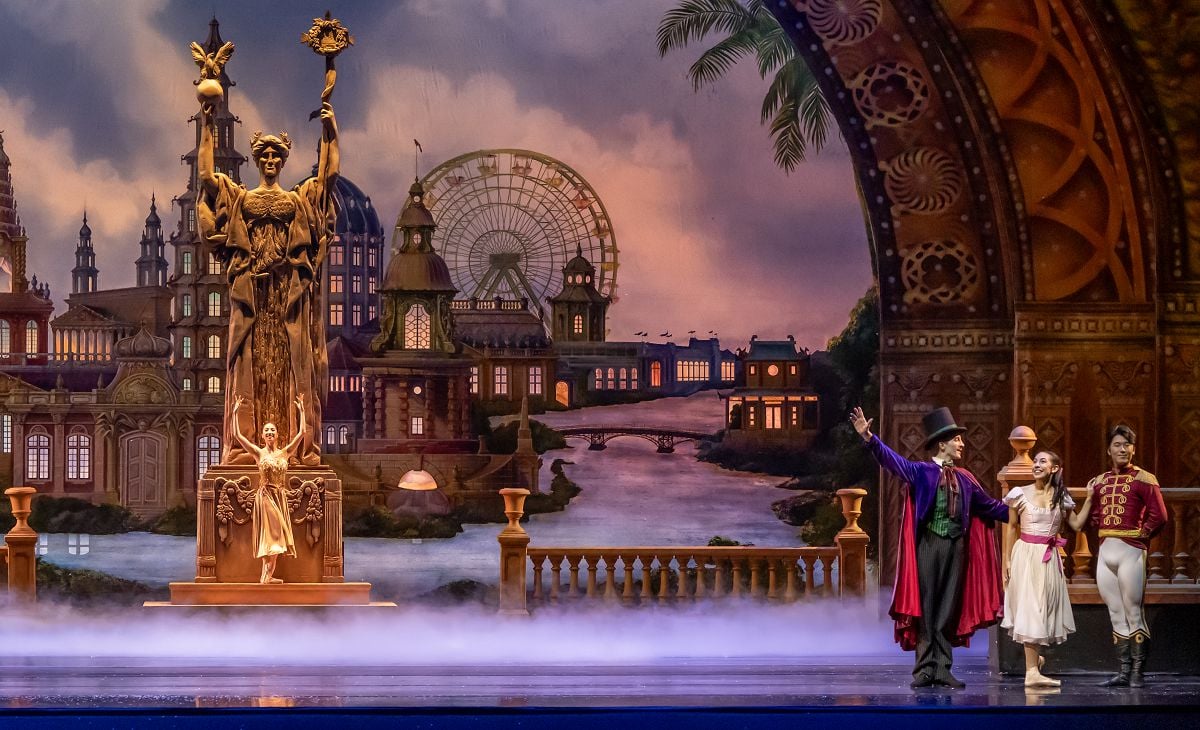
Now being revived until 28 December at the Lyric Opera House, the Joffrey’s Nutcracker still possesses plenty of magic in Nicolas Blanc, Adam Blyde and Christine Rocas’ re-staging of Wheeldon’s choreography. But the production takes on an added poignancy and relevancy this season, especially in light of the U.S. federal government’s ongoing (and often chaotic) immigration raids that have taken place this year in Chicago
Call it an immigrant tale of gumption, as Wheeldon and author Brian Selznick have re-set their Nutcracker around a striving community of migrant labourers who are excited to be working on and around Chicago’s forthcoming fair. It’s quite an economic shift from E.T.A. Hoffmann’s original 1816 story of The Nutcracker and the Mouse King, which starts out in the mansion of a wealthy family in Nuremberg.
In Wheeldon and Selznick’s Windy City re-telling of Nutcracker, the heroine Marie (Amanda Assucena on opening night) is now a street food vendor who is economically and emotionally supporting her migrant family. Marie’s widowed artist mother (Gayeon Jung) works as a sculptress for the fair, while Marie also has to keep an eye on her little brother, Fritz (Alan Ruesch), a rambunctious urchin who runs with a street gang of kids who actively seek out trouble.
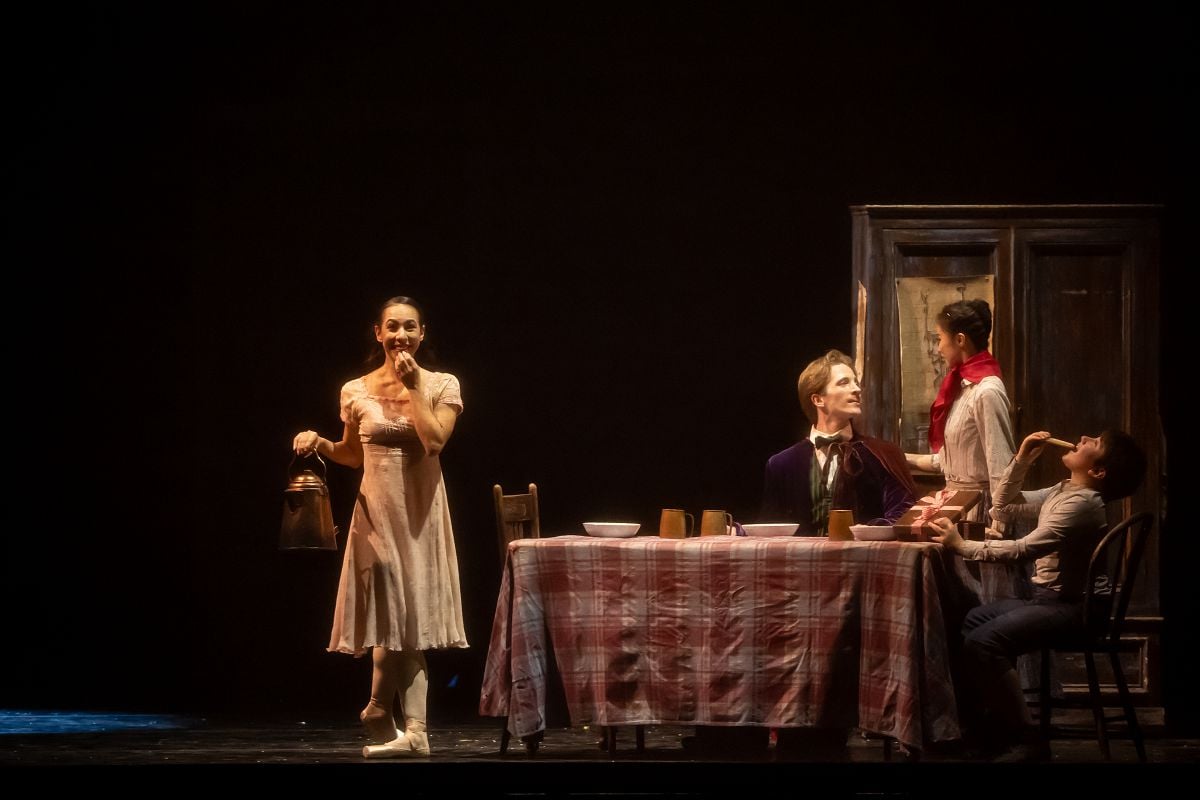
Despite their meagre circumstances, Marie’s family hosts a Christmas Eve party for their neighbours, full of cheer and plenty of folk dancing. Tchaikovsky’s grand party music has even been rearranged for an onstage violinist, clarinettist and accordion player (credited in the program to “Ljova”) to match the humble gathering.


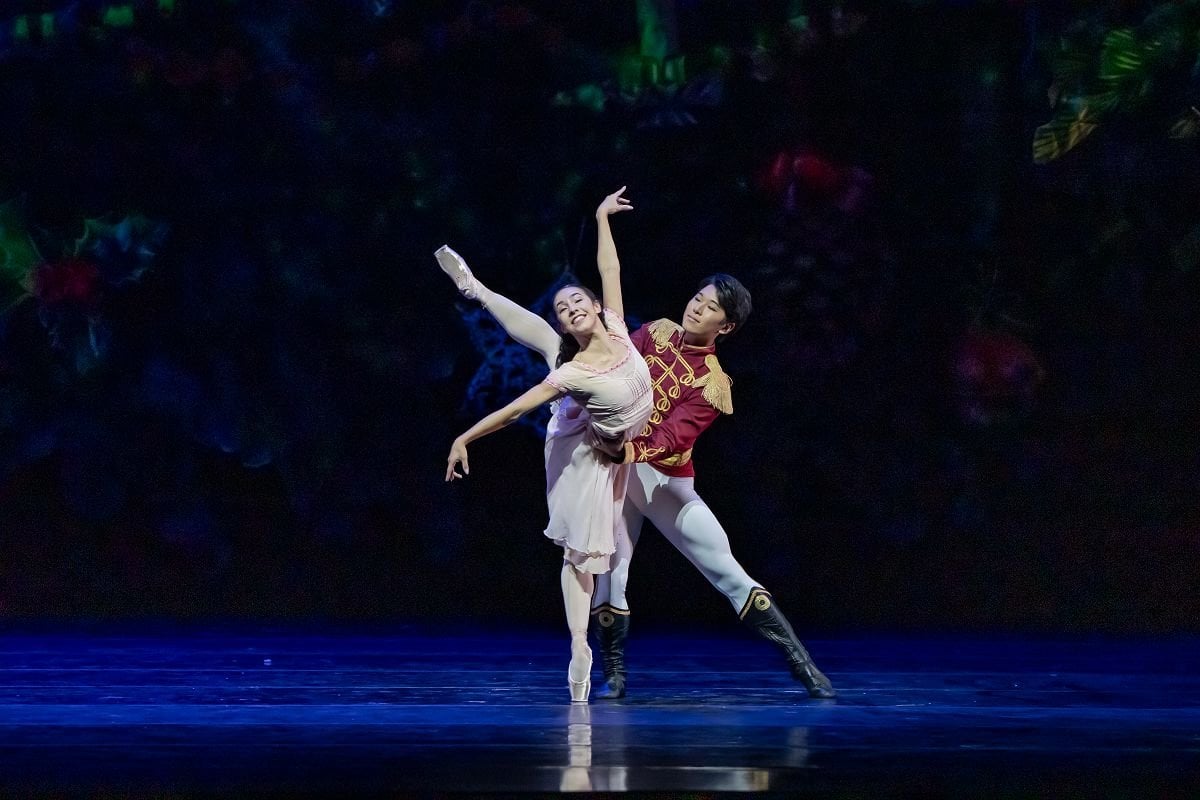
Where the magic comes in is with the Drosselmeyer stand-in, who is now called “The Great Impresario of the Fair” (Stefan Gonçalvez) and his assistant, Peter (Hyuma Kiyosawa). These two not only conjure up the anticipated wonders of the fair with a clever shadow play made up of everyday objects, but they also distribute a cart full of toys, including the magical Nutcracker (which has already gone on an adventure thanks to Fritz and his friends’ seemingly successful attempt to steal it earlier on).
There are also hints of romance. The Grand Impresario particularly admires the sculpting skills of Marie’s mother (she is first seen working on a scale model of Daniel Chester French’s golden Statue of the Republic, which dominated the fair), while Marie and Peter exchange flirtatious glances.
But Wheeldon and Selznick also highlight the public health and sanitation issues faced by poorer Chicago communities of the late 19th century, with the presence of many puppet rats in the first few scenes. There’s even a menacing Rat Catcher (Dylan Gutierrez) who disrupts the party and who later becomes The Rat King in Marie’s subsequent dream.
The design team of The Nutcracker really get to go to town with some nightmarish moments once Marie and Fritz fall asleep. You can marvel (or recoil) at the significant rat infestation ingeniously designed and constructed by puppeteer Basil Twist and Tandem Otter Productions.
And then there’s lots of other practical special effects dreamed up by set, costume and mask designer Julian Crouch as Marie shrinks down to aid the Nutcracker Prince (José Pablo Castro Cuevas) and his squadron of toy soldiers who do battle with an army of oversized rats. Here, Crouch’s work blends well with the spectral effects of lighting designer Natasha Katz and plenty of animated projection designs dreamed up by U.K.-based 59 Productions, especially when the Christmas tree grows to gargantuan proportions.
With The Rat King killed and his spell broken, Marie is pleased to see the Nutcracker transform into a likeness of Peter, the assistant of The Grand Impresario, who also reappears to help navigate their ongoing adventure. This trio then encounter loads of flurrying lake-effect snow off of Lake Michigan with a backdrop of the fair as Wheeldon sets a marvellous dance sequence of snowflakes embodied by Joffrey company artists and child trainees.
Rather than depicting a monarchy ruled over by a Snow Queen, Wheeldon presents a more egalitarian snowfall sequence with four Snow Soloists (Coco Alvarez-Mena, Dara Holmes, Yumi Kanazawa, Ao Wang) and four Ice Cavaliers (Evan Boersma, Jonathan Dole, Zachary Manske, Jackson Miles) — the swirling choreography amid the constant snowfall effects made for a beautifully enchanting close to Act I.


Act II then shifts to a dreamy version of the 1893 Columbian Exposition, with Marie’s mother now appearing as The Queen of the Fair in place of the usual Sugar Plum Fairy (her iconic solo has also been moved up in the lineup of dances). The usual Land of Sweets divertissements is now a celebration of the world’s fair national pavilions along the midway.
Many correlate with the original nationalities of the ballet, like the Spanish, Chinese and Arabian dances (Jeraldine Mendoza and Dylan Gutierrez particularly stood out as a seductively sinuous couple in the latter one). Others are changed to historically match the attractions of Chicago’s fair.
The Mirlitons now are Venetian Masked Dancers (Yumi Kanazawa, Nae Kojima and Ao Wang) to match the man-made lake full of gondolas for the fair’s neoclassical “White City.” And the Russian Trepek is now a showcase for a lasso-twirling Buffalo Bill Cody (a swaggering Valentino Moneglia Zamora) and a trio of “Wild West Women” played by Coco Alvarez-Mena, Laila Madison and Julia Rust (Buffalo Bill’s Wild West Show made an unofficial tour stop next to the fair during its six-month run).
The famed Waltz of the Flowers is now a showcase for a crowd of dancing Fair Visitors. Attired in candy confection-colored best-dress outfits, these couples continually spin in wonderment at the fair’s visual splendour.
The earlier hinted-at romance from Act I comes to full fruition in Act II. Not only do The Queen of the Fair and The Grand Impresario perform the main pas de deux dances, Marie and Peter, in the guise of The Nutcracker Prince, also get to dance their budding romance, too.
Though everything is revealed to be a dream by the end, Wheeldon and Selznick hint that a happy ending will be in store as the Grand Impresario of the Fair returns on Christmas morning to have breakfast and to officially begin the courtship of Marie’s mother. Marie clearly shows her approval, as a wish of rekindled romantic love for her mother starts to come true.
If there are any drawbacks to this revival of the Joffrey’s The Nutcracker, it’s for audiences who originally saw the production through 2019 in its original venue of the 1889 Auditorium Theatre, designed by architects Dankmar Adler and Louis Sullivan. Ornamental and architectural details of the Auditorium Theatre are incorporated into Julian Crouch’s Act II Nutcracker set designs, while lighting designer Natasha Katz also utilised that venue’s audience lighting to help build the grand finale.
Now at the 1929 Art Deco Lyric Opera House since 2021, the Joffrey’s Nutcracker still plays in a grand and gorgeous venue. But that architectural dialogue between the venue and production has slightly gone astray.
But this is a minor quibble for a grandly Chicago-centric production that draws upon the Windy City’s proud history. And in these uncertain times, the Joffrey’s Nutcracker has grown into the political moment by stating that migrants and their immigrant cultures have historically and recently continued to make Chicago great.
The Joffrey Ballet’s revival of Christopher Wheeldon’s The Nutcracker continues until 28 December at the Lyric Opera House, 20 N. Wacker Drive, Chicago. For more information, visit joffrey.org.

Chicago-based Scott C. Morgan is an avid opera and theatergoer. He is a frequent freelance contributor to the Windy City Times, and previously served as that publication’s freelance theater editor from 2008 to 2018. He also worked primarily as an arts writer for the Daily Herald in suburban Chicago from 2004 to 2022.
He has raised donations as an endurance race runner for AIDS Foundation Chicago via its charity training program Team to End AIDS from 2011 to 2023, and also co-hosted two Opera Tunes fundraisers at Chicago’s famed Sidetrack Video Bar in 2019.



I really had to laugh this morning after some thoughts on this politically charged “Nutcracker.” While the concept is shaped by sympathetic sentiments about the poor and the immigrant and determined to eradicate “elitist” elements of the storyline, I decided to check and see how many indigent and immigrant people in Chicago can afford to see this production. Hahaha! For a family of 3 to attend a matinee, it would cost over $500 to sit in the second half of the highest balcony in the Opera House–that is quite a viewing distance from the stage. Talk about irony!!!! Seats on the main floor so that a little one can actually see the entire set and the dancers faces go for over $800!!!!!
I’ve just logged in to the Joffrey’s own website and looked at the seating plan and prices, the highest of which is $230, going down to $64 in nose-bleed, so where you pluck the figure of $800 from, who knows. The ROH is currently charging the sterling equivalent of $250 for its performances of the ballet – in an admittedly blameless traditional staging – so if you think Chicago is pricey don’t come to London (where it’s completely sold out for the duration anyway).
Like London’s TKTS Booth in Leicester Square, the League of Chicago Theatres offers up discounted tickets for several Windy City productions via its Hot Tix service at hottix.org. Included is the Joffrey Ballet’s “The Nutcracker,” and Hot Tix is currently offering discounted tickets from $58-$79 to select performances. An endeavoring Chicago family of limited means can seek out discounted tickets, while others can choose to pay full price if they like.