[Review] MacMillan Celebrated – The Royal Ballet shows the choreographer fizzing with ideas
Jonathan Gray sees The Royal Ballet’s triple bill MacMillan Celebrated – showing a versatile and compelling creative force.
| Title | MacMillan Celebrated: Danses concertantes, Different Drummer, Requiem |
| Company | The Royal Ballet |
| Venue | The Royal Opera House, London |
| Date | 20 March 2024 |
| Reviewer | Jonathan Gray |
It’s easy to forget, in these days when “full-length” works dominate the stage, that the majority of ballets created by Frederick Ashton and Kenneth MacMillan – the leading creative forces within The Royal Ballet during the 20th Century – were in fact short, one-act pieces. With less pressure to produce evening-long “hits”, choreographers could experiment more and try out new ideas in a one-act work, and often, along the way, they produced real masterpieces that became mainstays of the repertoire. This was true of Ashton, and it was also true of MacMillan, which is why it is so good to know that, over the coming months, The Royal Ballet will be performing a series of programmes of short ballets by both men. We really don’t see enough of them and need to be reminded why they were considered great creators.
The first of these programmes – MacMillan Celebrated – opened at the Royal Opera House on 20 March, and brought back to the stage MacMillan’s Danses concertantes, dating from 1955, as well as his Different Drummer and Requiem, created during the 1970s and 1980s. None of these works had been performed at Covent Garden in years, and what was so wonderful about the programme was that it demonstrated MacMillan’s versatility as a creative artist. The styles of the ballets, all fizzing with ideas, ranged across pure dance, drama, and an almost abstract expression of mood and feeling, all three performed to very different types of music. The programme also emphasised how important design was to MacMillan, and how he never chose stage prettiness over a strong visual statement, especially when working with such distinguished artists as Nicholas Georgiadis and Yolanda Sonnabend. MacMillan Celebrated encapsulated the different strands that combined together to make MacMillan such a compelling creative force.


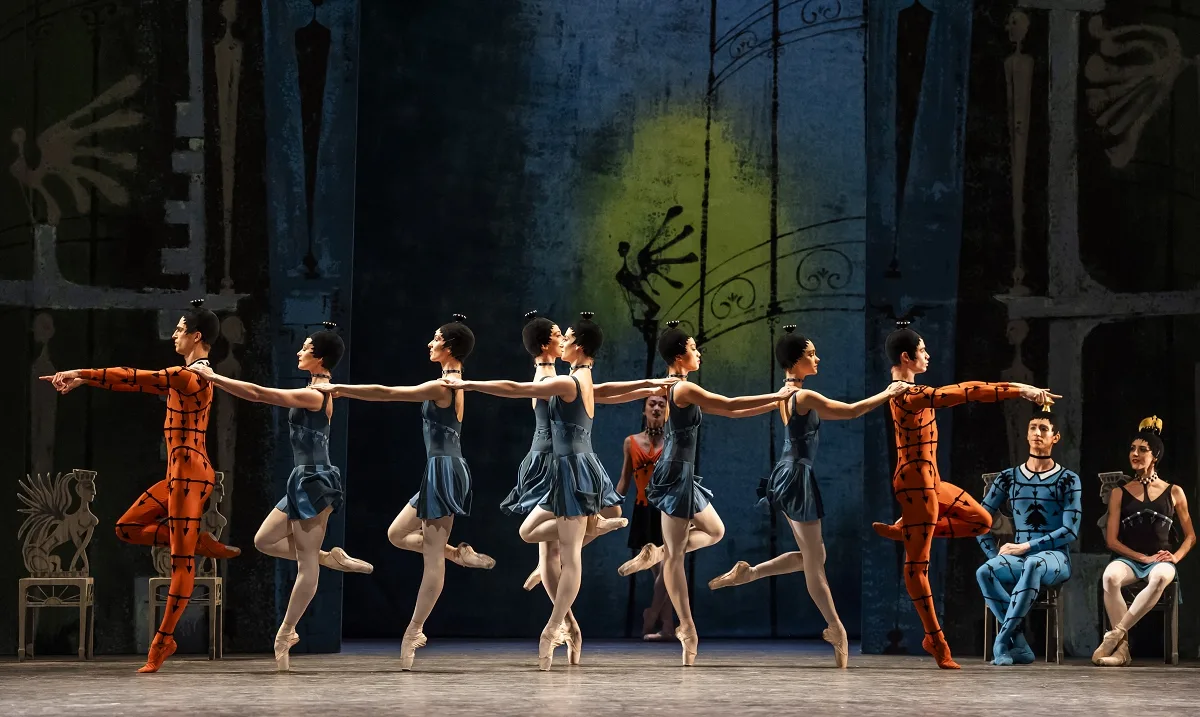


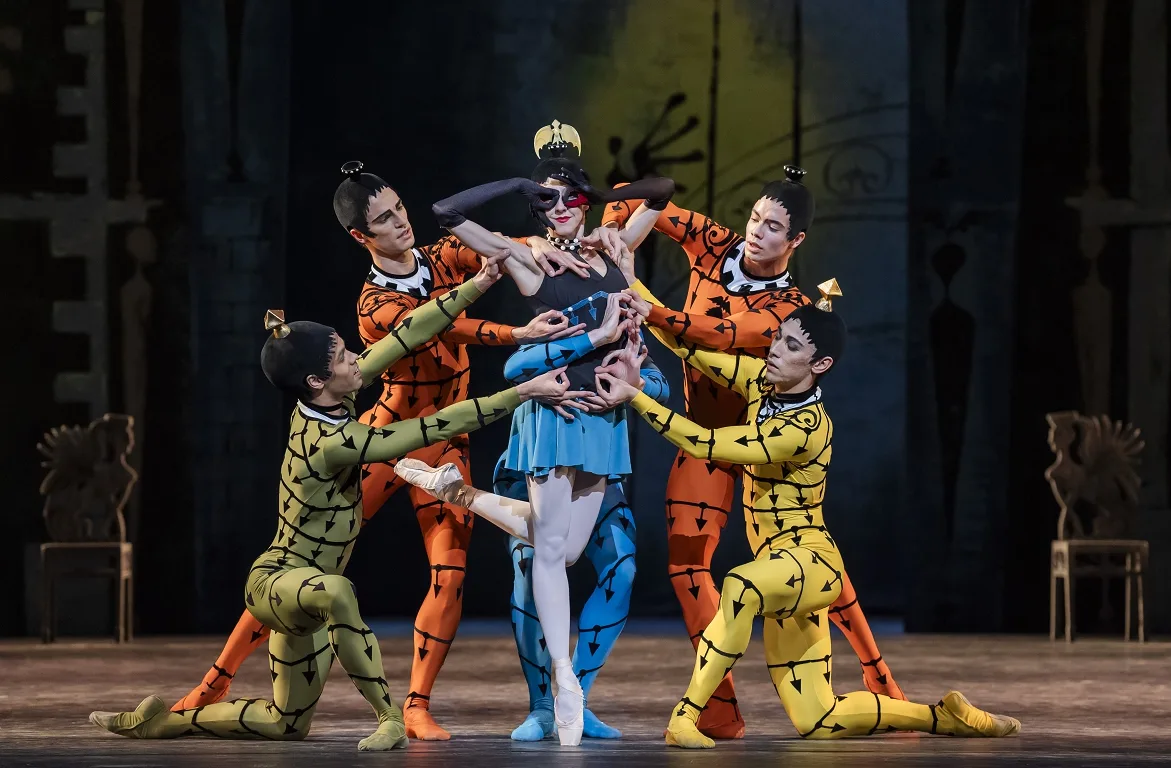
Danses concertantes was MacMillan’s first professional commission for the Sadler’s Wells Theatre (now Birmingham Royal) Ballet, and it turned up at this revival, staged by Laura Morera, as bright as a 1950s button. With Georgiadis’ brilliantly-coloured, painterly set – all startling blues, greens, oranges and yellows, edged with black, which caused a little gasp from the audience – the dancers sprang to life in the quirky, spiky, quick-paced choreography, their pointed fingers and sharply-sprung arabesques highlighting the acid vim of Igor Stravinsky’s music. What it also revealed was how MacMillan was influenced by the works of Ashton; the speedy footwork and geometric mathematical patterns in Danses recall Scènes de ballet and Cinderella, as well as Ashton’s theatricality. MacMillan was working in a very specific “Royal Ballet” way in 1955, as he continued to do throughout his life, and it was thrilling to see how closely today’s dancers recalled that style, especially Isabella Gasparini in the principal female role, along with Vadim Muntagirov, Luca Acri, Sae Maeda and Meaghan Grace Hinkis. Like an almost-forgotten painting brought down from the attic, Danses concertantes sprang to life with a vitality that was eye-opening.


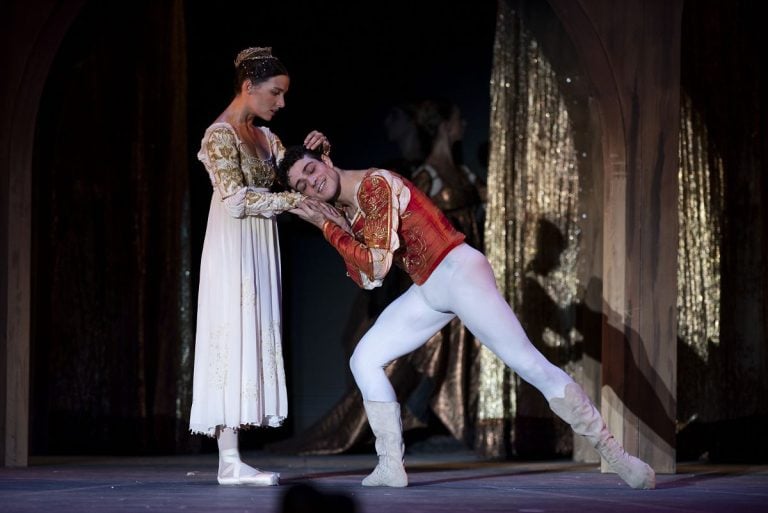
Different Drummer, MacMillan’s version of Georg Buchner’s Woyzeck, was made at a time when he was exploring the darker side of human nature through an expressionist style that many people found extremely uncomfortable. He seemed to be saying, “Why shouldn’t I make ballets that show the ugly side of life?,” and his choreography is anguished, extreme, even angry. Danced to music by Anton Webern and Arnold Schoenberg – all heightened strings and romantic yet tortured cadences – Different Drummer is grim and does not flinch from depicting the degradation and humiliation of Woyzeck, a soldier, at the hands of the Captain and the Doctor, who conduct medical experiments upon him. It is this sense of a broken soul, of a man pushed beyond endurance, that Marcelino Sambé, in a stand-out performance as Woyzeck, captures so strongly, his body wracked and twisting into extreme positions, his arm covering his downcast face when stepping into a lowering penchée arabesque, his torso and legs pushed above him from the floor with his neck and shoulders, like a break-dancer, his legs flailing. Woyzeck cannot even find comfort in his child and his common-law wife Marie (Francesca Hayward, who remains quietly dejected even whilst being courted by the arrogant Drum Major of Francisco Serrano), and the only option left to him is murder and suicide. Different Drummer is a bleak, unremitting, challenging ballet, but it makes a powerful impact. It was staged for this revival by Gary Harris.
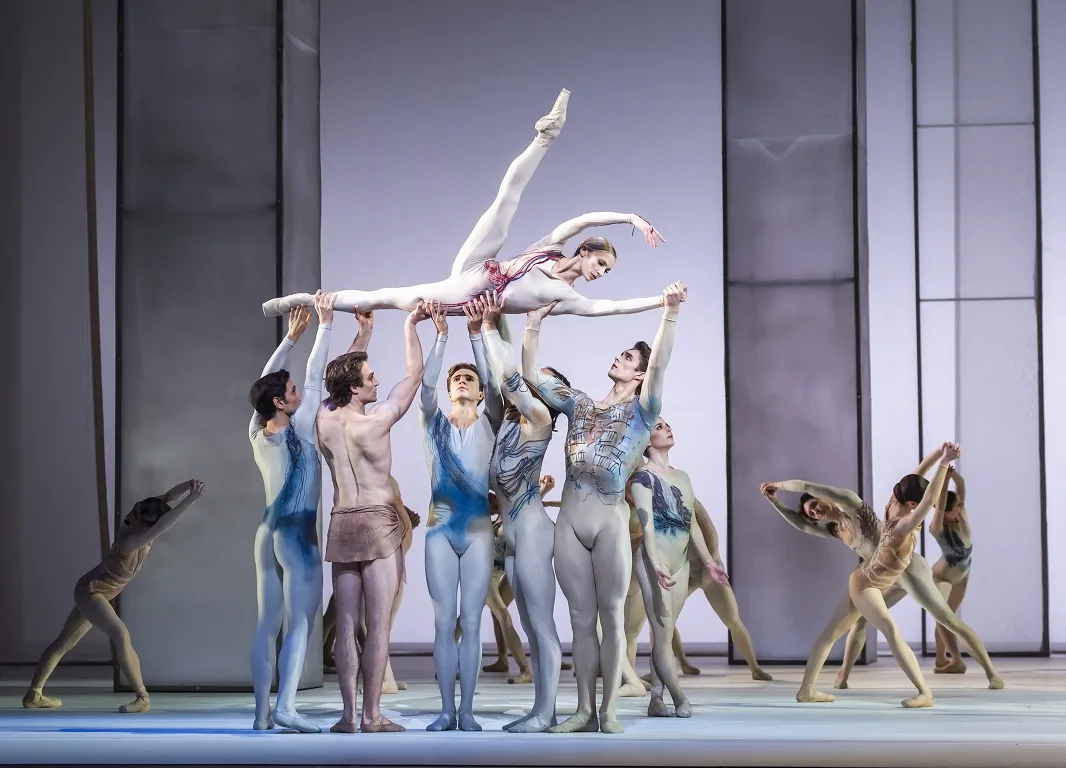


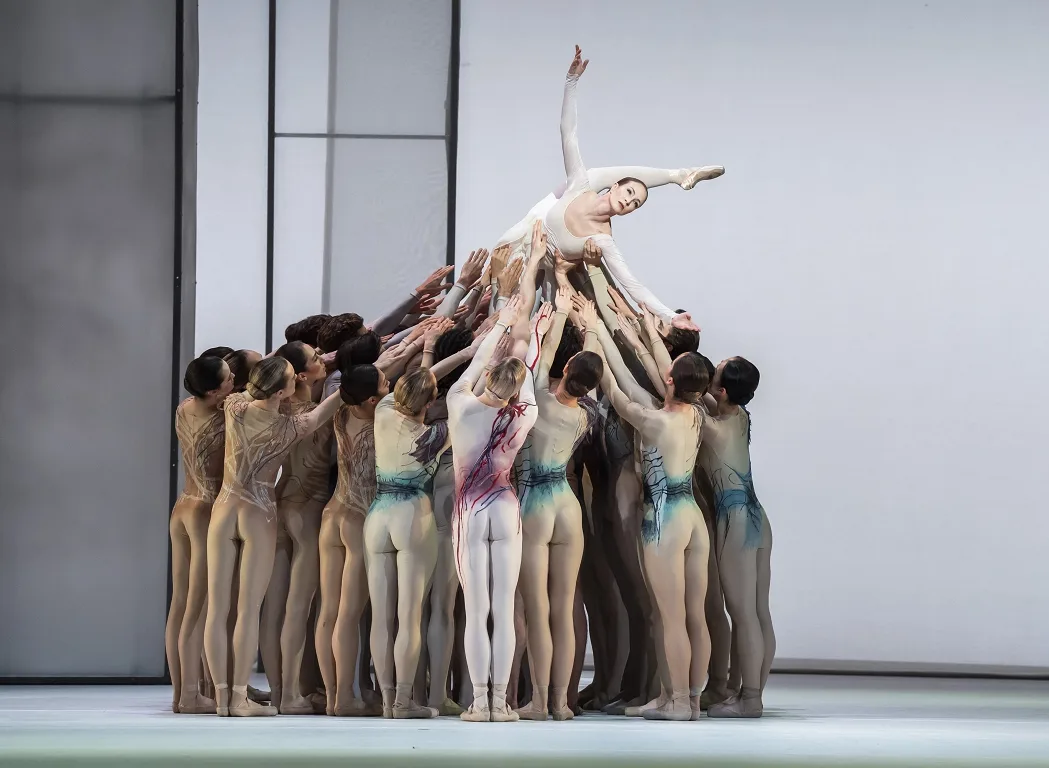
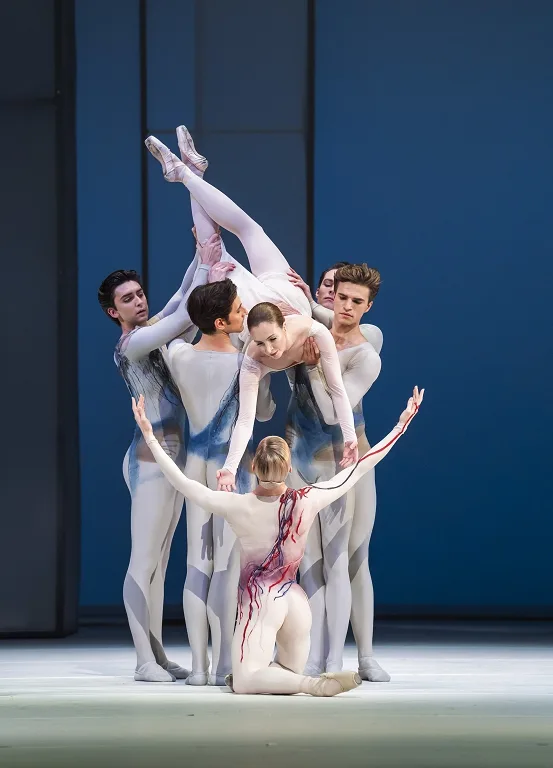


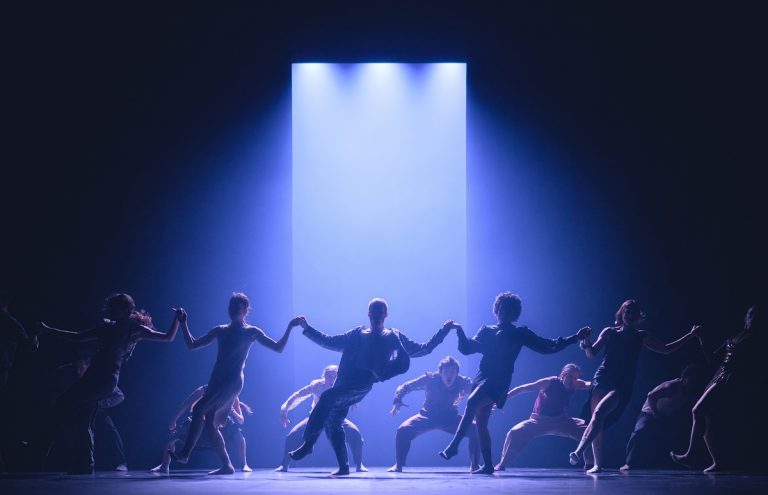
In complete contrast, Requiem, staged by Christopher Saunders and danced to ravishing music by Gabriel Fauré, seems to take place on a celestial plane, the simple beauty of Sonnabend’s soaring, luminous white columns providing the perfect setting for the ballet MacMillan made to remember his friend, the choreographer John Cranko, who died suddenly in 1973. The inspiration for the choreography, created on Stuttgart Ballet in 1976, came from the drawings and paintings of the visionary poet William Blake, and Sonnabend decorates the all-over body tights of her costumes with suggestions of the striations and ligaments of Blake’s muscular figures. MacMillan’s dancers pummel the air with their fists in grief, hold their arms like the bent wings of angels, or spiral down to the floor. Although MacMillan was not a religious man, in Requiem he shows a Christ-like figure in a loincloth amidst the dancers, and a woman dressed in a white shift who could be the Madonna, held aloft like a holy relic at her first appearance. Much of the dancing is expressed in movement of serenity or grief-stricken anger, the women sometimes held above by the men like angelic figures from a Baroque nativity scene. Above all, there is a glorious sense of line and grace expressed by the dancers that is deeply moving. Matthew Ball, all sinewy, muscular elegance, was perfectly cast as the Christ-like figure, and Lauren Cuthbertson was beautiful as the leading woman. They were joined on stage by Melissa Hamilton, Joseph Sissens and Lukas B. Brændsrød, all of them, as well as the Orchestra conducted by Koen Kessels, contributing to a perfect ending of this celebration to a magnificent choreographer.

Jonathan Gray was editor of Dancing Times from 2008 to 2022.
He studied at The Royal Ballet School, Leicester Polytechnic, and Wimbledon School of Art where he graduated with a BA Hons in Theatre Design. He was on the Curatorial Staff of the Theatre Museum, London, from 1989 to 2005, assisting on a number of dance-related exhibitions, and helping with the recreation of original designs for a number of The Royal Ballet’s productions including Danses concertantes, Daphnis and Chloë, and The Sleeping Beauty.
Jonathan Gray has also contributed to the Financial Times and The Guardian, written programme articles for The Royal Ballet and Birmingham Royal Ballet, and is co-author of the book Unleashing Britain: Theatre gets real 1955-64, published in 2005. He is a member of the Dance Section of The Critics’ Circle.