Review – English National Ballet’s Swan Lake in-the-round returns to London’s Royal Albert Hall

Matthew Paluch sees English National Ballet’s Swan Lake in-the-round, 27 years after its premiere in London’s Royal Albert Hall.
| Title | Swan Lake |
| Company | English National Ballet |
| Venue | Royal Albert Hall |
| Date | 15 June 2024 |
| Reviewer | Matthew Paluch |
What we know as the modern proscenium arch was introduced around the mid-16th century and has since defined the theatre experience – how work is created and seen. Enter the room Derek Deane in 1997, the then Artistic Director of English National Ballet, who was looking for a new proposition, or rather venue.
As ENB have never had a permanent theatre home, they’ve always been adaptable when it comes to performance spaces… but Deane chose the Royal Albert Hall, opened in 1871 and built in the shape of an oval.
What followed? Swan Lake in-the-round. And after Swan Lake came other productions. Deane choreographed Romeo & Juliet, The Sleeping Beauty and Strictly Gershwin for ENB at the Royal Albert Hall. The company also toured productions abroad, though the venues tended to be arenas more than concert halls, but still housed the in-the-round productions. And one must acknowledge Christopher Wheeldon’s successful, reworked Cinderella at the Royal Albert Hall for ENB also.
Other companies jumped on the bandwagon with Birmingham Royal Ballet staging The Nutcracker at the Royal Albert Hall, and the Royal Ballet doing a random Romeo & Juliet down at the O2 in Greenwich a while back – though both were presented on slightly more formulaic stage set-ups.
Cut to 27 years later, and Swan Lake in-the-round is still in the mix. “60 swans, stunning costumes and atmospheric lighting” are promised, as are new principals to lead the show through the mini two-week season.
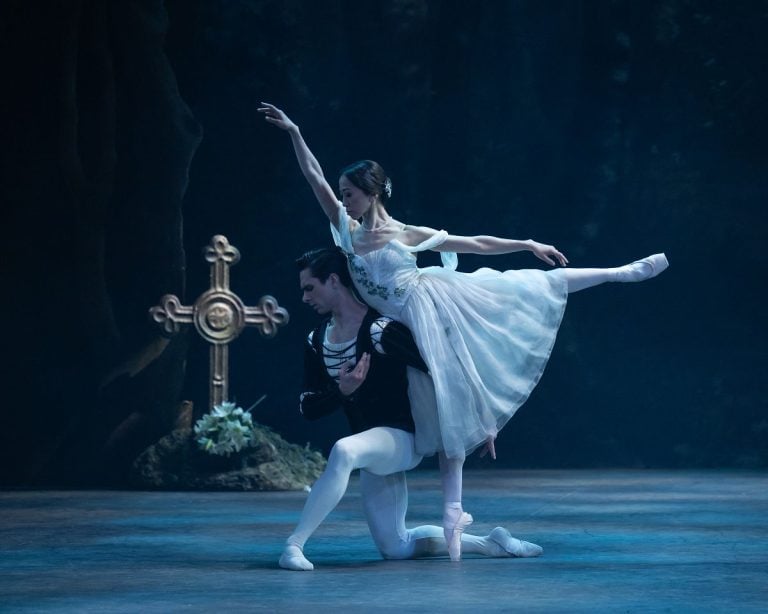
Deane has been responsible for the overall staging, and I saw Ivana Bueno and Francesco Gabriele Frola in the principal roles of Odette/Odile and Prince Siegfried respectively on the Saturday matinee of the first week.
Swan Lake – any version – isn’t an easy watch for me. I believe when you know a work very well it takes a lot to transcend the expected, or dare I say predictable. Deane’s Lac definitely has moments of emotive power, but equally there’s an abundance of empty dancing.
Act 1 for example, apart from setting the scene for Siegfried, what else do we get? A Waltz, a Pas de Douze, a dance by the Peasants… but none of it tells a story necessarily or offers character development. I understand these are all corps de ballet and soloist numbers, but these groups form the community within the narrative, and I couldn’t read much individual characterisation or ensemble connection.


Stina Quagebeur as the Queen stands out from the crowd. As an experienced dancer she knows her way around the stage, and even with very limited airtime manages to define the character, its relation to Siegfried, and communicate one of the story’s main linchpins all with stature, clear mime and dramatic flair.
Frola is doing the best he can with a one-dimensional role like Siegfried. His interpretation is full of intention, and the dancing communicates both the technique of a Prince and the sensitivity of a real man in dire straits.
Acts 2 and 4 work well in the Royal Albert Hall, though at times the stage feels a bit on the busy side… too many swans? Bueno doesn’t look like a dancer doing only her second show of the dual role. She communicates control throughout, coordination to die for, and arms that make her port de bras hypnotic.
Her first entrance felt very strong, and I thought we were in for a dramatic treat, but as the Act continued her interpretation settled rather than built. She had the odd technical blip but (impressively) wasn’t fazed, and though they make a handsome couple, there’s work to be done on the fundamental connection, and unspoken awareness that makes for a great partnership.
Fabian Reimair offers a valid interpretation of Von Rothbart. It can be easy to go OTT in this role, but Reimar finds a humanity within the evil, birdlike sorcerer, which works, and especially during the scenes with Odile.
Act 3 resonates similarly to Act 1, busy and attractive, but the group dances feel run-of-the-mill rather than a dynamic, exploration of the globe through styles and mannerisms.
The Ballroom dance of the Princesses was acceptably performed, but the storytelling emphasis seems misplaced. Each of the characters should dance with her eyes on Siegfried throughout, eager to seize any moment, simultaneously working out who her biggest threats are… but none of this felt front and centre, we were just watching another dance. Emptiness abounding.
The Black Swan pas de deux had more gumption thank god. Bueno’s Odile has playful eyes and fluid phrasing, and Friola did an absolute stonker of a solo, eating the space and suspending time whilst airborne. The lightning effect in the RAH feels a tad obvious, but atmosphere is created and felt in-the-round regardless.
Act 4 I adore, largely down to the music, played beautifully throughout under the dynamic baton of Gavin Sutherland. And Deane has undoubtedly choreographed some poignant moments for Odette and her Swans. The way she leads them off into flight is so caring, and Bueno’s attempt to join with a potent sense of defeat is arresting.
Deane chose to go with the happy ending version which I feel is the lesser choice. The drama of Act 4, both narratively and musically, needs the drastic finish of a double suicide, and the alternate good over evil outcome says ‘Disney’ in its feelgood vibes.
I believe the best place to watch Swan Lake in-the-round is probably from the top of the RAH, as the bird’s (pun) eye view will allow for Deane’s intricate, informed-by-nature patterning to really sing. Inevitably, that amount of distance means one would miss out on all the storytelling happening stageside, but sadly even just five rows back this aspect of the performance didn’t feel at the forefront of the experience. Which then begs the question – why are we bothering to watch a narrative ballet if the story isn’t at the epicentre of everyone’s agenda?