Review: Hamlet – South African choreographer Dada Masilo’s final work

Lydia Wharf sees Dada Masilo’s Hamlet, a queer, black, female dance interpretation of Shakespeare that didn’t live up to its promise.
| Title | Hamlet |
| Company | The Dance Factory |
| Venue | Sadler’s Wells, London |
| Date | 26 May 2026 |
| Reviewer | Lydia Wharf |
Dada Masilo, one of South Africa‘s most celebrated dancer/choreographers, was well known for her unique re-interpretations of classical ballet narratives. Deploying a fusion of classical, contemporary, and African dance techniques, Masilo used familiar stories such as Swan Lake and Romeo & Juliet as vehicles for socio-political commentary, with a focus on post-colonial revision.
Following Masilo’s sudden death in 2024, The Dance Factory has brought the premiere of her final work, Hamlet, to the London stage, having re-worked some elements of its content. Posthumous changes include the role of Gertrude (Hamlet’s mother), being played by the exceptional dancer Llewellyn Mnguni, a longstanding collaborator of Masilo’s, where it was originally played by an actor. Mnguni is given top billing, and her inclusion is a smart change, imbuing this key character with a deeper complexity through movement that fits seamlessly into Masilo’s oeuvre.
For sure, giving more space to dance in this re-imagined Hamlet makes absolute sense; it’s intriguing to consider how this complex, introspective psychodrama might translate into movement, something I’ve never seen attempted before, although the play is familiar. And Masilo’s work has an international reputation for its power and dynamism. In theory, at least, a queer, black, female dance interpretation of a Shakespearean play holds great promise.
But there’s some disappointment ahead. Choreography is shot through with spoken Shakespearean text; a hybrid that makes for uncomfortable viewing. The evening opens with the most famous of Hamlet’s soliloquies, “To be, or not to be…”, delivered devoid of context, spoken in the traditional way, with the protagonist played by an actor, front centre. This sets us so firmly in the familiar territory of the play that it feels almost impossible not to wonder how this dark, central quandary might have been expressed as an opening solo for the excellent Tumelo Lekana – a choice that might have avoided cliché, rather drawing out a physical expression of Hamlet’s agony as a more nuanced opening gambit.
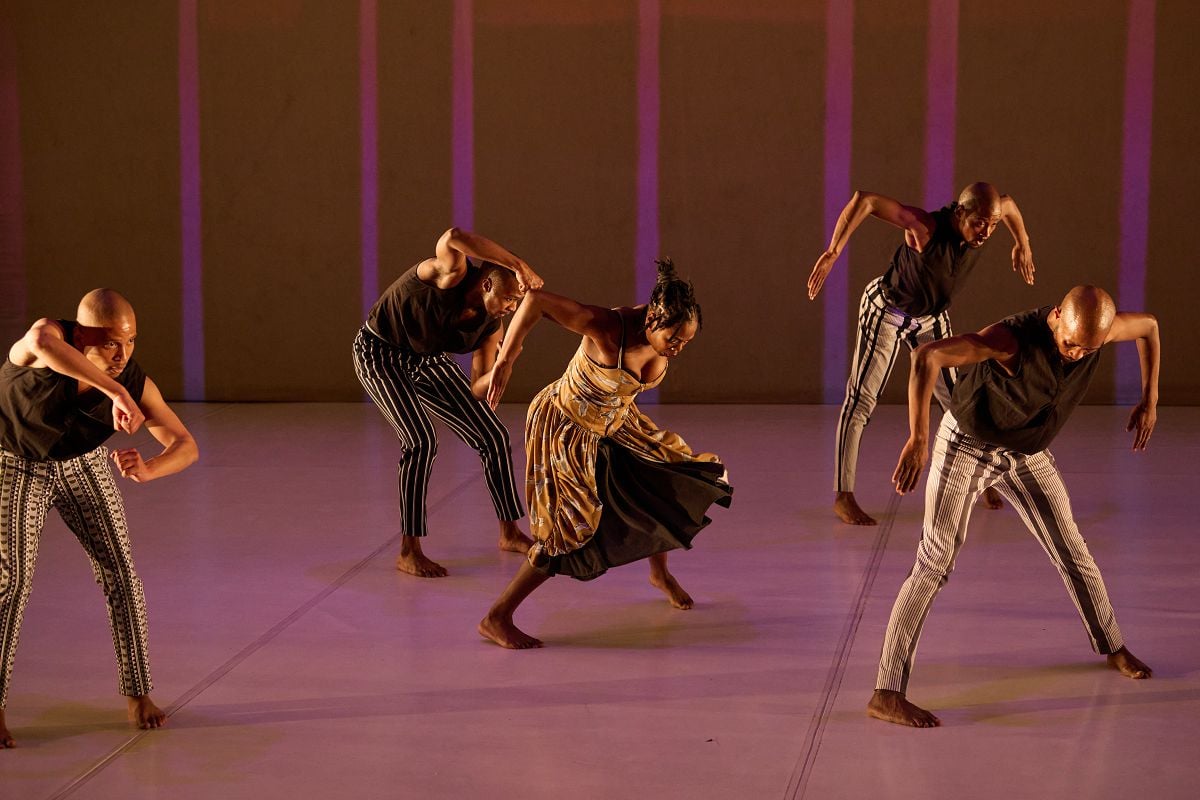
The same issue re-emerges throughout: Masilo’s choreography absolutely lives up to its promise as her paintbrush for each character, distinctive and identifiable by their individual flow, bodies expressing so tangibly the agonies and ecstasies of each twist of the tale. Bold, solid lunges, rapid-fire ripples across the upper body, sometimes enabling flight, Masilo creates a clarity of expression that cuts through and makes perfect sense of the story. Despite the depth that physical embodiment of characters brings, and however well this is augmented by a bold, original score from Thuthuka Sibisi, sections of familiar text break the spell that dance has so beautifully and effectively woven. The effect is to jar the audience back into being ‘told’ the story rather than feeling it, which is such a shame.
Masilo’s Hamlet is billed as a story told from the perspective of Ophelia, Hamlet’s tragic, erstwhile partner, rather than the eponymous character himself. It’s an interesting take that fits neatly with Masilo’s broader practice. Potentially, this decentralisation of the male role re-frames our understanding of the complex characters around Hamlet. And whilst the notion of an alternative perspective to Hamlet is nothing new – Rosencrantz and Guildenstern Are Dead, anyone? – it creates fertile ground for discoveries and possibilities. Indeed, Ophelia’s story is told well by a dreamy/dramatic Lehlohonolo Madise, whose descent into madness feels well-paced and well-drawn. From the dream-like charm of her early interactions with Hamlet, which exude mutual warmth, to the dismissive violence of his latter rejection and the way she eventually, slowly pushes herself offstage horizontally, hers is a story told entirely through movement, and all the stronger for it.


But whilst this angle on events gives more consideration to the psyche of both Ophelia and Gertrude, both of whom tell their story entirely through dance, it is still very much ‘Hamlet’ front and centre. Perhaps the most radical re-read is in how his character is played physically – less the self-flagellating procrastinator, much more the violent aggressor. When he comes across Gertrude flirting with Claudius in the wake of his father’s death, he doesn’t stop at chastising her – he grabs and shakes her. Similarly, he doesn’t stop at confusing and dismissing Ophelia, but throws her to the floor and drags her across it like a rag doll. It’s the women surrounding Hamlet who capture our hearts and sympathies, revealing the weaknesses in him, but they are not the protagonists – they are the victims of a serial abuser.
As the story moves towards its bloody conclusion, there’s a notable, tender solo for Laertes, played with solemn fluidity by Thuso Lobeko, followed by a significant shift in intensity and an opportunity for the strongest elements of choreography and staging to come to the fore. Rather insipid projections that have thus far only provided context (castle, woods, etc) give way to lighting that bathes the stage entirely in the glowing red of blood. As the music reaches its climax, each character is engulfed as they fight and eventually give in to the tragedy of grief, one by one. Performed with a conviction that carries this show over the line, there are virtuoso solos from the full cast, providing a visual feast and, perhaps with it, a reminder of the intensity and power with which dance can convey complex themes.
Lydia wharf is an independent producer working in contemporary dance theatre, tending to specialise in practices of care, access and inclusion.
She works directly with a range of artists and companies, most recently BirdGang Ltd, Dance Umbrella, Julie Cunningham & Company and Stuart Waters. Lydia has a long, twisty relationship with dance, as performer, writer, advocate and producer.