Review: 17th World Ballet Festival in Tokyo, Programme A

Matthew Paluch sees the Programme A gala at the 17th World Ballet Festival in Tokyo with 33 of the world’s top dancers.
| Title | World Ballet Festival, Programme A |
| Company | Japan Performing Arts Foundation (NBS) |
| Venue | Bunka Kaikan (Tokyo Metropolitan Festival Hall) |
| Date | 1 August 2024 |
| Reviewer | Matthew Paluch |
Japan is a special country for many reasons, one being their hardcore fandom of anything. So it makes sense that the World Ballet Festival started here in 1976.
The brainchild of Tadatsugu Sasaki, it sort to expose Japanese audiences to international dancers, and the 17th rendition (it runs triennially) is living up to the original mission.
The festival is offering two programmes from 31 July until 10 August, and I’m lucky enough to be in Japan and attend both held at the fabled Bunka Kaikan.
Programme A takes the audience all over the dance world and opens with Cranko’s Black Swan Pas de deux danced by Mackenzie Brown and Gabriel Figueredo of Stuttgart Ballet. It’s a rather busy version, which can be off-putting at times, but they’re a stunning pair. Brown is full of character and risk-taking, and Figueredo has a sumptuous technique, though he made the odd musical, or rather unmusical choice.
Yasmine Naghdi and Reece Clarke of the Royal Ballet danced Wayne McGregor‘s Qualia. I’ve written about this piece before, so I won’t again. The experience was similar – well executed, empty movement.
The Owl Falls by Sebastian Kloborg is a modern take on gala fodder created on and danced by Maria Kochetkova and Daniil Simkin. I find the content fresh and innovative but feel the first half of the pas de deux lacks connectivity structurally speaking. Kochetkova continues to be a visionary with her choice of repertoire, and Simkin the most playful of all dancers.
The Nutcracker in August feels wrong, but Casse-Noisette Compagnie by Jean-Christophe Maillot is a different proposition. I don’t know the full ballet, but this pas de deux introduction via Olga Smirnova and Victor Caixeta was unexpectedly satisfying. Lush and expressive, the original choreography acts as an ideal platform for the esteemed cast. Caixeta is all youthful abandon, and Smirnova passion personified. The most beautiful arms in the biz?
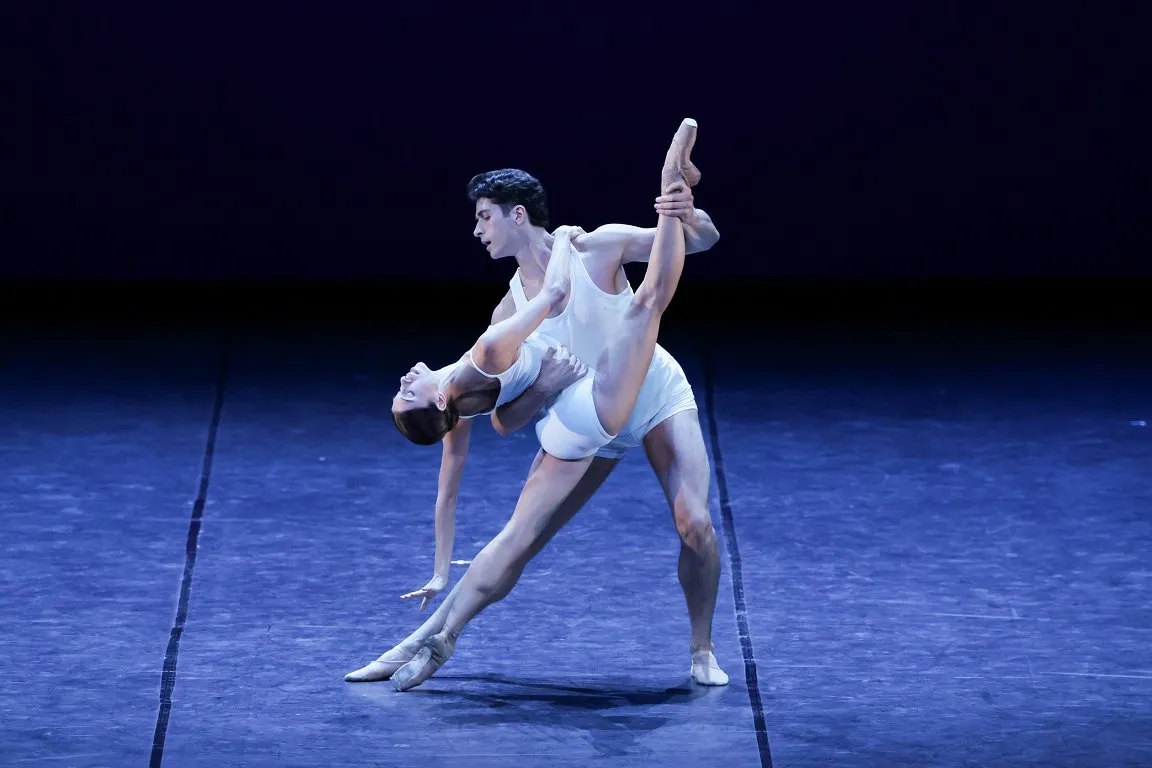


French dancers in white practice clothes = heaven. Enter les deux Étoiles Dorothée Gilbert and Hugo Marchand in Jerome Robbins’ En Sol. Robbins shares another lesson in simplicity, though it’s on the long side, and the two dancers are the epitome of understated, channelling vessels. I contemplated an endless conversation between long standing lovers.
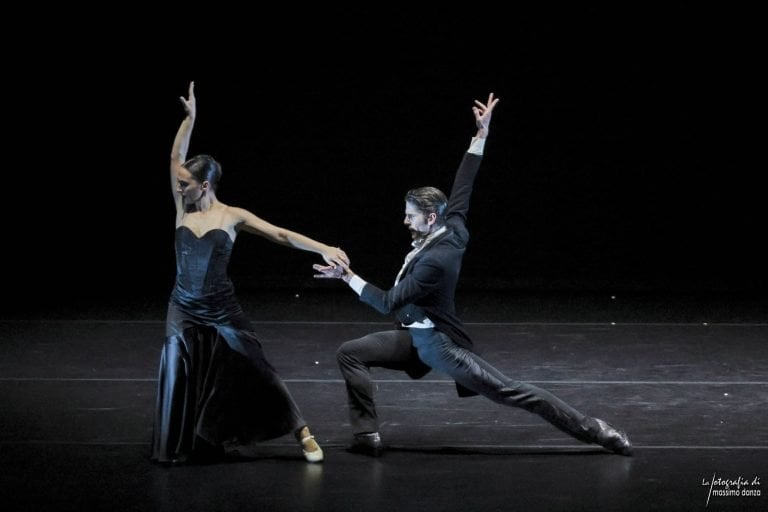
Part two opened with a tough watch – Hello by John Neumeier. Here we have a different take on relationships. One with clear dysfunction – think anxiety, tension and aggression. And the message was loud and clear thanks to Madoka Sugai and Alexandr Trusch of Hamburg Ballet. An interesting, original addition to the programme.
Next followed the essence of the Royal Ballet with Sarah Lamb and William Bracewell in Kenneth MacMillan‘s Manon. They took us directly into the narrative through the lesser performed pas de deux where the characters first meet in Act 1, and it’s refreshingly satisfying compared to the often seen Bedroom pas. Bracewell is a divine Des Grieux, showing a yearning arabesque line through his whole body and beyond, and Lamb emotes literary heroine if ever there was one. A masterclass.
Le Parc by Angelin Preljocaj was performed by Hannah O’Neill and Germain Louvet of the Paris Opera, and offered a tasteful, modern interlude. The infamous spinning kiss is impactful in the moment, but the Mozart makes Kylian’s Petit Mort difficult to forget.
George Balanchine’s Tchaikovsky Pas de Deux often features on gala menus – not performed by Balanchine-trained dancers – but the May Nagahisa and Kimin Kim combination isn’t in any danger of being run-of-the-mill. Though Japanese and Korean respectively, they both have their careers at the Mariinsky (still), so one assumes there are few invitations to dance in the West. Nagahisa is obviously a big deal in her homeland, and one can understand why. Her ease of movement isn’t a regular occurrence, and coupled with Kim’s elegant arrogance it’s all very much the real McCoy. They both take applause like you’d expect in St Petersburg, especially Kim. He almost expects it, it seems.


Part three opened with a personal favourite – Hans van Manen’s Trois Gnossiennes. I never tire of this purposeful work, and with Olga Smirnova and Hugo Marchand, the relevance continues. Marchand is chivalrous with deep undercurrents, and Smirnova devours the movement. She isn’t a precious ballerina and I love this; she actually dances. And I realised the (aforementioned) port de bras intention comes from the pit of her stomach. Powerful.
La Dame de Pique by Roland Petit was danced by Maria Alexandrova and Vladislav Lantratov of the Bolshoi. Again I haven’t seen the entire work, but this is a bizarre choice for a programme of divertissement. Alexandrova is clearly an experienced artist, but if you aren’t aware of the premise the general tone is one of Cruella de Vil and a rather tetchy military man.
The first Christopher Wheeldon work of the evening is Mercurial Manoeuvres exquisitely performed by Silvia Azzoni and Alexandre Riabko of Hamburg Ballet. Wheeldon has excellent taste in music (Shostakovich) and evident skill, and when brought to life by dancers of Azzoni’s calibre, his work becomes more than the sum of its parts. She absolutely leaned into everything on offer – power, poignancy and melancholy. How haven’t I seen her perform over her 32-year career to date? Pure class.
Shadow of the Whale in the Sky by Joost Vrouenraets closed the section and was danced by Gil Roman and Juichi Kobayashi. Their performances are committed but the self-indulgent, predictable work isn’t for me – balloons and rapid-gesture overload. Most surprising was the inclusion of Hope There’s Someone by ANOHNI. One assumes they agreed… but how to misuse one of the 21st century’s most important songs is the name of the game IMHO.


The final part (yes the show lasted from 6 until 10.15pm!) opened with Wheeldon #2, After the Rain. Performing were the icons of Italian dance, Alessandra Ferri & Roberto Bolle. I’m a fan of the original Wendy Whelan, but Ferri brings a more tentative quality to the tenderness which is very watchable. It’s as if she’s reborn with each move she makes, like everything is unknown… perhaps it is. Bolle is a besotted, attentive partner.
Sinatra Suite by Twyla Tharp was danced by the Mariinsky’s Diana Vishneva and Semperoper Dresden current Artistic Manager (and former principal of American Ballet Theatre) Marcelo Gomes. What to say? There are better dance in heels numbers I’d say…
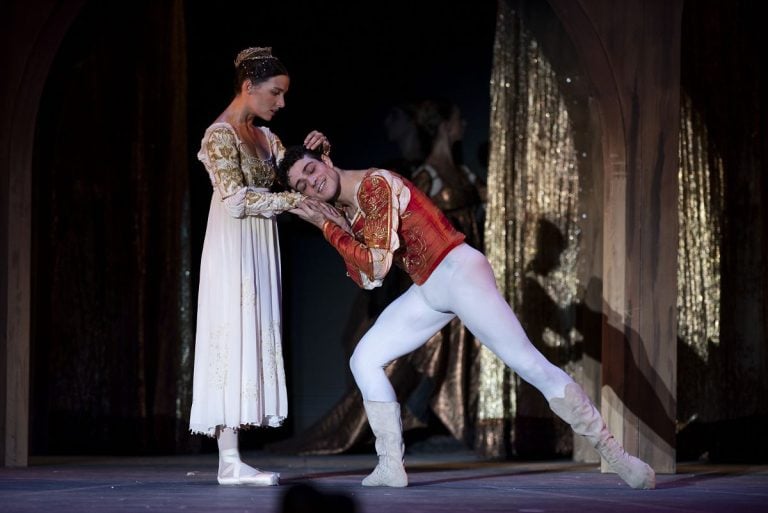
The surprise of the night was Neumeier’s Lady of the Camellias (Act 1 pas de deux) danced by Stuttgart principals Elisa Badenes and Friedemann Vogel. How interesting to see alternative takes on Marguerite and Armand from the Ashton. So many layers still to unpick within their genuine, complicated love affair. I saw Badenes as Juliet years back, and this performance suggested a huge development in her artistry. Vogel is ageless, and never more so than when a puppy-dog Armand.
How to close such an epic programme? Don Quixote with global dance royalty Marianela Nuñez and Vadim Muntagirov of course. One doesn’t need to explain the standard of work, but I can confirm there’s zero waver. Muntagirov has the most genuine smile I’ve ever seen on stage, confirming he clearly loves what he does. Nuñez is very at home in Japan and in total control throughout the technical number. Her Kitri is THE Boss Lady. And for the record, her fouettés didn’t come off the centre line even an inch. How?!


The evening was impressive in many ways. The dancing, obviously, the range of work on offer, the divine playing by the Tokyo Philharmonic Orchestra under the batons of Valery Ovsyanikov and Robertas Servenikas, and the extraordinary pianist Yoko Kikuchi who played for no less than six pieces!
I’d also like to acknowledge the technical staff. I’ve had the honour of performing in Japan in my youth, so know only too well the exacting standards found backstage. And what a difference it makes. The production values of most gala formats in the UK are an absolute fiasco, but not at the World Ballet Festival. Talk about a tight ship. Quite something.
My only question concerns curation. Dancers deserve to be celebrated, especially those who’ve had long, esteemed careers. But perhaps some repertoire choices need more rigorous discussion. Inclusion is paramount, but at all costs? No. The programme needs to make sense and have value, and not all moments did. It’s a fine line… and before we know it, we’re on the wrong side of adulation. An ongoing dialogue methinks, but roll on Programme B (and 2027!).

Matthew Paluch was awarded a place at The Royal Ballet School in 1990 where he graduated in 1997. His first four years as a professional dancer were spent working with London City Ballet, Scottish Ballet, K-Ballet and English National Ballet, becoming a full-time member of ENB until leaving in 2006.
Matthew graduated from the Royal Academy of Dance, Professional Dancers’ Teaching Diploma in 2007, and was formerly on faculty at The Royal Ballet School. He completed his Masters in Ballet Studies at Roehampton University in 2011, has been a freelance writer since 2010 and currently works in the Law Sector.
He is a member of the Dance Section of The Critics’ Circle.